
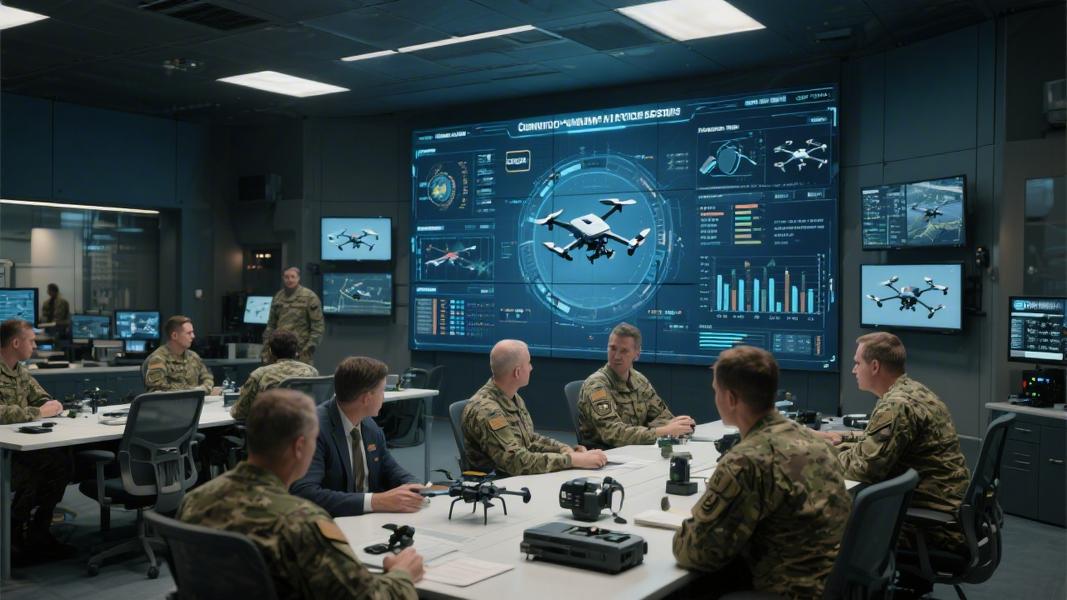
The Pentagon’s counter-drone task force is moving fast — and it wants the rest of the government to keep up.
Joint Interagency Task Force 401, the Defense Department’s dedicated counter-small unmanned aircraft systems organization, has spent the opening months of 2026 pushing out new policy, new partnerships, and a new philosophy for how the United States defends its skies from drone threats. The pace is deliberate. The stakes, officials say, are not abstract.
On March 10, 2026, JIATF-401 formally adopted what it’s calling “The Standard Guidelines for Test and Evaluation of Counter-Unmanned Aircraft Systems Technologies” — a sweeping framework requiring that all C-sUAS evaluations capture the same core data, creating a consistent evidentiary baseline across what the document refers to as the Department of War. It sounds bureaucratic. It isn’t, really. Without standardized testing data, comparing technologies becomes a guessing game. And in a threat environment that’s evolving by the month, guessing isn’t good enough.
Brigadier General Matt Ross, the Director of JIATF-401, didn’t mince words about what the task force is ultimately there to do. “The JIATF’s one measure of effectiveness is to quickly deliver state of the art C-sUAS capabilities into the hands of warfighters,” Ross said. “Achieving this outcome requires more than innovation; it demands a disciplined approach to testing, evaluation, and continuous improvement that translates promising technologies into operationally relevant solutions at scale.”
Building the Framework From the Ground Up
The testing guidelines didn’t emerge in a vacuum. Weeks earlier, on January 30, JIATF-401 had already published the “JIATF 401 Guide for Physical Protection of Critical Infrastructure,” introducing what it calls the “Harden, Obscure, Perimeter” framework — a set of passive countermeasures designed to protect critical infrastructure from drone threats without requiring sophisticated technology. Think netting, shielding, and strategic concealment rather than radar arrays and electronic jammers.
That guide, the full text of which is publicly available, stresses layered, outward-looking security that extends well beyond the fence line — hardening assets against threats that may originate from stand-off distances. It’s a recognition that not every facility has access to cutting-edge detection equipment, and that physical design itself can be a meaningful line of defense.
Around the same time, JIATF-401 also announced broader policy updates — expanded defensive perimeters, streamlined threat identification protocols, enhanced interagency data sharing mechanisms, and authority delegation for covered facilities. “JIATF-401 is an entirely joint, interagency endeavor dedicated to defeating small UAS,” Ross noted. The updates reflect just how seriously the task force is taking its mandate to centralize and coordinate what has historically been a fragmented response landscape.
Testing in the Real World
Policy on paper is one thing. Proving it works is another. JIATF-401 has been doing both simultaneously.
The task force recently participated in a Counter-Small Unmanned Aircraft Systems Threat Simulation Exercise at Joint Base Myer-Henderson Hall, putting eleven sensor systems and three mitigation devices through their paces across dozens of day and night scenarios. The exercise wasn’t just a technology showcase — it was a stress test of interoperability, pulling together interagency, federal, state, and local law enforcement partners to see whether they could actually function as a unified team under pressure.
Col. Brian Reynolds, provost marshal of Joint Task Force – National Capital Region, was direct about what the exercise was really for. “This training is about more than just technology; it’s about people and partnerships,” Reynolds said. “By bringing together interagency, federal, state and local law enforcement, we are building a unified and coordinated defense. The interoperability we are honing this week ensures that we can act as a cohesive team to detect, track and mitigate any potential aerial threat. Every agency brings a unique capability to the fight, and together, we create a formidable domestic shield for installations in the homeland.”
That spirit of partnership extended beyond the military. JIATF-401 also partnered with U.S. Border Patrol for dedicated counter-drone training, covering CBP-specific operations, protocols, and hands-on equipment experience. It’s a signal that the task force’s reach isn’t limited to conventional military installations — it’s threading counter-UAS doctrine into the broader federal security apparatus.
Industry Gets a Seat at the Table
On March 5, 2026, JIATF-401 hosted an Industry Day at the Hilton Alexandria Mark Center, convening private sector partners to strengthen the commercial side of the counter-drone ecosystem. The accompanying briefing, later made public, laid out the task force’s internal divisions — including Data, Analysis, Requirements, and Training (DART), Science and Technology, and Rapid Acquisition — while identifying capability gaps and underscoring the importance of data standardization.
Shortly after, the task force launched a Commercial Solutions Opening to solicit counter-UAS capabilities directly from the private sector. The move signals that JIATF-401 isn’t waiting for the traditional defense acquisition pipeline — it’s actively hunting for tools that can be fielded now.
No Silver Bullet. That’s the Point.
So what does JIATF-401 actually want? Not perfection, it turns out. Ross has been unusually candid about the limits of what any single technology can deliver, and it’s a refreshing departure from the usual procurement optimism. “I’m not asking for a 100 percent solution to defeat every drone — the silver bullet,” Ross concluded. “What we need is a layered defence: awareness, different capabilities and an ecosystem that works together so we can defeat threats consistently.”
That framing — ecosystem over silver bullet, consistency over perfection — runs through nearly everything JIATF-401 has done in recent months. Standardized testing so data is comparable. Physical protection guides for facilities that can’t afford high-end sensors. Interagency exercises to make sure the humans in the loop can actually work together. A commercial solutions opening to pull in capabilities that don’t yet exist inside the government. It’s a system-of-systems approach, and the task force is building it piece by piece, in public, at speed.
Whether the ecosystem comes together before the threat outpaces it — that’s the question nobody in this building can answer yet.
