
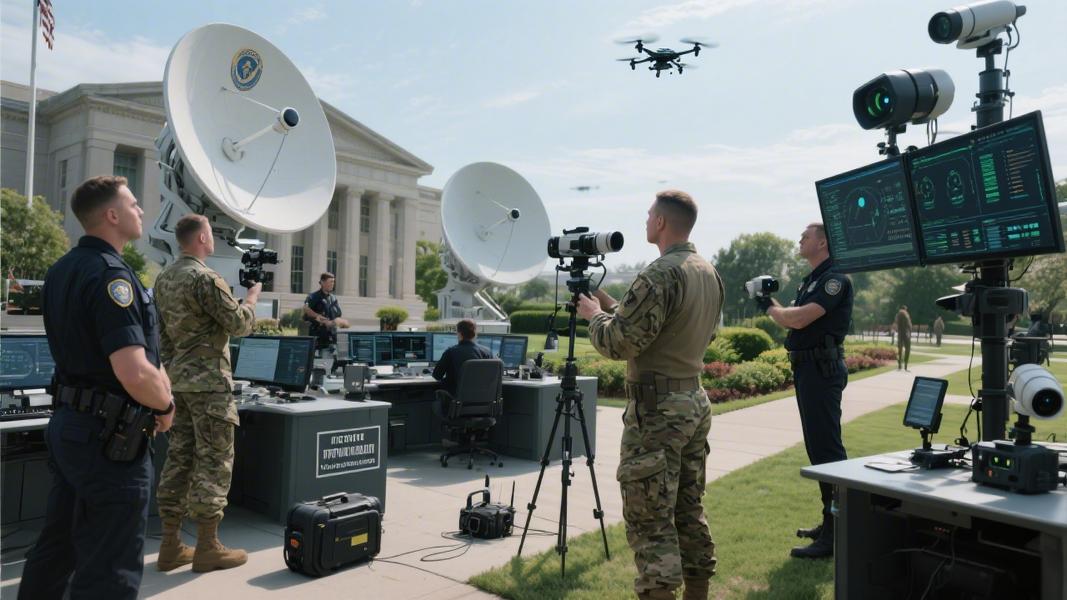
The U.S. military is moving fast on drones — and not just to fly them. A little-known but increasingly powerful task force is quietly reshaping how America defends itself against the growing threat of unmanned aerial systems, from the southern border to the Super Bowl.
Joint Interagency Task Force 401, known as JIATF-401, has spent the past several months issuing new guidance, expanding training programs, publishing technical frameworks, and broadening military commanders’ legal authorities — all in a concerted push to get ahead of a drone threat that officials say is no longer theoretical. The pace of activity is striking, and the implications stretch well beyond military installations.
A New Mandate, Signed at the Top
On December 8, 2025, Defense Secretary Pete Hegseth signed updated counter-drone guidance that significantly expanded JIATF-401’s operational authorities. The directive, which drew on provisions in the FY26 National Defense Authorization Act, gave base commanders more flexibility in how they respond to unauthorized drones — and formalized data-sharing arrangements with the Department of Homeland Security and the Department of Justice. The Pentagon confirmed the signing in late January.
Perhaps the most significant operational change: the removal of so-called fence-line limitations. Under the previous framework, threat determinations were tightly bound by physical proximity to installation perimeters. The updated guidance allows commanders to assess drone threats based on the totality of circumstances — a broader, more judgment-based standard that mirrors how law enforcement approaches ambiguous security situations. JIATF-401 announced the changes on January 26, 2026.
Sensors, Science, and Civil Liberties
On March 9, 2026, JIATF-401 published what may be its most technically detailed product yet: a guide titled Counter-UAS Operations: Safeguarding Freedoms and Preserving Privacy. The document walks through the sensor stack used to detect drone threats — Radar, Electro-Optical/Infrared, and Radio Frequency Detection — while also grappling, unusually for a Pentagon publication, with the civil liberties dimensions of persistent aerial surveillance. The guide is available in full through the Defense Department’s media portal.
“Countering drones is not just a battlefield problem — it’s a homeland defense imperative,” said Brig. Gen. Matt Ross, director of JIATF-401. It’s a line that could sound like boilerplate, but given the pace of the task force’s recent output, it reads more like a mission statement in motion.
That said, the privacy angle is worth pausing on. Counter-drone sensor systems — particularly RF detection and wide-area EO/IR cameras — can sweep up significant amounts of information about people who have nothing to do with any threat. The fact that JIATF-401 chose to address this directly in a published guide suggests the task force is aware it’s operating in contested legal and political terrain, not just airspace.
Low-Tech Defenses for a High-Tech Problem
Not everything in the counter-drone playbook requires a sophisticated kill chain. In late January, JIATF-401 published a separate guide focused on the physical protection of critical infrastructure — and the recommendations are, refreshingly, grounded in the practical. Walls. Enclosures. Hardened roofs. Overhead netting. Tensioned cables. The kind of measures that don’t require a procurement cycle or a software update.
The guide introduces what the task force calls the “Harden, Obscure, Perimeter” framework — a layered, passive defense model designed for sites that can’t afford or don’t yet have access to active counter-UAS systems. “Countering the drone threat is about more than exquisite systems,” the guide states. “You can take steps now to prepare and protect critical infrastructure.” The framework has been specifically highlighted for venues like stadiums, a pointed reference given the 2026 FIFA World Cup matches scheduled across the United States later this year. JIATF-401 formally released the infrastructure guide through official Pentagon channels.
The World Cup angle isn’t incidental. It’s been a recurring reference point across multiple JIATF-401 initiatives — along with America 250, the nation’s semiquincentennial celebrations. Large, symbolic, densely attended public events are exactly the kind of soft targets that worry security planners when small, commercially available drones are increasingly capable of carrying payloads. Inside Unmanned Systems noted the framework’s relevance to those upcoming events.
Training Up — Fast
Frameworks and guides only go so far if the people expected to implement them don’t know what they’re doing. JIATF-401 and the Joint Counter-UAS University (JCU) have developed three specialized training courses to address exactly that gap. US1401 covers small UAS awareness; US1402 focuses on counter-sUAS planning; and US1404 addresses tactics, techniques, and procedures. The Joint Chiefs’ knowledge portal highlighted the updated curriculum earlier this year.
Beyond the classroom, JIATF-401 is scaling through a train-the-trainer model — pushing expertise outward rather than centralizing it. That includes deployments to Guam, where the task force has worked with Task Force Talon and the Guam National Guard on counter-drone capabilities. Defense and Munitions detailed those expansion efforts as part of a broader Indo-Pacific readiness push.
Closer to home, JIATF-401 has also partnered with U.S. Border Patrol for joint counter-drone training exercises that included live small UAS flights. The Army documented the partnership — a collaboration that underscores just how far the counter-drone mission has stretched beyond traditional military operations.
Industry, Come On In
How does a task force moving this quickly keep pace with the commercial drone market? Partly by inviting the private sector to help. JIATF-401 announced a C-sUAS Industry Day seeking innovative partners, with RSVPs required by February 18, 2026. The solicitation, posted on the federal contracting portal SAM.gov, signals that the task force isn’t planning to build everything in-house — and that it’s actively looking for commercial technologies that can be integrated into its growing operational framework. CUASHub tracked the broader guidance expansion that has accompanied these outreach efforts.
The Bigger Picture
What’s happening here isn’t just bureaucratic housekeeping. It’s a fundamental rethinking of how the U.S. military — and by extension, the federal government — approaches a threat that is simultaneously everywhere and nowhere. Drones are cheap. They’re available to anyone. They don’t respect fence lines. And the gap between a recreational quadcopter and a weaponized one is narrower than most people realize.
JIATF-401’s flurry of activity over the past several months — new legal authorities, new training pipelines, new physical defense frameworks, new sensor guidance, new industry partnerships — reads like a task force that has looked at that gap and decided it can’t afford to wait for a single catastrophic incident to force the issue.
Whether it’s moving fast enough is another question entirely. But at least, for once, someone in the Pentagon seems to be asking it.
