
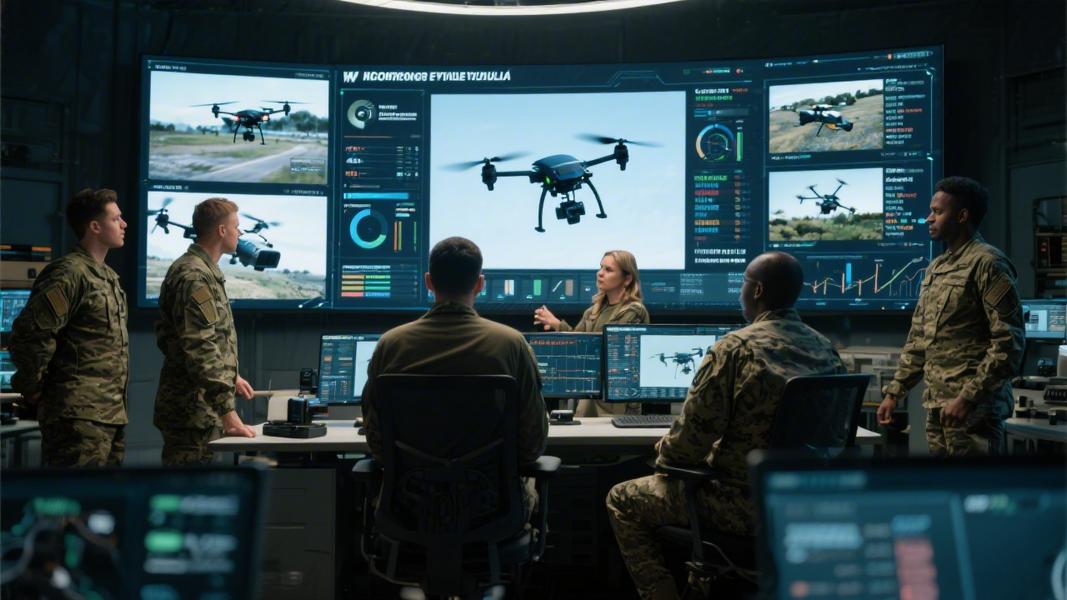
The Pentagon’s counter-drone task force is moving fast — and it’s leaving little room for ambiguity about who’s in charge, what the rules are, and what happens next.
JIATF-401, the Joint Interagency Task Force standing up the Defense Department’s unified response to small unmanned aircraft threats, has spent the past several months issuing a cascade of new guidance, training programs, procurement actions, and legal frameworks — all aimed at hardening the United States against a threat that, not long ago, barely registered as a strategic concern. The pace of activity suggests that what was once a niche problem for forward-deployed troops has become something far more urgent, far closer to home.
Expanding the Commander’s Authority
The most consequential shift may be the simplest to describe. Guidance signed by Secretary of War Pete Hegseth on December 8, 2025, removed what had been a defining limitation on installation commanders: the fence line. Under the updated authority, commanders are no longer required to wait for a drone to cross a perimeter before treating it as a threat. Unauthorized surveillance of a designated facility — even from a distance — now qualifies.
“With this new guidance installation commanders are empowered to address threats as they develop,” said Brigadier General Matt Ross, director of JIATF-401, “and the guidance makes clear that unauthorized drone flights are a surveillance threat even before they breach an installation perimeter.” That’s a meaningful doctrinal change. It shifts the legal and operational center of gravity outward, from the fence post to the horizon, grounded in threat determinations made under 10 U.S. Code § 130i and based on the totality of circumstances. Ross noted that the task force is “an entirely joint, interagency endeavor dedicated to defeating small UAS” — a reminder that no single service branch owns this fight.
A subsequent round of updated guidance, announced in late January, went further still. It formalized data-sharing arrangements with DHS and DOJ under the FY26 National Defense Authorization Act and, notably, opened the door for certified private contractors to serve as C-sUAS operators. That last piece has drawn attention. It’s one thing to authorize soldiers to counter drones. Authorizing contractors is a different conversation entirely.
Standardizing the Science of Testing
How do you know a counter-drone system actually works? It sounds like an obvious question, but until recently, the answer depended heavily on who was doing the testing and what they decided to measure. JIATF-401 moved to fix that on March 10, 2026, adopting The Standard Guidelines for Test and Evaluation of Counter-Unmanned Aircraft Systems Technologies — a framework requiring all C-sUAS evaluations across the Department of War to capture the same core data sets, enabling consistent, comparable evidence regardless of where or how a system was assessed.
“Achieving this outcome requires more than innovation,” Ross said. “It demands a disciplined approach to testing, evaluation, and continuous improvement that translates promising technologies into operationally relevant solutions at scale.” The task force’s stated measure of effectiveness is blunt: get state-of-the-art capabilities into warfighters’ hands, quickly. Standardized testing is the scaffolding that makes that possible at any kind of meaningful scale.
When Tech Isn’t the Answer
Still, not every installation can deploy sophisticated detection and interdiction systems overnight. Recognizing that gap, JIATF-401 published a guide in January focused on physical protection measures — the unglamorous but effective fundamentals. Hardening structures with concrete, obscuring visibility from aerial vantage points, and extending defensive perimeters beyond fence lines using physical barriers all feature in the document. It’s a nod to operational reality: sometimes the most reliable counter-drone technology is a wall.
Training at Scale, From Fort Sill to Guam
Equipment and doctrine are only as good as the people using them. That’s the logic behind the Joint Counter-sUAS University, or JCU, which has been expanding its curriculum to keep pace with rapidly evolving threat profiles. Three specialized courses — developed jointly by JIATF-401 and JCU and updated regularly with current tactics, techniques, and procedures — are now available across the joint force.
The footprint is expanding. “Whether it’s in a classroom at Fort Sill or on an airfield in Guam, our job is to support JIATF-401’s priorities,” said Peterson, a JCU official, in a statement published by Defense and Munitions. “We are improving joint force training to ensure our service members have the skills they need to defend every inch of the homeland.” The program has also extended beyond the military: JIATF-401 has partnered with U.S. Border Patrol for joint training sessions that include an overview of CBP operations and hands-on counter-UAS experience — a sign that the interagency vision isn’t just language in a policy memo.
The Privacy Question
That’s the catch, isn’t it? Counter-drone technology — particularly the kind that detects and identifies drones by intercepting their radio signals — sits in genuinely uncomfortable legal territory. JIATF-401 has tried to get ahead of that tension. The task force published a guide outlining how its detection systems comply with federal surveillance law, emphasizing that signal fingerprint analysis — identifying a drone by the unique characteristics of its transmission — does not require accessing the content of that transmission. The distinction matters legally, even if it sounds technical.
“This guide is part of our commitment to transparency,” an official said in the release, “ensuring that as we deploy these critical technologies, we do so in a way that is responsible, respects privacy, and maintains public trust.” Whether that framing satisfies civil liberties advocates is another matter. But the fact that JIATF-401 is publishing the guide at all suggests an awareness that public legitimacy is part of the mission.
Opening the Market
In late February, JIATF-401 launched a Commercial Solutions Opening — a procurement mechanism designed to accelerate access to non-traditional and commercial technology providers. The CSO signals that the Pentagon isn’t betting solely on legacy defense contractors to solve this problem. It wants the broader technology market in the conversation, and it’s willing to use flexible acquisition tools to get there.
Taken together, the arc of JIATF-401’s activity over the past several months tells a coherent story: a task force moving with unusual urgency to build doctrine, law, training, standards, and market access simultaneously — because it believes the threat isn’t waiting for any one of those pieces to catch up to the others. Whether the pieces come together fast enough is the question that matters most, and the one that won’t be answered in a policy memo.
