
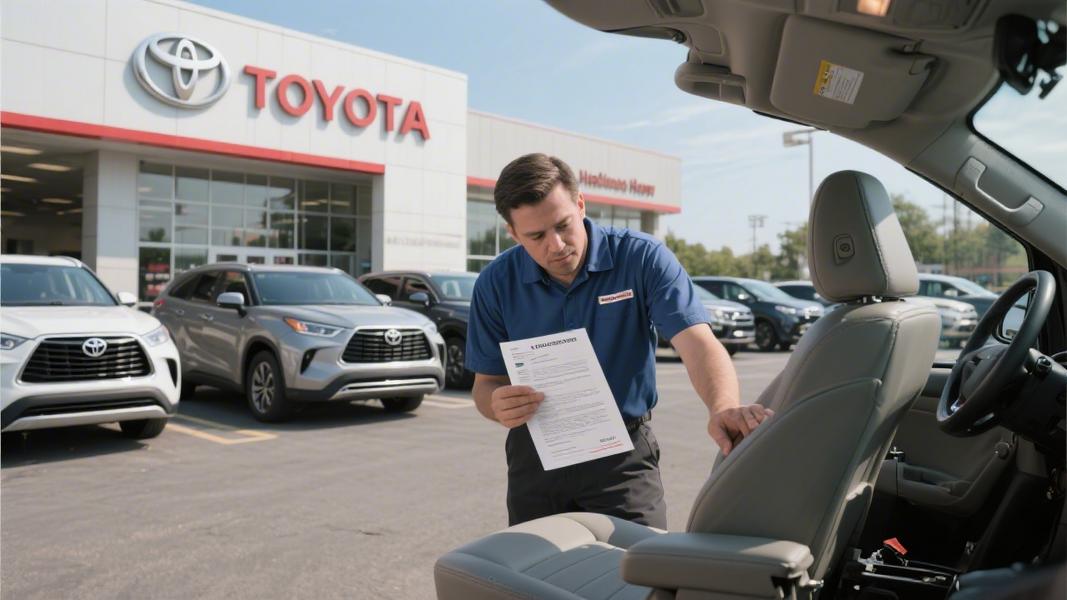
Half a million Toyota Highlanders may have a second-row seat that won’t stay put — and in a serious crash, that’s not a minor inconvenience. It’s a potential life-safety failure.
Toyota has issued a voluntary recall covering approximately 550,000 Highlander and Highlander Hybrid crossovers from model years 2021 through 2024 sold in the United States. The problem centers on a defective second-row seatback adjustment mechanism that may not fully lock after a passenger changes the recline angle — leaving occupants dangerously unsecured in the event of a collision. The recall was announced by Toyota’s pressroom and covers both gasoline and hybrid variants of the popular three-row SUV.
What’s Actually Going Wrong
The technical issue lies in the recliner assemblies built into the second-row seats. According to Toyota, “the second-row seatback adjustment mechanism may not fully lock after changing the recline angle.” In plain terms: a passenger adjusts their seatback, it feels secure, but it may not be. Under normal driving conditions, that might never matter. But in a high-speed crash, the consequences could be severe. As Toyota noted in its safety filing, “an unsecured seatback may fail to restrain occupants in the event of a high-speed crash, increasing the risk of injury.”
That’s the kind of language that tends to get federal regulators’ attention — and for good reason. The second row is often where children and other passengers ride, frequently in vehicles where families have grown accustomed to trusting the hardware without thinking twice about it.
The Fix — and the Timeline
Here’s the relatively good news: the repair is straightforward and free. Toyota dealers will swap out the faulty return springs in the recliner assemblies with improved components at no charge to owners. It’s not a complicated overhaul — but it does require a dealership visit, and that visit can’t happen just yet.
Owner notification letters are expected to go out by early May 2026. Toyota has confirmed that no injuries related to this defect have been reported as of the recall announcement — a fortunate detail, though one that doesn’t make the underlying risk any less real.
Still, waiting until May 2026 to begin notifying owners of a safety issue affecting half a million vehicles will raise eyebrows for some. That’s a long runway for a defect that involves crash restraint.
How to Check Your Vehicle Now
Owners don’t have to wait for a letter to find out if they’re affected. Toyota has made it easy enough: visit Toyota.com/recall or head to nhtsa.gov/recalls and plug in your Vehicle Identification Number or license plate. As Toyota’s pressroom stated, “to see if your vehicle is involved in a safety recall visit Toyota.com/recall or nhtsa.gov/recalls and enter your Vehicle Identification Number (VIN) or license plate information.”
Customers who want to speak with someone directly can also reach Toyota’s Brand Engagement Center at 1-800-331-4331. The automaker has emphasized that the repair will be handled at no cost through authorized dealers once the formal notification process begins.
The Bigger Picture
The Highlander has been one of Toyota’s best-selling nameplates for years, particularly among families drawn to its three-row layout and reputation for reliability. A recall of this scale — touching four consecutive model years across both powertrain variants — is a reminder that even trusted vehicles can carry quiet defects that only surface under the right conditions.
No injuries. A simple spring replacement. A fix that’s coming at no cost. By the grim calculus of automotive recalls, this one could have been much worse. But the 550,000 families driving these vehicles deserve to know: the seat holding your passenger in place may not be holding them quite as firmly as you think.
