
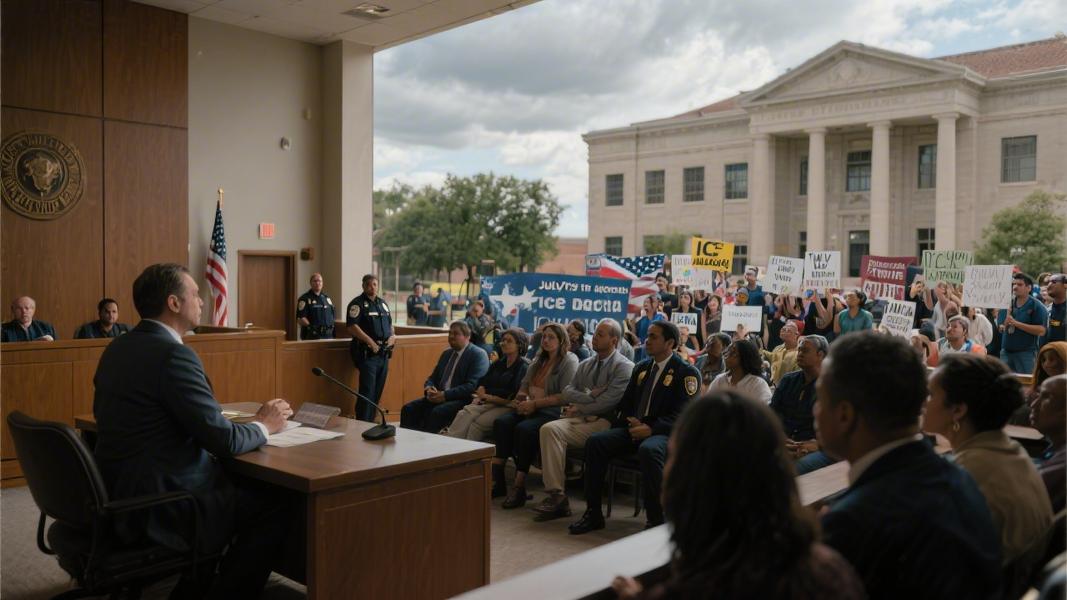
Closing arguments are underway in one of the most closely watched domestic terrorism trials in recent memory — a case that began with fireworks, ended with a bullet, and has since exposed what prosecutors call a coordinated Antifa cell operating in the heart of North Texas.
Nine defendants are on trial in connection with a July 4, 2025, ambush at the Alvarado ICE detention facility, a brazen attack that left an Alvarado police officer wounded and sparked what federal authorities are calling the first indictment in the country tied to alleged Antifa-related domestic terrorism charges. The trial, expected to run up to three weeks, is now in its final stretch — and the testimony has been anything but quiet.
A ‘Party’ That Wasn’t
Prosecutors say the plan came together in a Signal group chat cheekily named “4th of July Party!” — a thread that, investigators allege, was far less festive than the name implied. Messages reportedly covered everything from fireworks logistics and firearms to Ring camera locations, weather forecasts, local police station layouts, and exit routes. Defense attorneys, for their part, insist it was all just talk — that their clients intended a noise demonstration protest, nothing more. A judge and jury will have to decide which version of that story holds up.
But it’s not that simple. A lead investigator testified that one co-defendant, Meagan Morris, felt deeply deceived after the shooting unfolded. Morris allegedly expressed those feelings in the group chat itself, and the investigator recounted her words in striking detail: “My suspicion is (deleted name) wanted to do this the whole time, to shoot someone. (Deleted name) wanted us all to have our guns there as a distraction, to do his little (deleted name) fantasy and run away. I don’t think it’s an accident that (deleted name) set things up to have a bunch of people there for cover while he gets the (expletive) away. I feel disgusted and betrayed.” That’s not the language of someone who thought they were attending a protest.
The Man at the Center
Benjamin Song, a former U.S. Marine Corps reservist, sits at the top of the indictment. Prosecutors allege Song orchestrated the attack, directing the other defendants as part of an alleged North Texas Antifa cell that coordinated the operation online over weeks. Song allegedly purchased four firearms in the lead-up to the assault — including two AR-style rifles equipped with a binary trigger, a modification that allows the weapon to fire on both the pull and release of the trigger. He faces the most serious charge of the group: attempted murder of federal officers.
The shot that matters most in this case struck Lt. Thomas Gross — an Alvarado police officer — in the neck. Song is accused of firing it. Investigators say the fireworks were used deliberately as a diversion, a smokescreen timed to mask the group’s movements and create chaos before the gunfire began. The alleged sophistication of that planning is central to the government’s case.
Plea Deals and Cooperating Witnesses
Not everyone is fighting the charges. Five individuals connected to the case accepted plea deals and are now testifying against the remaining defendants — a development that’s likely made the defense’s job considerably harder. Their accounts, combined with the Signal chat evidence, form the backbone of the government’s argument that this wasn’t a spontaneous act of protest gone wrong. It was, prosecutors contend, a planned attack.
Still, the defense isn’t without ammunition of its own. Attorneys have pushed back on the terrorism framing, arguing that the “4th of July Party!” chat was misread, that the group’s intentions were political expression rather than violence, and that the prosecution is overstating the level of coordination involved. Whether the jury buys that narrative — given the medical kits, the reconnaissance, and the rifles — remains to be seen.
A Landmark Case, Whatever the Outcome
The broader stakes here extend well beyond Alvarado. Federal authorities have described this as a landmark prosecution — the first federal case in the U.S. to bring domestic terrorism-related charges explicitly tied to alleged Antifa activity. That framing has drawn scrutiny from civil liberties advocates who worry about how broadly the label might be applied going forward. Prosecutors, meanwhile, say the facts speak for themselves: an officer was shot in the neck on the Fourth of July outside a federal detention facility, and the people who planned it should answer for it.
The charges against the nine defendants range from rioting and conspiracy involving explosives to materials used in support of terrorism and firearms violations. It’s a sweeping indictment — and if convictions follow, the legal precedent could reshape how federal prosecutors approach politically motivated violence for years to come.
Closing arguments are still ongoing. A verdict, and perhaps a reckoning, is coming soon. The question that’ll linger long after it does: when does protest become something else entirely — and who gets to draw that line?
