
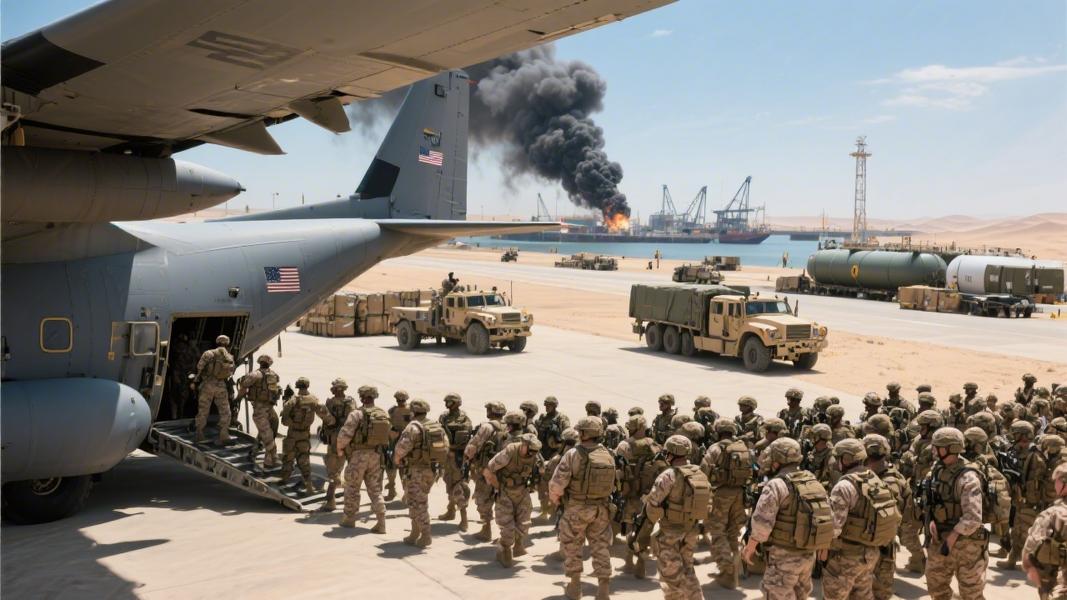
The United States is pouring more firepower into the Middle East — and the bill is already staggering. As American forces press deeper into a conflict with Iran, the Pentagon is moving to significantly expand its military footprint in the region, sending thousands of additional sailors and Marines to reinforce an operation that has already reshaped the strategic landscape around one of the world’s most critical waterways.
The core of it: up to 5,000 additional U.S. personnel are headed to the Middle East, part of a broader push to counter Iran’s escalating aggression in and around the Strait of Hormuz. Department of War Secretary Pete Hegseth approved the deployment after receiving a formal request from U.S. Central Command, green-lighting an amphibious ready group and its accompanying Marine Expeditionary Unit — a package that includes the USS Tripoli and a constellation of supporting warships. The decision signals that Washington isn’t planning to dial back anytime soon.
A War Already Underway
This isn’t a precautionary repositioning. Operation Epic Fury is well into its opening phase, and the numbers coming out of CENTCOM are striking. American forces have struck roughly 6,000 targets inside Iran since the war began, while simultaneously dismantling Iran’s naval capacity — eliminating more than 60 Iranian ships and over 30 minelayers in the process. That’s an extraordinary tempo of operations, even by modern standards.
Still, Iran hasn’t gone quiet. The Pentagon is weighing yet more warship deployments as Tehran continues to intensify its attacks in the Strait of Hormuz — the narrow chokepoint through which roughly a fifth of the world’s oil flows. Disrupting it, even partially, carries enormous consequences for global energy markets. Iran knows that. So does Washington.
$11.3 Billion — In Six Days
How much is all of this costing? The first six days of Operation Epic Fury alone ran American taxpayers an estimated $11.3 billion, according to figures cited in reporting on the conflict. That’s not the total price tag — that’s just the opening week. At that burn rate, the financial arithmetic becomes uncomfortable very quickly, and it’s the kind of number that tends to eventually force a political reckoning back home, no matter how strong the initial war footing.
That said, the administration appears, for now, fully committed. Hegseth’s approval of CENTCOM’s request wasn’t a reluctant sign-off — it was a deliberate escalation, framed internally as a necessary response to a threat environment that U.S. commanders describe as fluid and dangerous. The amphibious ready group gives American forces the kind of flexible, expeditionary capability that can respond quickly to a range of scenarios, from direct combat operations to potential ground contingencies.
The Strait and What’s at Stake
Iran’s continued attacks in the Strait of Hormuz are more than tactical harassment — they’re a message. Tehran is signaling that even under sustained bombardment, it retains the ability to threaten global energy supply lines and impose costs on any adversary operating in its backyard. Whether that posture holds as American pressure mounts is the central question hanging over the entire conflict.
The arrival of thousands more U.S. Marines and sailors in the coming weeks will test that calculus directly. With the USS Tripoli and its strike group moving into position, the United States is making clear it has the will — and, for now, the resources — to sustain and intensify this fight. Whether that’s enough to break Iran’s resolve, or whether it simply deepens a conflict with no clean exit, remains very much an open question.
Eleven billion dollars in six days. The meter is still running.
