
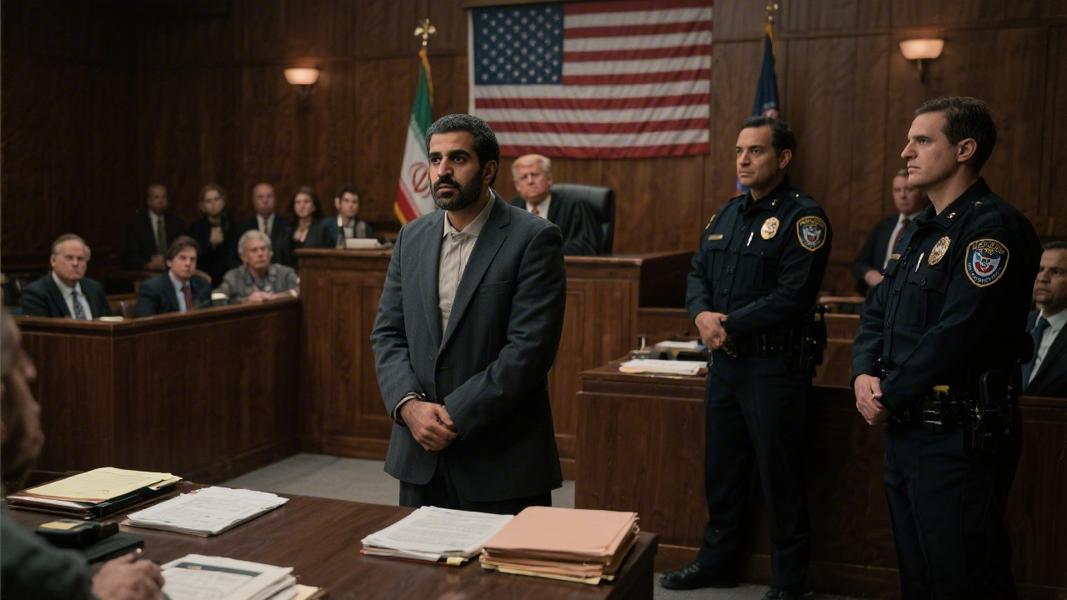
A Pakistani national has been convicted of terrorism and murder-for-hire after federal prosecutors proved he traveled to the United States on behalf of Iran’s Islamic Revolutionary Guard Corps to arrange the assassination of senior American political figures — including a sitting president. The verdict lands with the weight of something out of a Cold War thriller, except it’s entirely real.
The Plot, the Targets, and the Sting
Asif Merchant arrived in the United States in April 2024. By June of that year, he was meeting with individuals he believed were hired killers. They weren’t. They were undercover FBI agents, and by July, Merchant was in handcuffs — arrested before he ever made it back out of the country. Federal prosecutors in the Eastern District of New York secured his conviction on terrorism and murder-for-hire charges tied to what they described as a coordinated campaign of political assassination directed by the IRGC.
The targets were not minor figures. Prosecutors identified President Donald Trump, President Joe Biden, and U.S. Ambassador Nikki Haley as among those in the crosshairs — the plot framed as retaliation for American actions against the Iranian regime. Attorney General Pamela Bondi didn’t mince words in the aftermath. “This man landed on American soil hoping to kill President Trump — instead, he was met with the might of American law enforcement,” she stated.
Merchant’s Defense: Coercion, Family, and Fear
Here’s where it gets complicated — or at least, where Merchant tried to make it complicated. On the stand, he claimed he didn’t want any of this. He testified that the IRGC had threatened his family still living in Iran, leaving him, in his telling, with no real choice. “My family was under threat, and I had to do this,” he said. “I was not wanting to do this willingly.”
Prosecutors weren’t buying it. During cross-examination, Assistant U.S. Attorney Nina Gupta cut straight to the bone. “You traveled to the United States for the purpose of hiring Mafia members to kill a politician, correct?” she asked. Merchant’s answer was blunt: “That’s right.” That exchange, more than perhaps anything else in the trial, likely sealed his fate. He also handed the undercover agents $5,000 as a token payment — a down payment on political murder, the government argued. Whatever coercion he claimed, the jury found his actions deliberate enough to convict.
A Broader, Darker Pattern
This isn’t a one-off. The Merchant case is one thread in a much larger, more unsettling web. FBI Assistant Director James C. Barnacle, Jr. was direct about what it represents: “At the direction of the Iranian regime, Asif Merchant plotted to assassinate a United States politician or government official on American soil.” That phrasing — at the direction of the Iranian regime — is doing a lot of work. It frames this not as a rogue actor, but as state-sponsored violence operating inside U.S. borders.
Indeed, the IRGC’s reach into American territory has been documented across multiple cases. Other alleged plots have targeted figures like Masih Alinejad, the Iranian-American journalist and activist, among others. Analysts tracking these operations have noted a pattern of escalation — Iran increasingly willing to move from surveillance and intimidation to outright assassination planning on U.S. soil. That’s a significant, and deeply troubling, escalation in tactics.
What It Means Going Forward
The conviction sends a message, though how loudly Tehran hears it remains an open question. American law enforcement disrupted this plot cleanly — the FBI sting worked exactly as designed, and no one was harmed. Still, the fact that a foreign intelligence service could recruit an operative, fund a down payment, and nearly execute a plan to kill multiple senior American officials before anyone pulled a trigger should give pause. It’s not a story about how the system failed. It’s a story about how close things can get before the system catches up.
Merchant faces a potentially decades-long prison sentence. The IRGC, of course, faces no courtroom. And somewhere in that gap between justice and accountability lies the uncomfortable truth of where this story really ends.
