
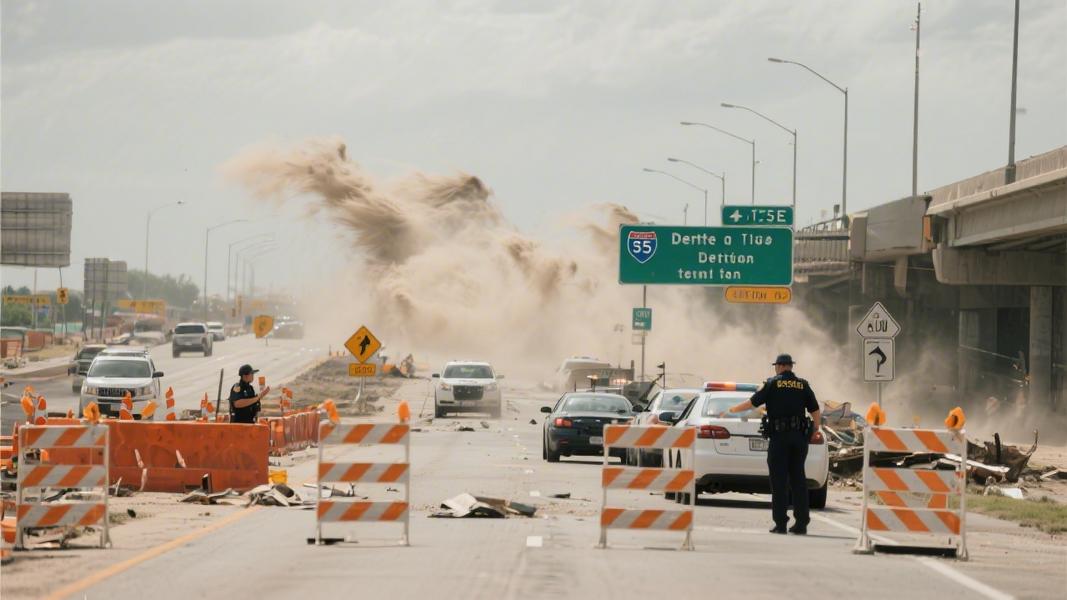
When the wind picks up along I-35E, it doesn’t just rattle your mirrors — sometimes, it shuts down the whole road. That’s exactly what happened on a blustery Sunday afternoon in the Dallas-Fort Worth corridor, and the ripple effects stretched well beyond the highway.
On March 15, construction debris caught by high winds blew onto northbound lanes of I-35E near Bonnie Brae Street, prompting authorities to close that stretch of roadway at approximately 1:42 p.m. The closure came amid an active wind advisory, with sustained winds clocking in at 20 to 30 mph and gusts surging as high as 50 mph — the kind of conditions that turn unsecured job-site materials into projectiles. Nobody was seriously injured, but the incident raised pointed questions about construction site safety protocols during severe weather events in one of the country’s most active building corridors.
A Highway Shut Down by the Wind
The debris field stretched across multiple northbound lanes, forcing Texas Department of Transportation crews and local law enforcement to respond quickly. Drivers were diverted as cleanup operations got underway. It’s the sort of disruption that sounds minor on paper — a lane closure, some scattered materials — but anyone who’s sat in a DFW traffic backup knows the cascading reality of it. One blocked interchange at the wrong time of day can snarl commutes for miles in every direction.
The Denton and Lewisville areas have been in the thick of major construction activity throughout early 2026, with multiple overlapping projects running simultaneously along the I-35E corridor. That density of active worksites, sources noted, increases the statistical likelihood of weather-related incidents — particularly when forecasters have already flagged dangerous wind conditions. The wind advisory had been in effect before the debris event occurred.
That’s the catch, isn’t it? The warning was already out there. The question isn’t whether officials knew the winds were coming — it’s whether that knowledge translated into any protective action at the sites themselves before materials ended up scattered across a major interstate.
T-Pain’s Arlington Gig: A Casualty of the Gusts
The highway wasn’t the only thing the wind took out that day. Over in Arlington, T-Pain’s scheduled performance at the Java House Grand Prix of Arlington was cancelled as conditions deteriorated. Event organizers cited safety concerns, and given that gusts were hitting 50 mph at points throughout the afternoon, the call wasn’t exactly a tough one — outdoor stages and 50 mph winds are a combination that nobody in the live events industry wants to test. Fans who’d made the trip were understandably disappointed, though officials indicated the broader event schedule was being evaluated on a rolling basis.
Still, the cancellation added an unexpected cultural footnote to what was otherwise a straightforward infrastructure story. It’s not every day that a wind advisory manages to simultaneously close an interstate and cancel a hip-hop headliner. North Texas had itself quite a Sunday.
Construction Sites and Weather: A Recurring Problem
This isn’t a new tension. Construction booms and volatile weather have always been uncomfortable neighbors, and the DFW metroplex sits at the intersection of both. Texas sees more than its share of high-wind events in the spring months, and the sheer volume of active development across Denton and Lewisville means there’s no shortage of exposed materials, unsecured scaffolding, and job-site equipment that can become hazardous when conditions turn.
Industry safety standards require contractors to account for weather risks, including securing or removing materials that could become airborne. Whether those protocols were followed — or whether they’re simply insufficient for gusts of this magnitude — is a question that investigators and site managers will likely be sorting through in the days ahead. Regulators have broad authority to issue citations when weather-related failures result in public safety hazards, and a debris field on an active interstate tends to attract attention.
How often does this actually happen? More than most people realize. Wind-related construction incidents spike noticeably during spring advisory seasons across North Texas, according to safety data tracked by weather and occupational health researchers. The March 15 event may have been dramatic, but it wasn’t anomalous.
What Comes Next
Northbound lanes were eventually reopened after debris was cleared, and no fatalities or serious injuries were reported in connection with the closure. That’s the good news. The less comfortable news is that construction activity along this corridor isn’t slowing down anytime soon — and neither is Texas spring weather.
Local officials and transportation planners will face pressure to revisit how active worksites are managed during forecast wind events, particularly when advisories are already in place before incidents occur. There are protocols. There are standards. Whether they’re being applied consistently, and whether they’re actually adequate for conditions like those on March 15, is a conversation that can’t really wait for the next gust to settle the matter.
Because if a 50 mph advisory wasn’t enough to keep a construction site’s debris off a major interstate, it’s worth asking what threshold actually would be — before the wind gets to answer that question for everyone again.
