
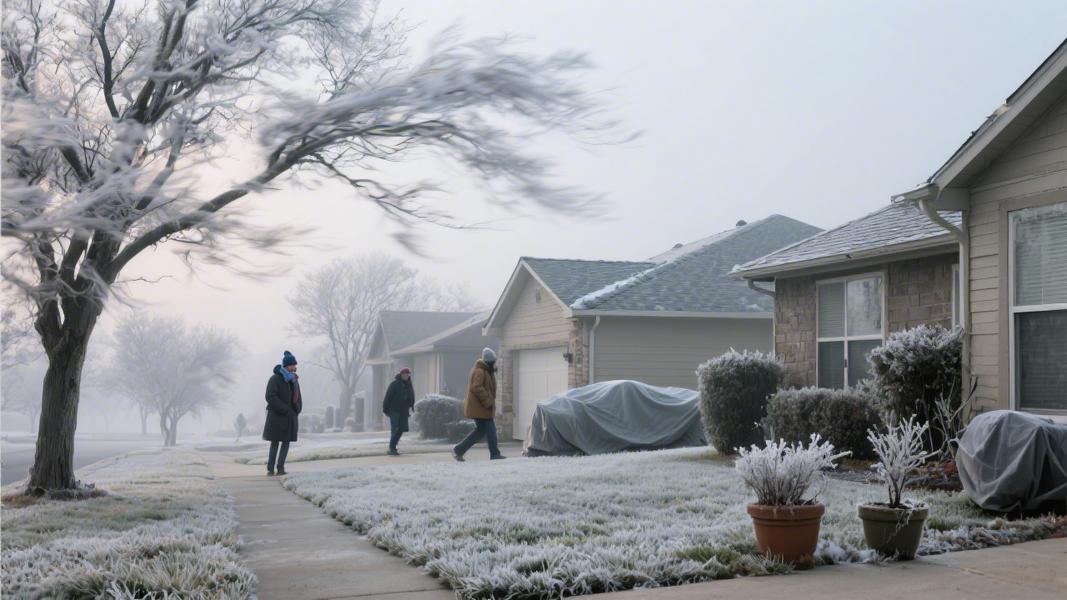
A brutal Arctic storm is tightening its grip on Texas, sending temperatures plummeting across the Panhandle, West Texas, and North Texas — and it’s not done yet. The freezing line is pushing south, and Houston is next.
The storm, which has already paralyzed large swaths of the state, is expected to deliver subfreezing temperatures, sleet, freezing rain, and wind chills as low as the single digits to much of the northern two-thirds of Texas through the weekend. Gov. Greg Abbott issued a disaster declaration for 134 counties — a move that signals both the storm’s reach and officials’ determination not to be caught flat-footed the way they were five years ago. The ghost of Winter Storm Uri hangs over all of it.
Houston in the Crosshairs
The timing for Houston couldn’t be worse. A strong Arctic front is expected to push through the city from midday to late Saturday, then linger all day Sunday. Forecasters warn of freezing rain, sleet, gusty winds, and wind chills that could dip into the single digits to teens. “The storm’s freezing line is expected to push through Houston overnight,” one meteorologist noted, “when temperatures may reach the single digits.” Parts of the Houston region are already under Winter Storm Warning, Extreme Cold Warning, or Ice Storm Warning — sometimes all three at once, depending on the zip code.
That’s a wide swath of vulnerable urban infrastructure sitting in the path of a fast-moving deep freeze. And for a city that doesn’t exactly keep a fleet of snowplows on standby, the ice threat is the real concern.
West Texas and DFW Feeling It First
Up in West Texas, the situation is already deteriorating. Precipitation is transitioning from sleet to snow Saturday night, and the roads are going with it. Kevin Lamberson, a meteorologist with the National Weather Service in Midland, warned that “residents should largely be wary of dangerous road conditions and cold temperatures lasting into Monday,” with wind chills expected to bottom out between -5 and -10 degrees on Sunday. That’s not a number you shrug off.
In the Dallas-Fort Worth area, sleet and freezing rain are already falling, and temperatures are locked below freezing through the weekend. Fort Worth NWS meteorologist David Bonnette said there’ll be a brief break in precipitation during the early afternoon — but don’t get comfortable. “Even more will fall later in the day,” he cautioned. The reprieve is temporary. The misery is not.
Officials Push Hard on the Stay-Home Message
How bad does it have to get before Texans listen? Apparently bad enough that Dallas Police Chief Daniel Comeaux felt the need to say it plainly at a Wednesday news conference: “If you don’t have to go outside, please don’t.” It’s the kind of blunt public safety message that rarely gets delivered unless officials are genuinely worried about what’s coming — and what’s coming is a weekend of icy roads, limited visibility, and temperatures that can turn a fender-bender into something far worse.
Abbott struck a careful balance between urgency and reassurance. “The severity of it is not quite as great, and the size of it is not quite as great as winter storm Uri,” he said. “That said, people would be making a mistake if they don’t take it serious.” That’s a politician threading a needle — acknowledging the fear without feeding the panic. Whether Texans take the warning seriously this time remains to be seen.
The Grid Question — and Why This Time Is Different
Still, the most pressing question isn’t just about the cold. It’s about the lights staying on. Uri knocked out power for millions of Texans in February 2021, killing hundreds and exposing catastrophic vulnerabilities in the state’s grid. That failure has shadowed every winter storm since.
But it’s not the same grid anymore — at least, not entirely. Texas has added thousands of megawatts of battery storage since Uri, a development that energy experts say fundamentally changes the calculus. “We didn’t really have battery storage on the grid during Winter Storm Uri, and now we have thousands of megawatts of batteries,” one grid analyst explained. “That’s a gigantic change. That’s a huge asset when we have this kind of winter event.” It’s not a guarantee, but it’s a meaningful buffer that simply didn’t exist last time.
On the utility side, CenterPoint Energy says it has 3,300 electric workers and 700 gas workers staged and ready to respond across the Houston area. The company has also trimmed 8,000 miles of vegetation across its footprint over the past two years — a direct response to criticism that overgrown trees contributed to outages during previous storms. Whether all that preparation holds under real-world conditions is the $64,000 question, and Houstonians watching their thermostats this weekend will be the ones waiting for an answer.
What Comes Next
Forecasters expect conditions to remain dangerous through Sunday and into Monday across most of the state, with a gradual moderation arriving early next week. Until then, emergency warming centers are open, roads are being pre-treated, and officials are urging residents to check on elderly neighbors, bring pets inside, and have backup supplies on hand.
Texas has been here before. The difference between this storm and Uri — if there is one — won’t be measured in snowfall totals or wind chill records. It’ll be measured in whether the lessons of 2021 were actually learned, or just talked about. The next 48 hours will tell the story either way.
