
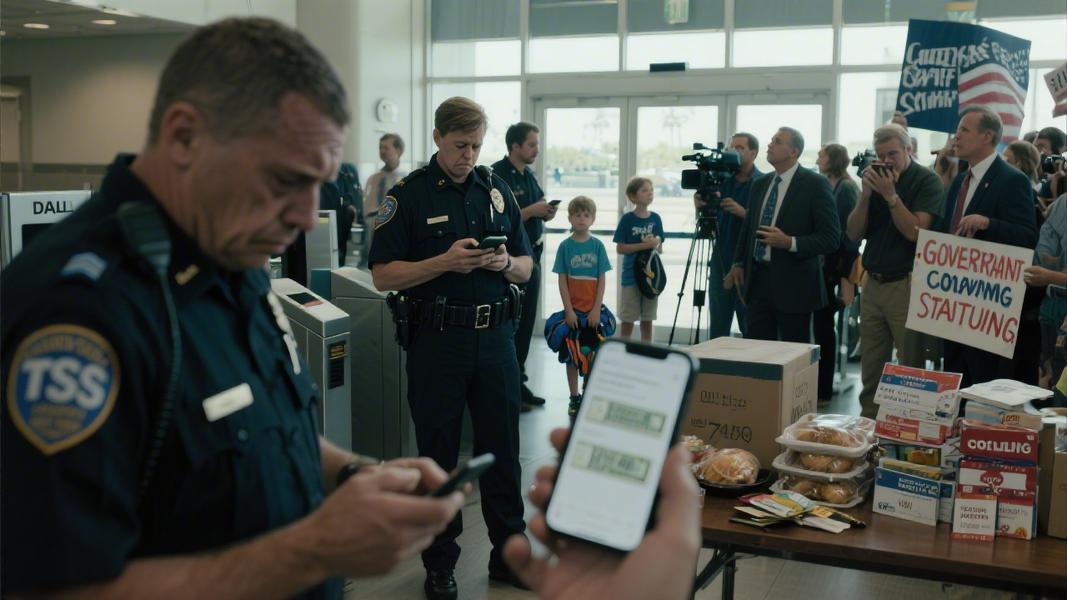
Hundreds of Transportation Security Administration officers have quit their jobs since the partial government shutdown began, and the ones still showing up to work haven’t been paid. The cracks are starting to show at airports across the country.
The shutdown began at 12:01 a.m. on February 14 after Congress failed to reach an agreement on Department of Homeland Security funding — a standoff rooted in a broader dispute over ICE. More than a month later, the fallout is landing hardest on the roughly 50,000 TSA officers who are still legally required to report to work, paycheck or not. Reports show the agency has lost 366 officers since the funding lapse began — and that number keeps climbing.
Zero in the Bank
This past weekend, TSA officers missed their first full paycheck entirely. The one before it wasn’t much better. “They missed their paycheck this weekend. It was a big fat zero in a bank account,” one official noted. “And two weeks before that, most officers received anywhere between 25 and zero percent.” For workers earning a base salary that starts somewhere between $34,454 and $55,486 — not exactly a cushion for absorbing missed paychecks — the math gets ugly fast.
And people are leaving because of it. Over 300 TSA employees have resigned since the shutdown took hold, with the agency’s unscheduled call-out rate more than tripling. Normally sitting at around 2%, that figure has ballooned to an average of 6% during the shutdown, according to data tracking airport operations. Travelers at Houston Hobby, Atlanta, New Orleans, Philadelphia, and Charlotte have already felt the squeeze — long lines, stretched-thin checkpoints, and fewer hands to move things along.
Family First
For some officers, the decision to walk away wasn’t ideological. It was personal. “I love the agency. I love the people that I worked with,” one former TSA officer said after resigning. “But my family has to come first.” It’s a sentiment that’s hard to argue with — and one that’s being repeated, quietly, across airport security lanes from coast to coast.
That’s the catch, isn’t it? These are essential workers. They can’t legally strike. They can’t simply refuse to show up en masse without facing serious consequences. So instead, they’re resigning — one by one — or calling out sick at rates the agency hasn’t seen before. The result is a slow bleed that’s becoming harder to ignore.
A Bill That Didn’t Make It
There was a potential fix on the table. Republican Senator Ron Johnson introduced the Shutdown Fairness Act on October 15, 2025 — legislation designed to ensure essential federal workers get paid even when Congress can’t agree on a budget. It failed in the Senate, 54 to 45, and a reconsideration attempt in November went nowhere. The bill’s collapse drew a pointed, if resigned, reaction from those it was meant to help. “Sure, the federal employees would love to see it pass,” said one TSA representative. “I just don’t think that the politicians want to pass it. With that bill being passed, it would probably eliminate the leverage that they want to use — to use the federal employee to whatever they need to use this for in their political bargaining.”
Still, criticism isn’t coming only from the left. New Hampshire Governor Chris Sununu, a Republican, didn’t mince words when asked about TSA workers going without pay. “What else is more important than paying your own workers?” he said. “Have your political fights on the side, but don’t drag down the entire traveling American public because of it.”
The Bigger Picture
How bad does it have to get before something changes? More than 300 resignations. A sick-call rate three times the norm. Zero-dollar paychecks for workers screening millions of passengers every week. The reality playing out at America’s airports right now isn’t hypothetical — it’s a staffing crisis unfolding in real time, at security checkpoints that the public depends on every single day.
Washington has used federal workers as leverage before. It probably will again. But somewhere between the political calculus and the budget negotiations, there are real people standing at conveyor belts — unpaid, understaffed, and running out of reasons to stay.
