
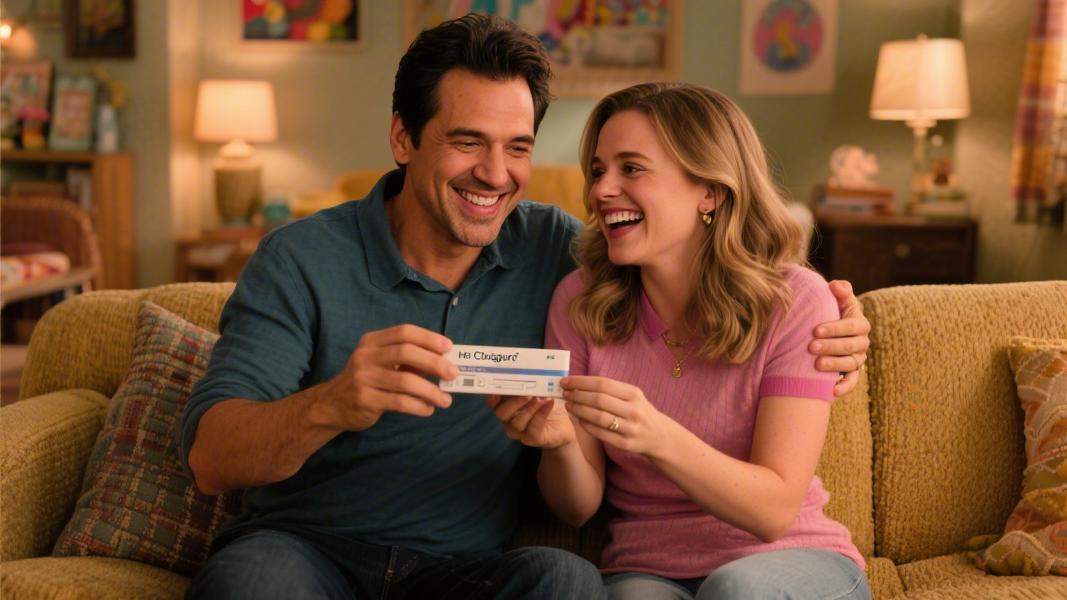
They made America fall in love with a fictional San Francisco family in the late ’80s. Now, three decades later, John Stamos and Jodie Sweetin are back together — this time with a far more serious message than anything that ever aired on Full House.
The two former castmates have teamed up with Abbott for a public health campaign called “The (Second) Talk” — a pointed, deliberately uncomfortable conversation about colorectal cancer screening that the company hopes will reach the millions of Americans who’ve been putting off exactly that discussion. The campaign centers on Cologuard, the at-home stool DNA test developed by Exact Sciences, which Abbott has been promoting as a less invasive alternative to traditional colonoscopies for average-risk adults.
Why These Two, Why Now
It’s a smart pairing, and it’s not accidental. Stamos, 61, and Sweetin, 42, carry with them an almost reflexive warmth in the American cultural memory — the kind of nostalgic goodwill that’s genuinely hard to manufacture. Abbott is leaning into that familiarity deliberately, using the duo’s chemistry to soften what is, frankly, a topic that makes most people change the subject fast.
Colorectal cancer is the second leading cause of cancer death in the United States, according to the American Cancer Society — and yet screening rates remain stubbornly, dangerously low. The math isn’t complicated: when caught early, survival rates climb dramatically. When it’s caught late, they don’t. That gap between what’s possible and what’s actually happening is precisely the space this campaign is trying to occupy.
Still, awareness campaigns live and die by execution. Celebrity endorsements can feel hollow — a famous face nodding earnestly at a camera before cashing a check and moving on. What Abbott appears to be betting on here is something different: the specific, lived-in dynamic between Stamos and Sweetin, who’ve known each other since she was a child actor, and who bring a sibling-like ease that’s difficult to fake.
The Name Says It All
“The (Second) Talk” is a clever bit of framing. The original “talk,” of course, is the birds-and-bees conversation parents dread having with their kids. This one flips the dynamic — adults talking to other adults, peers nudging peers, about a medical screening that too many people treat as optional until it isn’t. The parenthetical is doing real work in that title. It signals self-awareness, a wink at the awkwardness, without letting the campaign slide into pure comedy and lose its weight.
Cologuard itself has been on the market since 2014, cleared by the FDA for average-risk adults 45 and older. It doesn’t require a bowel prep, no sedation, no time off work — patients collect a sample at home and mail it in. Abbott’s pitch is straightforward: remove the barriers, remove the excuses. The test detects altered DNA and blood in stool that may indicate the presence of colorectal cancer or precancerous conditions.
The Bigger Picture
How bad is the screening gap, really? According to the Centers for Disease Control and Prevention, roughly one in three adults who should be screened for colorectal cancer simply aren’t. That’s tens of millions of people. And the disparity isn’t evenly distributed — screening rates are lower among uninsured populations, rural communities, and certain racial and ethnic groups who already face elevated risk. A celebrity campaign won’t fix structural inequities in healthcare access. That’s worth saying plainly.
That said, normalization has real value. When people see someone they trust — or someone who reminds them of a trusted figure from their past — talking openly about something they’d otherwise avoid, research consistently shows it moves the needle. It’s not a silver bullet. It’s a nudge. And sometimes a nudge, repeated loudly enough across enough platforms, is what tips someone toward scheduling an appointment they’ve been ignoring for two years.
Sweetin, for her part, has been candid in interviews about the importance of preventive health — particularly given the pressures of a life lived largely in public, with all the scrutiny that entails. Stamos has spoken openly about health scares of his own in recent years. Neither of them is coming to this as a stranger to vulnerability, which may be exactly why Abbott chose them over a more conventional spokesperson.
What Comes Next
The campaign is rolling out across digital platforms, social media, and broadcast — a full-court press timed to coincide with Colorectal Cancer Awareness Month in March. Abbott is directing consumers to a dedicated campaign hub where they can learn more about Cologuard and, pointedly, find out whether the test is covered under their insurance. For most Americans with standard coverage, it is.
Whether “The (Second) Talk” breaks through the noise of a media landscape that is, to put it mildly, not short on content — that remains to be seen. Public health campaigns are notoriously difficult to evaluate in real time. The metrics that matter most, screening rates and early detection numbers, take years to surface in the data.
But here’s the thing: if even a fraction of the people who grew up watching Full House — who are now, themselves, squarely in the age range where this screening matters — pause long enough to have an uncomfortable conversation with their doctor, then two familiar faces doing something a little awkward on camera will have been worth every second of airtime.
As Uncle Jesse himself might have put it: have mercy — and get screened.
