
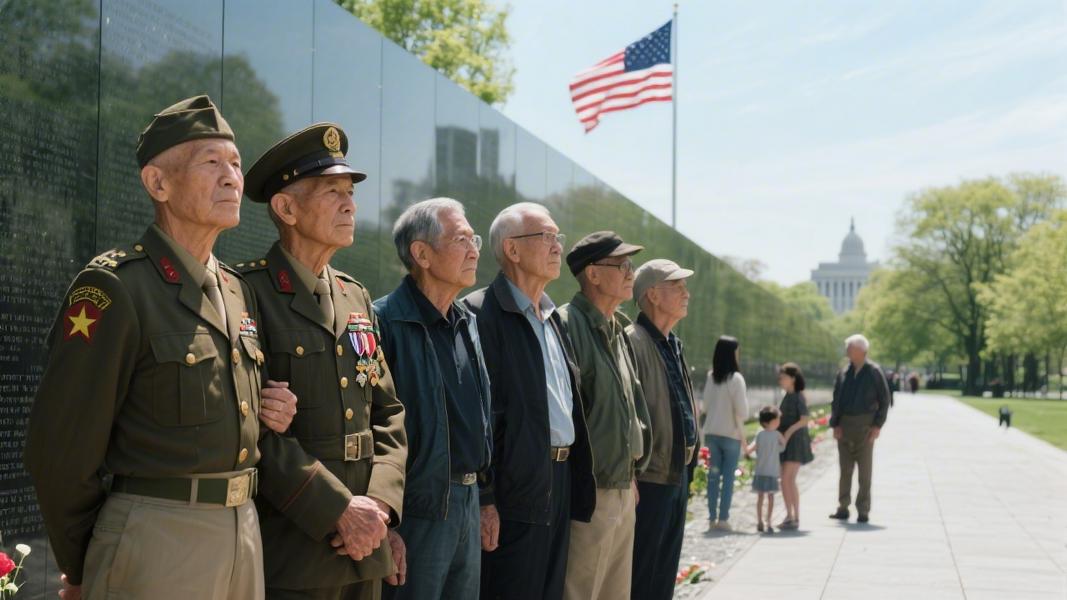
Fifty-three years after the last American combat troops left Vietnam, the country is still reckoning with what it owes the men and women who fought there. On Sunday, the White House made clear it hasn’t forgotten.
In a Presidential Message issued March 29, 2026, the administration formally honored National Vietnam War Veterans Day — marking the anniversary of the U.S. military withdrawal on March 29, 1973, after more than eight years of combat in Southeast Asia. The message was both a tribute and a policy statement, arriving alongside a string of veterans’ initiatives the administration says represent a long-overdue commitment to those who served.
A Date That Took Decades to Recognize
It’s worth remembering how recent this holiday actually is. National Vietnam War Veterans Day was only signed into law in 2017, when President Trump enacted the Vietnam War Veterans Recognition Act designating March 29 as the official day of commemoration. That it took nearly half a century to formalize says something — about politics, about the cultural wounds the war left behind, and about how long it can take a nation to say thank you and mean it.
The numbers alone demand some kind of reckoning. 58,000 American service members were killed during the Vietnam War. More than 300,000 were wounded. Generations of families were fractured. And for many veterans, the homecoming was its own kind of trauma — met not with gratitude, but with suspicion or outright hostility. As former President Obama once described it, theirs was “a story of patriots who braved the line of fire, who cast themselves into harm’s way to save a friend, who fought hour after hour, day after day to preserve the liberties we hold dear” — yet who faced neglect upon their return.
What the Administration Is Claiming
The White House didn’t let the occasion pass without touting its record. The presidential message noted that the administration has opened more than 30 new veteran health clinics and is currently constructing the National Center for Warrior Independence, a facility expected to house up to 6,000 homeless veterans by 2028. That’s not a small number — and if it delivers, it would represent one of the more tangible federal commitments to veteran housing in recent memory.
On the benefits side, the administration highlighted that the VA backlog of veterans waiting for benefits has dropped more than 60 percent since last year, with record numbers of disability claims now processed. For veterans who’ve spent years — sometimes decades — caught in bureaucratic limbo, that figure matters enormously. Whether the pace holds is a different question.
The president’s own words were direct: “As President, I will always ensure that our veterans have the respect and support our country owes them.” It’s the kind of line every administration delivers. The difference, as always, is in the follow-through.
The Voices That Stay With You
Still, no policy announcement quite captures what this day is really about. That’s better understood through the people who actually served. Vietnam veteran Fuller put it plainly when he reflected on his time in-country: “When I was in Vietnam, there were a few times I questioned myself as to why I volunteered to go to Vietnam… But probably as many times as I questioned my decision to volunteer, I also said that I was glad I went and especially glad I made it back. I was glad I made the sacrifice and decision to serve my country.” There’s something quietly powerful in that — the ambivalence, the pride, the relief, all tangled together.
Kay Price, a fellow Vietnam veteran, echoed that sense of shared identity: “I am proud to be counted among the thousands of Veterans who served in Vietnam. My fellow veterans served with honor and distinction.” Those words carry weight precisely because they come from someone who was there.
The Broader Stakes
What does it mean to honor a war that divided the country so deeply? That’s not a rhetorical question. The Vietnam War didn’t just cost lives — it cracked something in the American consensus about military service, about government credibility, about who gets to define patriotism. Congressman Jeff Miller captured the simpler, enduring truth when he noted that “the willingness of America’s Veterans to sacrifice for our country has earned them our lasting gratitude.” But gratitude without structure — without clinics, without housing, without benefits processed on time — is just sentiment.
That said, the enemy at the time wasn’t without his own clarity of purpose. Ho Chi Minh reportedly warned French colonialists with a line that proved prophetic: “You can kill ten of my men for every one I kill of yours. But even at those odds, you will lose and I will win.” History recorded how that calculation played out. Understanding that history — fully, honestly — is part of what honoring these veterans actually requires.
A Promise Still Being Kept
National Vietnam War Veterans Day is young as holidays go, but the debt it marks is old. Broadcaster Elmer Davis once wrote that “this nation will remain the land of the free only so long as it is the home of the brave.” The Vietnam generation supplied that bravery in full. What March 29 asks — every year, and this year especially — is whether the nation has supplied the rest of its end of the bargain. According to the record, progress is real. Whether it’s enough is a question those 58,000 names on a black granite wall in Washington can’t answer for us.
