
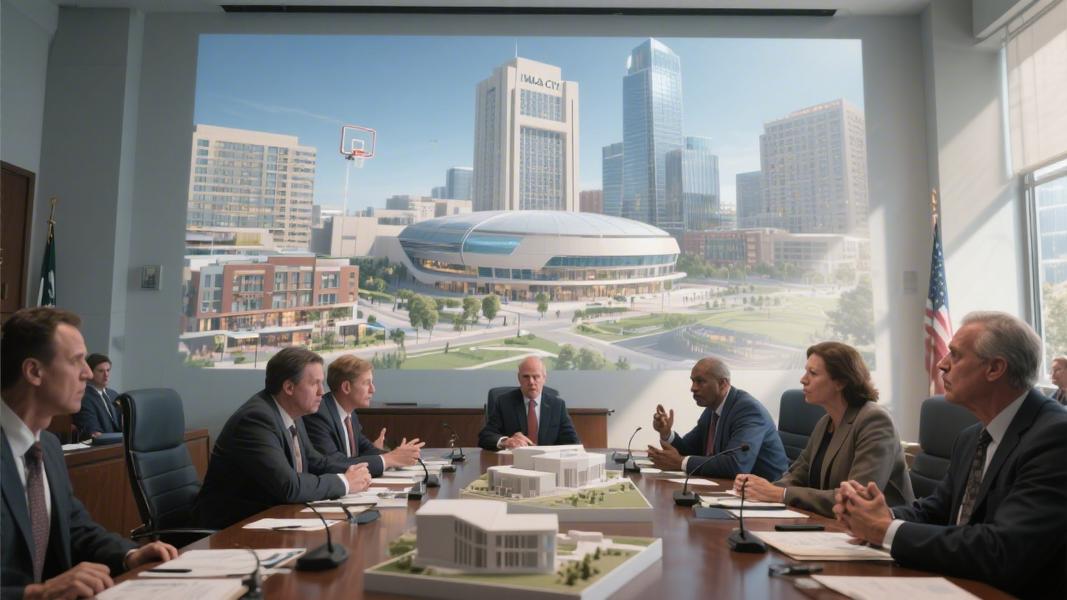
Dallas City Hall might be getting a new address — and the bill for staying put is enough to make anyone want to move.
The Dallas City Council voted 9-6 Wednesday to explore buying or leasing a new home for city government, setting off what promises to be a months-long reckoning over one of the most consequential — and contentious — real estate decisions the city has faced in decades. A third-party property condition report put the potential cost of renovating the current building at more than $1 billion, a figure that’s hard to argue with and even harder to ignore. The council has until no later than May to receive a full report back on relocation options, with the Finance Committee set to convene on May 26.
A Building in Trouble — And a Price Tag to Match
How bad is it? Bad enough that the numbers alone reported Wednesday made renovation look more like a money pit than a fix. Just relocating city operations during any renovation would cost between $113 million and $185 million, according to the third-party assessment — and that’s before a single wall gets torn down or a single pipe gets replaced. When all is said and done, full renovation and modernization could run between $500 million and $1 billion-plus, with temporary relocation alone eating up roughly a fifth of that range, estimated at $100 million to $200 million.
Still, the council didn’t slam the door on staying put entirely. The resolution also requires staff to develop a repair-and-stay plan for comparison — a nod to the six dissenting votes and to a public that hasn’t fully been brought along for the ride.
The Mavericks Connection Nobody Talked About — Until Now
That’s the catch. Long before the council formally took up the issue, City Manager Kimberly Tolbert had already been having conversations about City Hall’s future with an unlikely counterpart: Dallas Mavericks CEO Rick Welts. The talks happened more than a year ago, and they weren’t exactly front-page news at the time — because most council members didn’t know about them.
Welts described the outreach this way: “Over a year ago, City Manager Tolbert came to us and said, ‘Look, I got to move out of City Hall. I can’t afford to operate what we do in that building going forward for the taxpayers.'” The Mavericks, for their part, have big ambitions. Welts laid out a sweeping vision for 50 continuous acres of development around a new arena — a hotel, corporate headquarters, practice facility, medical partnership, residential units, retail, and restaurants. City Hall’s current footprint, it seems, fits neatly into that picture.
Council Member Adam Bazaldua didn’t take kindly to learning about any of this after the fact. “I feel that we have had an extremely dishonest conversation with the public to this point,” he said flatly — a pointed rebuke of a process he believes bypassed the people elected to represent Dallas residents.
Transparent or Not? Depends Who You Ask.
Mayor Eric Johnson pushed back hard. He pointed to a written memo he sent to council requesting a committee review of City Hall options, and noted that all subsequent meetings were open to the public. “The process has been the definition of transparent,” he said. “It’s just not true that this process hasn’t been transparent.” That might be technically accurate. But there’s a difference between meetings being open and the public actually knowing what’s being negotiated — and on whose behalf.
Bazaldua, for his part, isn’t opposed to downtown investment or even keeping the Mavericks in Dallas. His frustration runs deeper than that. “The fact that we can’t invest in our Downtown Dallas, and keep the Mavericks, and maintain city assets for civic purposes is absurd,” he said — framing the whole thing not as an either/or, but as a failure of political imagination.
Where Could City Hall Actually Go?
At least 15 potential sites are reportedly on the table. Six have emerged as leading candidates: the EPIC Buildings in Deep Ellum, Bryan Tower in Downtown Dallas, Comerica Bank Tower, Founder’s Square in the West End, Cityplace Tower north of downtown, and the former Sears Roebuck distribution center in the Cedars neighborhood. It’s a geographically scattered list, reflecting just how wide-open this search still remains.
Each option comes with its own tradeoffs — proximity to transit, square footage, symbolic weight. A city hall says something about a city. Whether Dallas ends up in a repurposed corporate tower or a converted warehouse will say something too, whether anyone intends it to or not.
What Comes Next
The Finance Committee’s May 26 meeting is shaping up to be the real inflection point. By then, staff will need to have assembled enough data — on costs, sites, logistics — for the council to make a meaningful comparison between moving and staying. That’s a tight window for a decision of this magnitude. Dallas has been operating out of its current City Hall since 1978. It won’t be easy to untangle nearly five decades of civic infrastructure in a few months of committee meetings.
But the clock, and the price tag, may leave the city little choice but to figure it out fast.
