
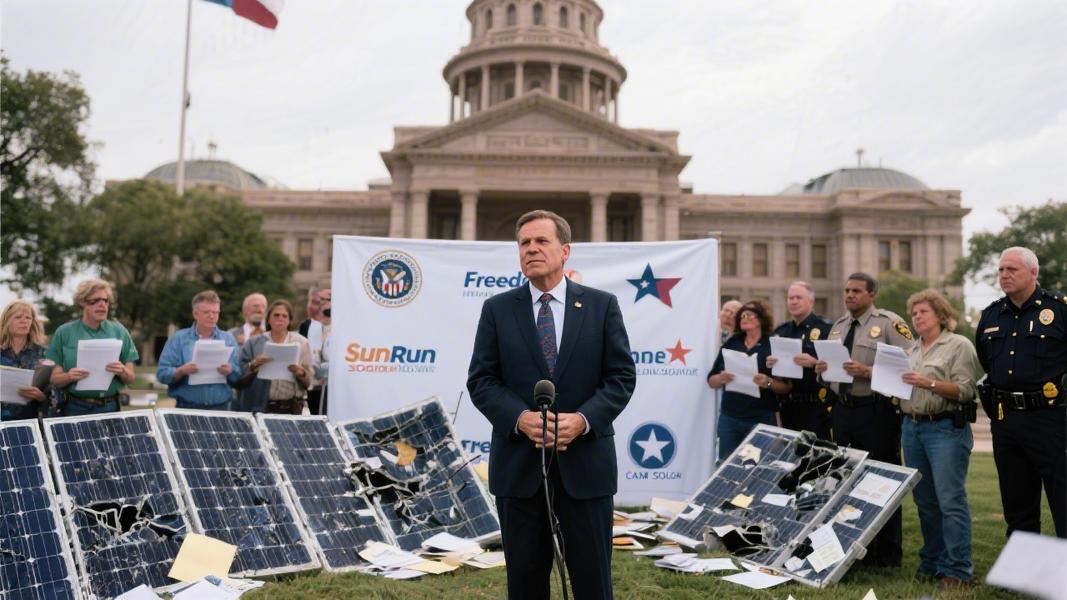
Texas homeowners looking to go green may have gotten burned instead — and now the state’s top law enforcement officer wants answers.
Texas Attorney General Ken Paxton has launched a sweeping consumer protection initiative targeting solar panel companies accused of misleading thousands of residents across the state, issuing Civil Investigative Demands to several major installers and opening formal inquiries into alleged deceptive sales practices, hidden fees, and contracts that left customers locked into deals they never fully understood.
What Triggered the Crackdown
The initiative didn’t come out of nowhere. Consumer complaints about solar sales tactics have been piling up at the Attorney General’s office for months — homeowners describing high-pressure door-to-door pitches, promises of dramatic utility savings that never materialized, and financing arrangements buried in fine print that balloon in cost over time. The volume, Paxton’s office has indicated, became impossible to ignore.
Among the companies under scrutiny are Freedom Forever, SunRun, Lone Star Solar, and CAM Solar — a mix of national heavyweights and regional players that together represent a significant slice of Texas’s rapidly expanding residential solar market. None of the companies have been formally charged with wrongdoing at this stage. The Civil Investigative Demands are investigative tools, compelling the production of documents and records, not indictments. Still, receiving one is rarely a good sign.
The Complaints Behind the Headlines
So what, exactly, are Texans saying happened to them? The pattern, according to the Attorney General’s office, is troublingly consistent. A salesperson shows up at the door — often in the early evening, often friendly and confident — and walks the homeowner through a pitch built around energy independence, shrinking electric bills, and federal tax incentives. What allegedly gets glossed over: the true cost of the loan, escalating lease payments, what happens when you try to sell your home with panels attached, and the reality that savings projections are often based on best-case assumptions.
Some complaints go further. Customers allege signatures were obtained on documents they weren’t given time to read, that promised rebates never arrived, and that customer service essentially vanished the moment installation was complete. That’s the kind of allegation that lands squarely in the crosshairs of the Texas Deceptive Trade Practices Act — one of the more muscular consumer protection statutes in the country.
Paxton’s Broader Consumer Protection Push
The solar initiative fits into a pattern Paxton has cultivated — positioning the Attorney General’s office as an aggressive watchdog on consumer fraud even as he pursues more politically charged battles on other fronts. Whether you view that framing charitably or skeptically, the mechanics here are conventional consumer protection work: investigate, demand records, assess whether the law was broken, and litigate if the evidence supports it.
Texas is a particularly attractive market for solar companies, and not just because of the sunshine. The state’s deregulated electricity market, volatile grid pricing — memories of the 2021 winter storm blackouts haven’t faded — and a large suburban homeowner base have made it fertile ground for solar expansion. That same urgency, critics argue, is exactly what bad actors exploit.
What Comes Next
Civil Investigative Demands typically require companies to produce internal communications, sales scripts, training materials, and customer complaint records within a defined window. Investigators then assess whether the evidence supports formal legal action. The process can take months. It can also end quietly, with a company agreeing to reform its practices and pay restitution without ever seeing a courtroom.
But it can also escalate. If Paxton’s office concludes the violations were systematic — not isolated mistakes but deliberate policy — the exposure for these companies could be substantial. The Deceptive Trade Practices Act allows for treble damages in cases involving knowing violations, and attorneys’ fees on top of that. For a company with thousands of Texas customers, the math gets uncomfortable fast.
Homeowners who believe they were misled are being encouraged to file complaints directly with the Attorney General’s consumer protection division, which is using the volume and specificity of those complaints to shape the investigation’s direction.
The Bigger Picture
It’s worth stepping back for a moment. The residential solar industry has genuinely helped a lot of people — lower bills, cleaner energy, some measure of insulation from grid chaos. The technology works. The problem isn’t the panels; it’s the sales pipeline, where incentive structures sometimes reward closers over honest disclosure. That’s a regulatory gap that states across the country are increasingly trying to close.
Texas, with its scale and its independent streak, may end up setting a precedent that ripples outward. Or the investigation may yield modest settlements and a few policy tweaks. Either way, the message being sent to solar companies operating in the state is clear enough: the Attorney General is watching, the complaints are being read, and the days of treating Texas as an enforcement-free frontier may be coming to an end.
For the homeowners who signed on the dotted line and then spent months wondering what they’d actually agreed to, that’s cold comfort — but it’s a start.
