
Your body might be telling doctors something your words never could. Researchers are now using the way you walk — and even the way you stand up from a chair — to detect signs of depression and anxiety.
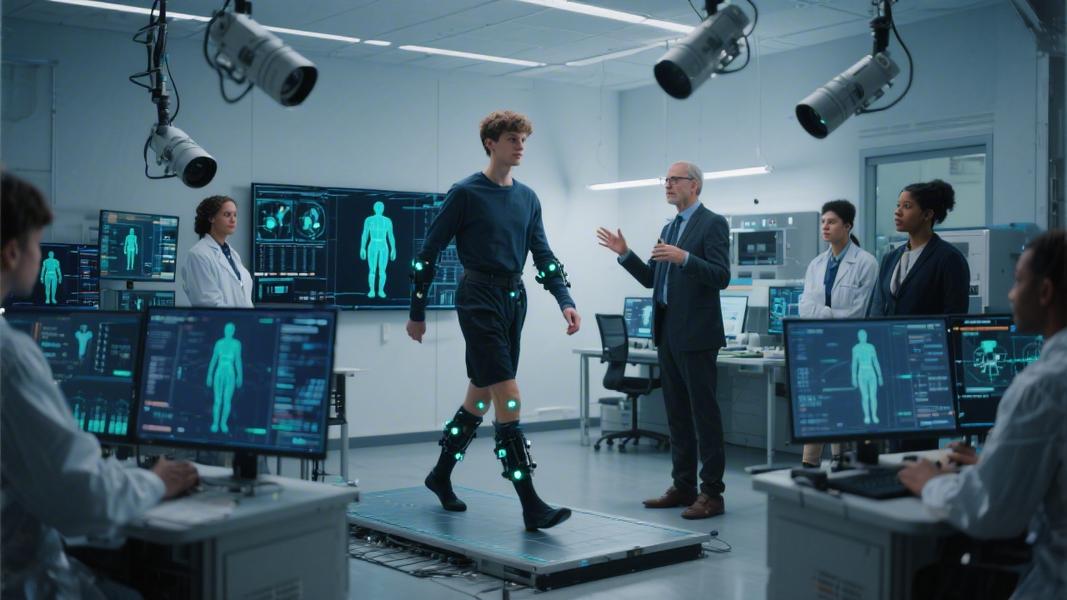
Scientists at the University of Texas at Dallas have developed a system combining 3D motion capture technology with machine-learning models to identify mental health conditions from physical movement alone. The results are striking: the system achieved 75% accuracy when analyzing walking patterns and 77% accuracy for sit-to-walk tasks — numbers that, while not yet clinical-grade, suggest the body carries far more psychological information than medicine has traditionally credited it with.
Reading the Body Like a Text
It sounds almost counterintuitive. Mental health has long been assessed through conversation, self-reporting, questionnaires — tools that rely on a patient’s ability and willingness to articulate their inner experience. But that’s precisely the problem. People can’t always find the words. Or they won’t.
“Our study showed that depression and anxiety can be identified from human movement,” said Dr. Gu Eon Kang, assistant professor of bioengineering in the Erik Jonsson School of Engineering and Computer Science, as reported by UT Dallas. The implication is significant: clinicians may one day have an objective, observable data point to supplement — or even prompt — a mental health evaluation.
The research, noted by technology observers as part of a broader wave of biomechanical mental health tools, builds on a well-established but underutilized insight: psychological distress manifests physically. Slower gait. Reduced arm swing. Changes in posture and transition timing. The body, it turns out, keeps the score in ways that cameras and algorithms can now begin to measure.
Not Just Movement — Prediction
Meanwhile, another UT Dallas researcher is working on a different but complementary frontier: catching psychosis before it happens.
Dr. Amy Pinkham is co-principal investigator on a five-year NIH grant worth up to $3.6 million, aimed at refining how clinicians assess social cognitive deficits in high-risk teenagers and young adults. The goal is to determine whether those deficits — things like difficulty reading facial expressions or understanding social cues — can reliably predict who will convert to full psychosis. “We hope to establish here that social cognitive impairments predict conversion to psychosis and that, with better measurement, we can get a good idea of the scale of risk for these individuals, with hopes of finding methods for prevention,” Pinkham explained.
Prevention. That word carries enormous weight in psychiatry, a field that has historically been far better at treating crises than averting them. If social cognition tests can be sharpened into reliable early-warning systems, the implications for adolescent mental health care — already strained to its limits — could be profound.
The Brain, the Body, and the Gap Between Them
Still, it’s worth asking: how far can movement-based diagnostics really go? Accuracy rates in the mid-to-upper 70s are promising, but they also mean roughly one in four assessments is wrong. That’s not a margin most clinicians would accept in isolation.
That’s the catch. These tools aren’t meant to replace clinical judgment — they’re meant to augment it. And there’s precedent for that kind of integration. Specialists treating functional neurological disorder, for instance, already use physical therapy as a core intervention, working with movement to update the brain’s predictions about the body, while layering in psychotherapy and medication for symptoms like anxiety and depression, as outlined by UT Southwestern Medical Center. The mind-body relationship, in other words, is already a clinical tool — researchers are just building sharper instruments around it.
The UT Dallas motion capture findings were published in early 2026, part of a growing body of work that treats the human body not just as a vessel for the mind, but as a readout of it. Whether that readout becomes a standard part of mental health screening may depend less on the science — which is advancing quickly — and more on whether the healthcare system is ready to listen.
After all, the body has been trying to tell us something for a long time. We’re only now learning how to hear it.
