
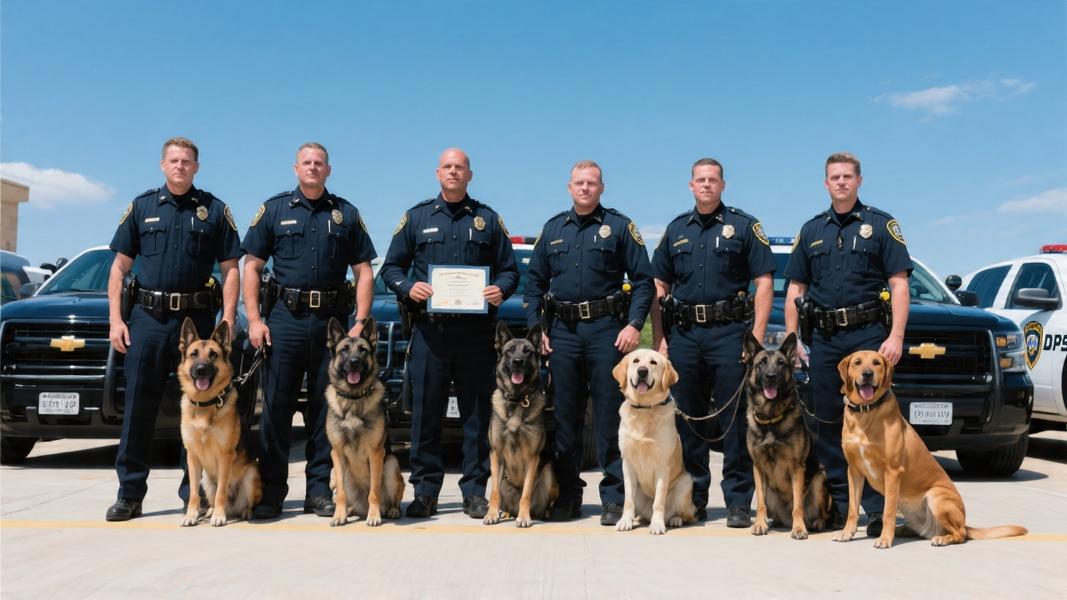
Eight new K-9 teams are about to hit the roads, schools, and public events of Texas — and they’ve earned it the hard way.
The Texas Department of Public Safety graduated eight new K-9 teams and two certified K-9 Tech Trainers on April 17, 2026, adding fresh firepower to one of the state’s most specialized law enforcement programs. The teams are now set to deploy statewide, taking on narcotics detection, explosives sweeps, and tracking operations across a state that, frankly, keeps them plenty busy. It’s the latest expansion of a program that’s become central to DPS’s public safety mission — and the timing, given persistent concerns about drug trafficking and public event security across Texas, is no accident.
Nine Weeks, Six Breeds, One Mission
Getting here wasn’t quick. Each graduating K-9 team completed a nine-week training program — including six weeks of pre-training for the dogs themselves — led by experienced handlers and certified trainers. The breeds represented in the program read like a working-dog hall of fame: German Shepherds, Dutch Shepherds, Belgian Malinois, Labrador Retrievers, and at least one Vizsla, a lesser-known but capable scent-detection breed that’s been quietly making inroads in law enforcement circles.
The April graduating class breaks down into two distinct specialties. Five narcotics detection teams were trained to identify methamphetamine, heroin, cocaine, and marijuana in high-pressure environments — the kind of chaotic, fast-moving situations where a dog’s nose is worth more than most pieces of technology. The remaining three teams specialize in explosives detection, trained to work across commercial, military, and homemade explosive materials in venues like schools and crowded public events. That’s not a small ask.
Texas Highway Patrol Chief Bryan Rippee didn’t mince words about what these animals mean to the department. “Our K-9 teams are an integral part of DPS and play a vital role in our mission to protect and serve the people of Texas,” Rippee said. It’s a line that could sound like boilerplate — except that the numbers behind the program give it real weight.
A Program That’s Quietly Grown Into Something Formidable
With this graduating class now in the fold, the DPS K-9 program stands at 101 total personnel, including 88 handlers. The working dog roster breaks down into 59 narcotics detection K-9s, 15 explosives detection dogs, and 14 tracking dogs. That’s a substantial operational footprint — one that’s been built out deliberately over years of incremental graduating classes just like this one.
What often gets overlooked in announcements like these? The trainers. Two individuals in the April class earned K-9 Tech Trainer certifications, a designation that requires TCOLE-approved instructor status and the completion of 250 credit hours. These aren’t just glorified handlers. They lead pre-training programs and oversee evaluations — essentially the people who make sure the next graduating class is as ready as this one. It’s a pipeline that feeds itself, which is exactly how a program this size stays functional.
This Isn’t the First Rodeo This Year — Or Even This Season
The April ceremony wasn’t DPS’s first graduation in recent memory. Back on November 7, 2025, the department celebrated nine new K-9 teams joining its ranks — another class built around tracking, narcotics, and explosives detection. That November cohort included six narcotics teams, two explosives teams, and one tracking team reportedly capable of executing tracks stretching up to 16 miles. Three members of that class also earned K-9 tech trainer certifications, according to local coverage from the Bandera Bulletin, which noted the program at that point comprised 100 personnel and 85 handlers.
So in roughly five months, DPS has added nearly two dozen new K-9 personnel to its statewide operation. That’s not a slow burn — that’s a deliberate push.
Why It Matters Beyond the Ceremony
Still, graduation ceremonies are easy to celebrate and easy to forget. The harder question is what happens next — whether these teams get the sustained support, deployment opportunities, and institutional backing to actually make a dent. Texas is a big state with a long border and a drug trafficking problem that isn’t going away. Explosives threats at schools and public gatherings have become a grim fixture of American life. A K-9 team’s value is almost impossible to quantify until the moment it’s needed — and then it becomes very obvious, very fast.
For now, eight new dogs and their handlers are ready. Whether the state is ready to use them well is a different question — and one worth watching.
