
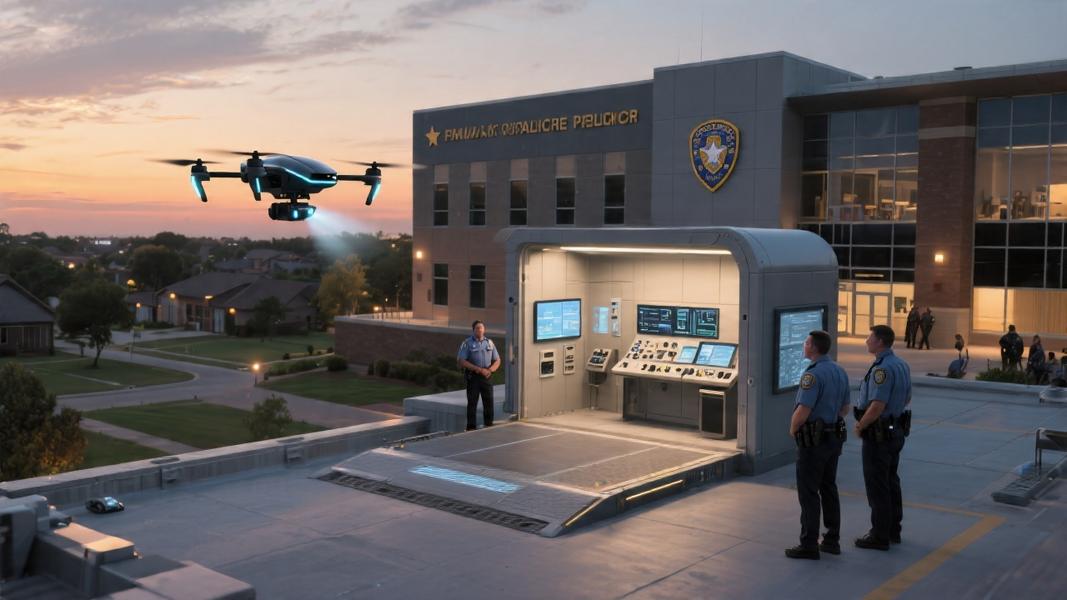
Before the squad car even pulls out of the bay, the drone is already there. That’s not a marketing slogan — it’s becoming standard procedure in at least one North Texas city.
The Colony Police Department has deployed a drone named Maveric as a dedicated first responder, launching it from a dock mounted on the roof of the police station and sending it airborne within seconds of a 911 call. The program represents a broader shift in how law enforcement agencies across the Dallas-Fort Worth region are thinking about response time, officer safety, and the limits of traditional patrol. And it’s catching on fast.
Eyes in the Air Before Boots on the Ground
Lt. Marc Hamm doesn’t mince words about what the technology offers. Plainly put, “We have a drone in a dock on the roof of our police department that we can use to respond to calls for service.” What makes that remarkable isn’t just the hardware — it’s the physics. Maveric doesn’t sit in traffic. It doesn’t reroute around a backed-up intersection or wait for a light to change. “This drone doesn’t have to stop for traffic lights, it doesn’t have to avoid congestion or road blockages, and it can just get there quick,” Hamm noted.
In practice, that means dispatchers can launch a drone mission in under 90 seconds after a 911 call comes in, with the aerial feed streaming live before any ground unit arrives. The system integrates with Flock911 for real-time call streaming, and all flights are publicly logged — a transparency measure the department has been deliberate about building into the program from the start.
A Team, Not Just a Gadget
It’d be easy to treat this as a technology story. But the people running these missions matter just as much as the machine itself. The Colony’s drone team was first formed in 2018 and now includes 15 certified pilots — all holding FAA Remote Pilot Licenses — drawn from both the police and fire departments. Four drones support a wide range of missions: search and rescue, crime scene reconstruction, warrant services, and indoor searches, among others.
Pilot Edwardo Hernandez describes the core value simply and clearly. “We have the ability to relay to them real-time data, real-time information so they know what kind of scenario is going on,” he said. That situational awareness — knowing whether a suspicious person is armed, or whether a missing child is near a roadway — can change how officers approach a scene entirely. It’s not about replacing judgment. It’s about informing it before anyone walks into the unknown.
The program’s planned use cases are broad: parking complaints, ordinance violations, in-progress thefts, traffic stops, missing persons, runaways, and suspicious persons. That’s a deliberately wide net. Whether that scope draws scrutiny from civil liberties advocates remains to be seen, but the department has moved to get ahead of concerns by maintaining public records of every flight.
What It Costs — and Who’s Paying
Here’s where it gets interesting. The total program runs about $300,000, but the drone itself — Maveric — cost roughly $30,000. The bulk of the funding came not from the city’s general budget but from a grant through the North Texas Regional Auto-Theft Task Force, with additional support from an MVCPA grant. For a city looking to modernize without blowing its public safety budget, the grant-heavy funding model is worth noting.
That said, the infrastructure investment — the dock, the integration software, the pilot training and certification — adds up. This isn’t a plug-and-play solution. It’s a sustained operational commitment.
Rockwall County Is Watching — and Following Suit
The Colony isn’t alone in this push. Rockwall County Sheriff’s Office has launched its own Drone as First Responder (DFR) program, operating out of its Communications Center with a notable distinction: the department has secured an FAA Beyond Visual Line of Sight (BVLOS) waiver, allowing drones to fly beyond what a pilot can see directly — a regulatory hurdle that many agencies are still working to clear.
Sheriff Terry Garrett framed the program in unambiguous terms. “This program represents our commitment to innovation and public safety,” he said. “By utilizing drone technology, we can respond faster, operate smarter, and keep our community safer.” It’s the kind of statement that reads like a press release — because it is — but the underlying operational logic is hard to argue with.
The Bigger Picture
So what does it mean when a drone can beat a patrol car to a crime scene? For law enforcement, it means fewer officers walking blind into dangerous situations. For residents, it may mean faster response to emergencies that minutes — sometimes seconds — actually decide. For critics of expanding surveillance infrastructure, it raises questions that neither department has fully answered yet about data retention, oversight, and scope creep.
What’s clear is that the technology is no longer experimental. It’s operational, it’s funded, and it’s spreading across the region. The drone on the roof isn’t a pilot program anymore. It’s the new first responder — and it’s already in the air.
