
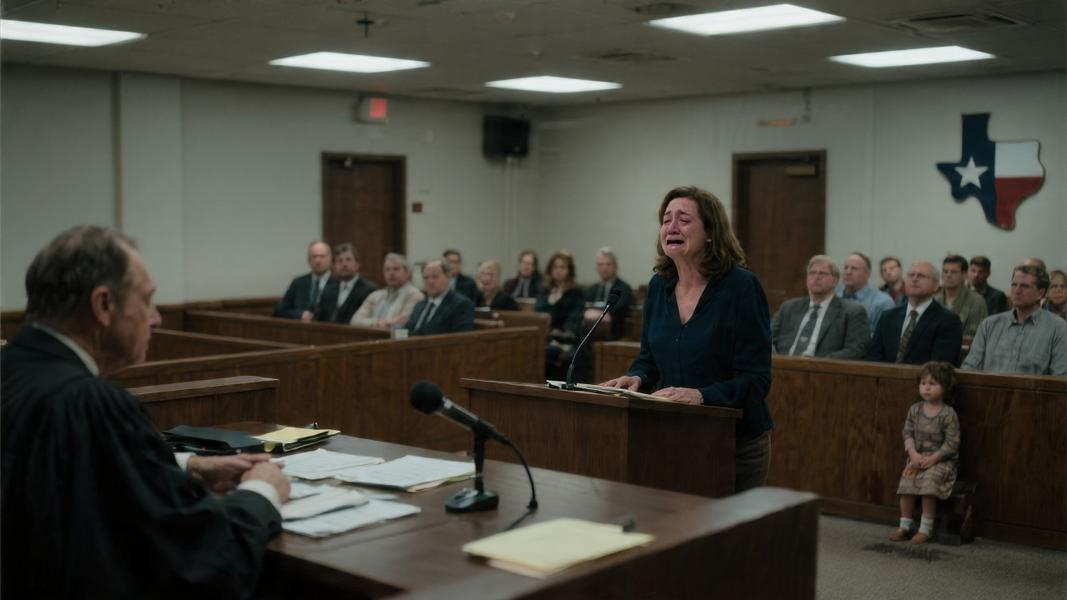
A Texas jury is now deciding whether a FedEx driver who confessed to killing a 7-year-old girl should be executed — and the testimony coming out of that Wise County courtroom has been, by any measure, devastating.
Tanner Horner pleaded guilty to capital murder and kidnapping in the 2022 death of Athena Strand, a child he abducted while delivering a package to her family’s home on November 30, 2022. The guilty plea was never really the question. What the jury must now decide — death or life without parole — has turned the sentencing phase into one of the most emotionally charged proceedings Texas courts have seen in years.
What Happened to Athena
Horner told police he struck Athena with his delivery van, panicked, and then — in what investigators described as a deliberate and prolonged act — attempted to break her neck before strangling her inside the FedEx vehicle. The confession alone was damning. But prosecutors didn’t stop there. Crime lab experts presented DNA evidence, including blood and semen found on Horner’s work clothing and male DNA recovered from Athena’s sexual assault kit. The picture painted for jurors was one of almost incomprehensible brutality.
Medical examiner Dr. Jessica Dwyer testified that Athena died from a combination of blunt force injuries, smothering, and strangulation. She also testified that she believed the child suffered. That word — suffered — seemed to hang over the courtroom like a weight that wouldn’t lift.
A Father’s Grief, Measured in Pounds
Athena’s father, Jacob Strand, took the stand and told jurors what the last two years have done to him. “I lost like 50 pounds,” he said — a simple, almost clinical statement that somehow cut right through to the bone. Grief has a way of doing that. It doesn’t always arrive in grand declarations. Sometimes it arrives in a number on a scale.
The Defense’s Case: Autism and a Troubled Beginning
How do you defend a man who’s already pleaded guilty to capital murder? Carefully, and with a very specific argument. Horner’s attorneys have leaned heavily on his diagnosis of Autism Spectrum Disorder, contending it reduces his moral blameworthiness and effectively negates the traditional purposes of capital punishment — deterrence, retribution, and the like. It’s a legal argument that courts have wrestled with before, though rarely in cases with facts this stark.
Still, the defense also went further back — all the way to before Horner was born. His mother took the stand and described a life shaped by addiction. Heroin was her drug of choice, she admitted, alongside meth and heavy alcohol use. She said she didn’t discover she was pregnant with Tanner until she was eight or nine weeks along. The defense pressed her on how she managed to perform at all during that period. “What did you do to get up courage to go up on the stage?” they asked. “Drink. Drink heavily,” she replied. It wasn’t a defense of Horner’s actions so much as an attempt to explain the environment that produced him — a distinction that may or may not matter to twelve people in a jury box.
The Weight of the Decision Ahead
That’s the catch, isn’t it. Mitigating circumstances are meant to humanize a defendant, to complicate the simple calculus of punishment. But jurors in this case aren’t being asked whether Tanner Horner had a hard life. They’re being asked whether a man who confessed to kidnapping, sexually assaulting, and killing a second-grader should live or die. Those are very different questions.
The prosecution has made no secret of what it wants. The defense is asking for mercy, however uncomfortable that word feels in this context. And somewhere in the middle of all of it is the memory of Athena Strand — seven years old, walking to the door when a van pulled up, never coming home.
The jury’s deliberations will determine whether Horner receives the death penalty or spends the rest of his natural life behind bars. Either way, no verdict will answer the question that lingers longest after a case like this one: how does a family ever find a way to carry something like that forward.
