
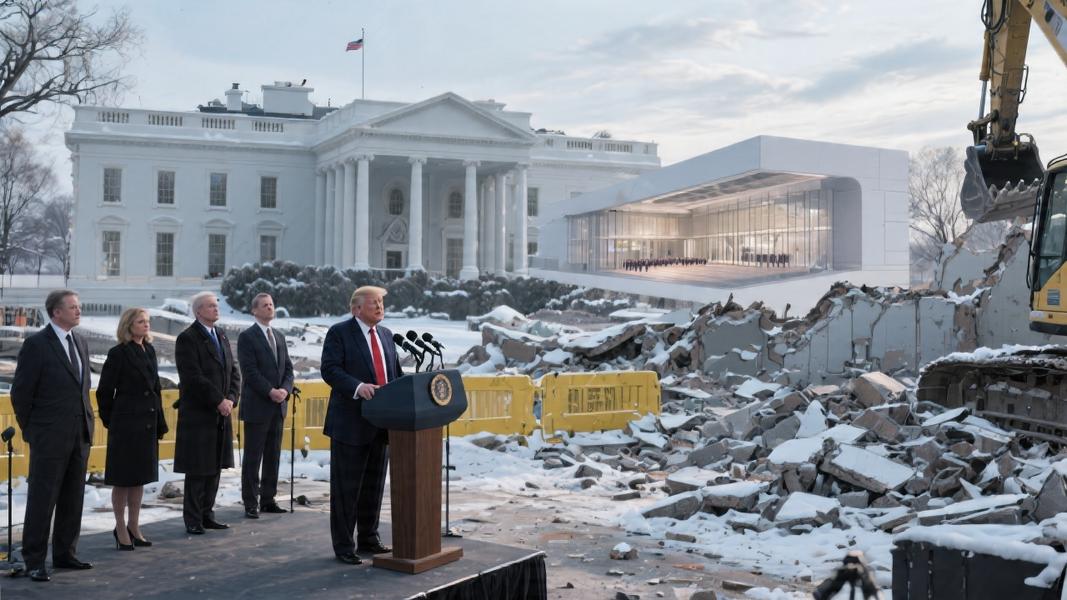
The wrecking crews came for the East Wing in October. Now, in its place, the Trump administration is building something the White House has never had — a ballroom the size of a small airport terminal.
President Donald Trump has ordered the demolition of the 123-year-old East Wing and the historic Jacqueline Kennedy Garden to make way for a 90,000-square-foot State Ballroom — a project that carries a price tag now estimated at $300 to $400 million and is reshaping one of the most symbolically loaded pieces of real estate on earth. Construction began in September 2025, with the original East Wing razed the following month. The White House says it’ll be done before Trump’s term ends in 2029. Not everyone is convinced that’s the only thing worth worrying about.
A Builder in the Oval Office
The announcement came on July 31, 2025, when the White House confirmed the project publicly, naming McCrery Architects, Clark Construction, and AECOM as the firms leading the effort. Funding, the administration insists, is entirely private — with Trump himself contributing $200 million of the total. That’s a remarkable figure, though the final cost has already crept upward since the initial announcement, a trajectory that’s familiar to anyone who’s followed large-scale construction projects.
Trump has been characteristically direct about his reasoning. “I didn’t want to say this,” he said, “but this is why we have to have all of the attributes of what we are planning at the White House. It’s actually a larger room and much more secure. It’s drone-proof. It’s got bulletproof glass. We need the ballroom.” The framing — security, scale, necessity — is vintage Trump, and it’s landed with predictable controversy.
The White House has tried to soften the cultural edges of the project. “President Trump is a builder at heart and has an extraordinary eye for detail,” the administration stated, adding that the president and his team are “fully committed to working with the appropriate organizations to preserving the special history of the White House while building a beautiful ballroom that can be enjoyed by future Administrations and generations of Americans to come.” Whether demolishing a 123-year-old wing counts as preservation is, to put it gently, a matter of debate.
The Numbers Are Hard to Ignore
Ninety thousand square feet. Let that land for a moment. The new structure would be nearly double the size of the main White House building itself, according to reports tracking the project’s scope. It would seat 650 guests — triple the capacity of the East Room, which currently maxes out at around 200. By any architectural measure, this isn’t an addition. It’s a statement.
The new East Wing is designed to stand apart from the main residence while mirroring its neoclassical architecture — a deliberate aesthetic choice meant to signal continuity even as the original structure is gone. Construction noise has reportedly been audible inside the Oval Office during working hours, which is either a minor inconvenience or a striking metaphor, depending on your politics.
Legal Battles and Landmark Concerns
It hasn’t gone unchallenged. Legal efforts to halt the project have so far failed to stop the bulldozers, though courts have allowed construction to continue only until June 2026, leaving the project’s long-term legal footing somewhat uncertain. Preservation groups have raised alarms, and the Society of Architectural Historians has weighed in with pointed concern about the irreversible loss of a structure that predates two world wars.
Still, the project moves forward. That’s the reality on the ground — or rather, beneath it, where foundations for a $400 million ballroom are being poured on land that once held a garden named for a First Lady who spent years fighting to preserve the White House’s historical character. Jackie Kennedy, it’s safe to say, would have had thoughts.
The project is expected to be completed before January 2029 — a deadline that functions as both a construction target and a political one. Whether the ballroom becomes a celebrated addition to the People’s House or a lasting symbol of executive overreach may depend entirely on who’s telling the story. And who’s in office when the ribbon gets cut.
