
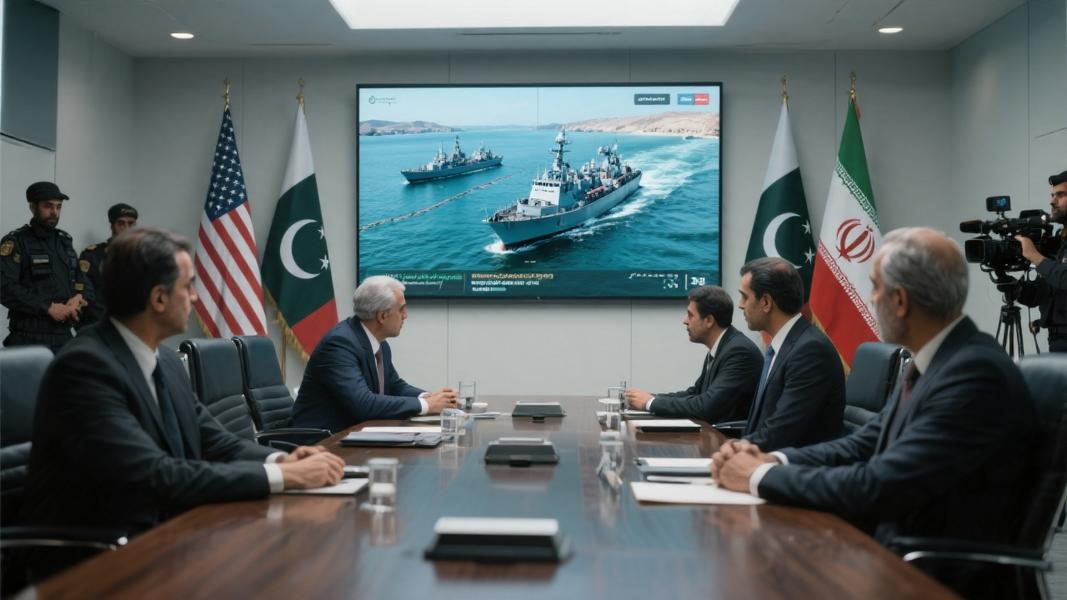
Pakistan thought it had a seat at the table. Then Washington didn’t show up.
Pakistani mediators are scrambling to keep US-Iran peace negotiations alive after President Donald Trump abruptly canceled a planned trip to Islamabad by two of his top envoys — Steve Witkoff and Jared Kushner — leaving diplomats on both sides of the conflict staring at an empty chair. The cancellation has thrown an already fragile back-channel process into fresh uncertainty, raising serious questions about whether a deal to end the war and reopen the Strait of Hormuz is still within reach.
Pakistan Steps Into the Breach
Regional officials say Pakistani mediators are now working overtime to bridge what one described as “significant gaps” between US and Iranian demands — a diplomatic chasm that, frankly, sounds wider with every passing hour. Iran’s position, relayed through Islamabad, is blunt: the US must lift its blockade before any new round of talks can begin. That’s not a starting point. That’s a precondition. And Washington doesn’t appear to be in a particularly generous mood.
Iranian Foreign Minister Abbas Araghchi traveled to Islamabad personally to present Tehran’s terms for a long-term peace arrangement, a notable gesture of engagement that nonetheless failed to move the needle in Washington. Trump, for his part, made his feelings known with characteristic restraint — which is to say, none at all. “If they want to talk, all they have to do is call!!!” he declared, punctuation and all.
Iran’s Offer — and Its Limits
Here’s where it gets complicated. Iran has reportedly submitted a formal proposal through Pakistani intermediaries that would reopen the Strait of Hormuz — one of the world’s most critical oil shipping lanes — while deliberately pushing nuclear negotiations to a later phase. It’s a sequenced approach, essentially asking the US to accept a partial win now and deal with the harder questions down the road. Trump apparently wasn’t buying it. Administration officials signaled that the Iranian proposal fell well short of what the White House considers an acceptable framework.
Iranian President Masoud Pezeshkian drove the point home in a call with Pakistani Prime Minister Shehbaz Sharif, telling him that the US should first remove “operational obstacles, including the blockade,” before Tehran would engage in any substantive new negotiations. That’s a hard line. And it’s one that, at least for now, the Trump administration has shown little appetite to accommodate. Trump himself insisted the US holds “all the cards” in the conflict — which may be true, but holding all the cards doesn’t automatically mean you know when to play them.
Islamabad’s Unenviable Role
So where does that leave Pakistan? Stuck, essentially, in the middle of two governments that can’t agree on what a phone call is worth — let alone a peace deal. Pakistani officials have been working quietly to keep lines of communication open, but mediating between Washington and Tehran has never been a job for the faint-hearted. The cancellation of the Witkoff-Kushner visit was a blow to those efforts — a public signal, whether intentional or not, that the US isn’t ready to sit down at a table Islamabad helped set.
Still, the talks haven’t collapsed entirely. Araghchi’s visit to Pakistan and the submission of Iran’s Hormuz proposal suggest Tehran is at least willing to keep the channel open, even if it’s insisting on its own terms for doing so. Whether that’s genuine diplomatic flexibility or a calculated stall is, depending on who you ask in Washington, very much an open question.
What Comes Next
The Strait of Hormuz remains at the center of everything. About a fifth of the world’s oil passes through it, and its closure — or the threat of its closure — has already rattled energy markets and rattled nerves from Riyadh to Brussels. A deal to reopen it, even a partial one that defers the nuclear question, would carry enormous economic and strategic weight. That’s precisely why the failure to get US envoys to Islamabad feels like more than a scheduling hiccup.
Iran submitted its Hormuz proposal through Pakistan. The US canceled its delegation. And somewhere in between, Pakistani diplomats are trying to hold together a process that neither principal seems fully committed to right now. It’s a lot to ask of a country that isn’t even a party to the conflict.
Trump says Iran just needs to call. Iran says the US needs to act first. And Pakistan, for the moment, is left holding the phone — hoping someone on either end eventually picks up.
