
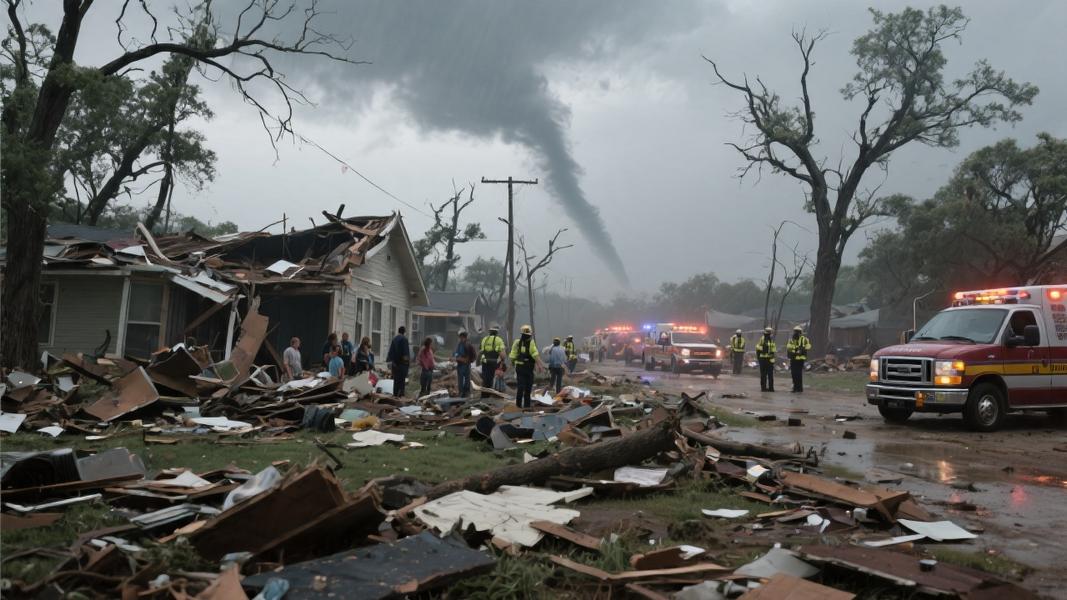
Two people are dead and dozens more are displaced after a violent tornado outbreak tore through North Texas late Saturday night, leaving behind a trail of destroyed homes, blocked roads, and communities scrambling to recover.
The storms struck with little mercy. A slow-moving supercell churned southeast from around Wichita Falls, near the Oklahoma border, passing just west of Fort Worth at approximately 10 p.m. Saturday — catching many residents in the dark, mid-sleep, with no time to do much more than run. Fatalities were reported in the Runaway Bay and Springtown areas, two communities that bore the worst of it.
What the Storms Left Behind
National Weather Service survey teams spent Sunday piecing together the scope of what hit. Their findings weren’t reassuring. An EF-2 tornado with peak winds of 135 mph touched down in the Runaway Bay area of Wise County, while an EF-1 tornado with winds reaching 105 mph was confirmed in the Springtown area of Parker County. That’s two confirmed tornadoes, two counties, and a Saturday night that no one in those communities is going to forget quickly.
At least 20 families have been displaced, with many homes sustaining major structural damage. Some structures weren’t just damaged — they were gone. The kind of destruction that takes years to rebuild, if people even choose to come back.
Getting In Was Half the Battle
How do you help people when you can’t reach them? That was the grim reality facing emergency crews through the night and into Sunday morning. Blocked roadways and downed utility lines made access to the hardest-hit areas genuinely treacherous. “Access has been difficult due to blocked roadways and downed utilities, but crews have continued pushing forward to reach those in need,” an official stated Sunday, offering a frank summary of conditions on the ground.
Widespread power outages compounded the chaos, leaving residents without electricity as crews worked to navigate the debris-strewn landscape. It’s the kind of cascading problem that makes disaster response feel like threading a needle in a blackout.
The Storm’s Path
Meteorologist Patricia Sanchez of the Fort Worth National Weather Service office described the supercell as slow-moving — which, counterintuitively, can make these systems more dangerous. A storm that lingers gives a tornado more time to grind through populated areas rather than passing quickly overhead. This one tracked southeast across a broad swath of North Texas, threading between major population centers while still managing to devastate the smaller communities caught directly in its path.
Still, the death toll — as devastating as any loss of life is — could have been considerably worse given the intensity of the EF-2 and the hour at which it struck. That’s not comfort, exactly. But it’s context.
What Comes Next
Recovery in Wise and Parker counties is just beginning. Families are out of their homes. Roads remain impassable in places. And the full picture of damage is still coming into focus as crews push further into affected neighborhoods. Authorities have not yet released the identities of the two people killed.
For the 20-plus displaced families, Sunday wasn’t a day of answers — it was a day of waiting, of standing in what used to be a neighborhood and trying to figure out what happens now. That question, unfortunately, doesn’t have a quick answer in the aftermath of a 135 mph wind event. It rarely does.
