
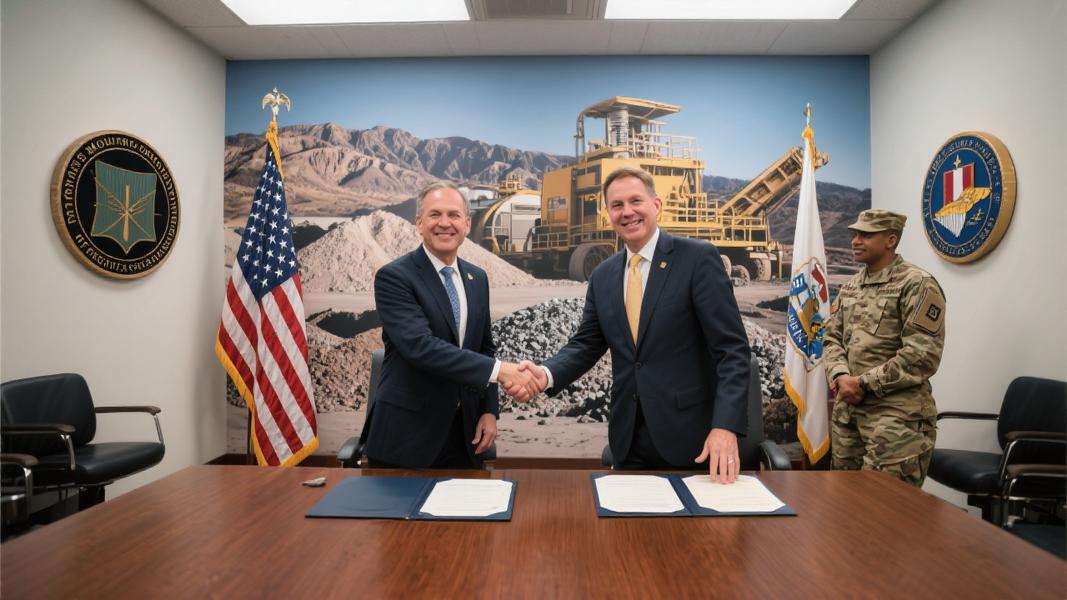
The Pentagon is betting big on rare earth independence with a $150 million loan to MP Materials, marking a significant shift in America’s strategy to break China’s stranglehold on critical minerals essential for defense technologies.
The Department of Defense announced the substantial funding to expand MP Materials’ processing facility at Mountain Pass, California — the only active rare earth mining and processing site in the United States. The investment aims specifically at enhancing the company’s heavy rare earth separation capabilities, a crucial step in creating a complete domestic supply chain from mining to magnets that has long been dominated by Chinese companies.
Breaking China’s Monopoly
“MP Materials will also receive a $150 million loan from DoD to expand their rare earth processing facility,” the Federation of American Scientists noted in their analysis of the partnership. This move comes as national security officials have grown increasingly alarmed by America’s dependence on foreign sources for materials critical to everything from F-35 fighter jets to missile guidance systems.
Why does this matter? The numbers tell a sobering story. China currently controls an overwhelming 92% of rare earth elements processing globally, according to the Bipartisan Policy Center, which highlighted the strategic vulnerability this creates for U.S. defense capabilities. Beyond rare earths, China dominates other critical mineral processing, including 57% of lithium and 77% of cobalt — all essential components in advanced technology.
The deal goes beyond just the loan. The Columbia Center on Global Energy Policy explains that “The DoD will separately extend a $150 million loan to support the expansion of MP’s rare earth separation capabilities at Mountain Pass,” as part of a broader strategy to rebuild domestic capacity.
Long-Term Commitment
This isn’t simply a one-off financial injection. The Pentagon has structured the deal with significant long-term commitments on both sides. The Payne Institute at Colorado School of Mines detailed that the loan comes with a 12-year term and includes profit-sharing arrangements that kick in at certain thresholds.
Perhaps most significantly, the partnership includes a 10-year offtake agreement where the Defense Department commits to purchasing 100% of the output from the new facility. Financial analysts at AInvest reported this arrangement also establishes a price floor for neodymium-praseodymium (NdPr) at $110 per kilogram — providing crucial market stability for MP Materials as it scales operations.
The facility expansion represents a major step toward creating what industry insiders call “mine-to-magnets” capability — the full spectrum of rare earth processing that has been absent from American soil for decades.
National Security Implications
Could America’s technological edge be at risk without this investment? Defense officials have increasingly viewed rare earth dependency as not just an economic issue but a critical national security vulnerability.
The Mountain Pass mine in California has a complicated history. Once the world’s dominant source of rare earths, it closed in 2002 amid environmental concerns and Chinese market dominance. MP Materials reopened the mine in 2017, but until now, most of its output has been shipped to China for processing — creating the very dependency loop the Pentagon seeks to break.
Industry experts note that rebuilding domestic rare earth processing isn’t just about mining more material — it’s about mastering the complex chemical separation processes that transform raw ore into usable elements. These processes require significant technical expertise that largely migrated to China over the past two decades.
The $150 million loan specifically targets this processing gap, with a focus on heavy rare earths — the less abundant but often more valuable elements used in specialized applications like precision-guided weapons and night vision technology.
As global tensions rise and supply chains face increasing scrutiny, this partnership between MP Materials and the Pentagon signals that rare earth elements have moved from obscure periodic table entries to the center of national security planning — with billions in defense technology hanging in the balance.
