
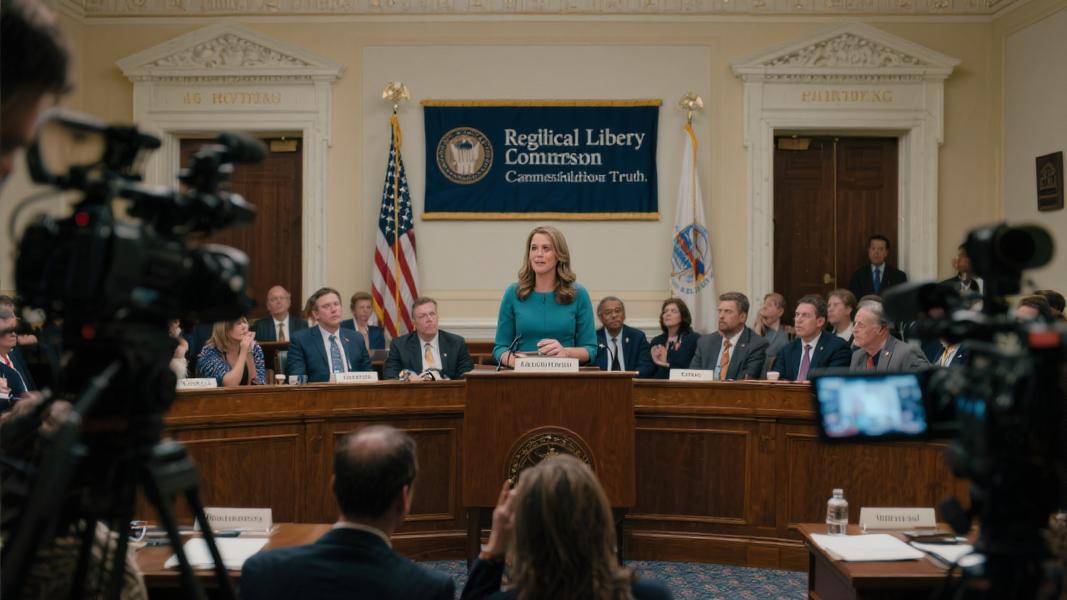
Religious liberty stands at a crossroads in America, with faith leaders, theologians and policymakers engaging in a renewed battle over the boundaries between church and state. Their weapons? Constitutional interpretation, historical precedent, and impassioned rhetoric about the soul of the nation.
The newly formed Religious Liberty Commission held its first hearing on June 16, 2025, bringing together prominent religious voices to address what many conservatives see as an erosion of religious freedom in public life. The commission, established with presidential backing, aims to examine religious liberty issues ranging from prayer in public spaces to government funding for faith-based organizations.
Pastor Paula White, a key figure at the hearing, framed religious liberty as foundational to American identity. “This commission, in part with the President’s guiding, is so that we all in America can reclaim that inheritance our founders gave us,” she stated. “The Declaration of Independence is consistent with the Bible, and the Bible is consistent with the Declaration of Independence.”
White emphasized that the commission’s work extends to all faiths, addressing fundamental questions: “Where can I pray? When can I pray? Who can I pray to? Because this commission is about all faiths.” Her remarks underscored the importance of religious liberty as “the bedrock of our country,” a theme that was echoed throughout the proceedings.
Cultural Battles and Religious Freedom
Bishop Robert Barron, a Catholic intellectual and media figure, painted a more combative picture of religion’s place in modern America. “My own conviction is that we’ve got a very special battle today,” Barron testified. “There’s a texture to the way religion is being attacked in our society—it’s coming from a philosophy that Joseph Ratzinger, Pope Benedict XVI, called the ‘dictatorship of relativism.'”
What exactly does that mean in practical terms? Barron described it as “the culture of self-invention: the complete prioritization given to individual” autonomy over traditional religious values. This philosophical clash, in his view, presents a unique threat to religious communities trying to maintain their traditions and practices.
The bishop reserved particular criticism for a Washington state law that would reportedly require priests to break the seal of confession in certain circumstances—a sacred obligation in Catholic teaching. “It’s the most outrageous violation of the free exercise clause that I can think of,” he warned. “And I don’t think anything will lead Catholics to more open opposition than if that” requirement were enforced.
Faith-Based Solutions to Social Problems
Meanwhile, Dr. Ben Carson, former presidential candidate and neurosurgeon, advocated for increased federal support for faith-based organizations that provide social services. Drawing on scripture, Carson referenced the Book of James: “Pure religion and undefiled before God and the father as to visit the fatherless and the widows, and to keep himself unspotted from the world.”
Carson suggested that religious organizations have proven track records in addressing social ills. “I think when we look at all these various things that we’ve been talking about, it’s the proof is in the pudding,” he said, arguing that faith-based programs build civic virtue and transform lives in ways government agencies alone cannot.
The commission’s formation reflects growing tensions between religious conservatives who feel marginalized in an increasingly secular society and progressives concerned about religious exemptions to civil rights protections. These tensions have flared in recent Supreme Court cases involving everything from healthcare mandates to anti-discrimination laws affecting LGBTQ+ individuals.
As the Religious Liberty Commission continues its work, one question looms large: can a pluralistic democracy accommodate deeply held religious convictions while ensuring equal protection under law for all citizens? The answer may determine not just the legal boundaries of religious expression, but the character of American public life for generations to come.
