
Texas finds itself caught between two housing crises at once: a severe shortage of affordable homes for its poorest residents, and a market shifting dramatically for everyone else as inventories surge to levels not seen since the 2008 financial crisis.
Governor Greg Abbott recently signed a trio of bills aimed at tackling these issues, but experts question whether these measures will be enough to address what has become one of the state’s most pressing challenges. The legislation aims to boost housing density and ease development restrictions at a time when the gap between housing need and availability continues to widen across the Lone Star State.
Affordable Housing Crisis Deepens
For Texas’s lowest-income residents, the numbers are stark. The state now ranks among the bottom five in the nation for affordable housing availability, with only 25 affordable rental homes available for every 100 extremely low-income households.
“In Texas, that number falls to 25 such homes available to extremely low income households, or 1 available home for every 4 households in need, putting our state in the bottom five states in the country,” according to Texas Housers, a nonprofit focused on housing justice.
The situation is even worse in major metropolitan areas. Dallas, Houston, and Austin have become three of the five poorest performing metro areas nationwide, with just 14, 16, and 16 affordable homes available per 100 extremely low-income households, respectively.
Market Shifts Underway
Meanwhile, the broader Texas housing market appears to be undergoing a significant transformation. After years of breakneck price growth that saw median home values jump 40% between 2019 and 2023, the market has begun to cool. Active listings surged by 30.7% in early 2025 compared to the previous year, while prices have essentially flattened, growing just 0.3% to a statewide median of $331,000.
Christy Gessler, Chairman of Texas REALTORS®, noted, “Buyers had more opportunities and a little more breathing room to consider their options in the first months of this year compared to last year. But prices and sales did not shift much in either direction in most Texas markets.”
Is this the beginning of a buyer’s market? Some indicators suggest it might be. Texas A&M University’s Real Estate Research Center found that home sales declined by 1.8% in the first quarter of 2025, while inventory levels reached their highest point since the 2007-08 financial crisis. Perhaps most tellingly, sellers are now cutting prices at rates not seen since 2011.
“High inventory and slow sales have motivated sellers to slash prices at record rates to attract buyers,” the research center reported, pointing to persistently high mortgage rates near 7% as a key factor dampening demand.
A Shortage Years in the Making
Despite the recent surge in inventory, Texas still faces a fundamental housing shortage. The state lacks an estimated 306,000 homes, according to analysis from Up for Growth, a national housing research organization.
The affordability crisis has been building for years. Even as Texas has led the nation in issuing new building permits, construction hasn’t kept pace with the state’s explosive population growth. When combined with mortgage rates that hit a 23-year high of 7.79% in October 2023, homeownership has become increasingly out of reach for many Texans, particularly low- and middle-income families.
Legislative Response
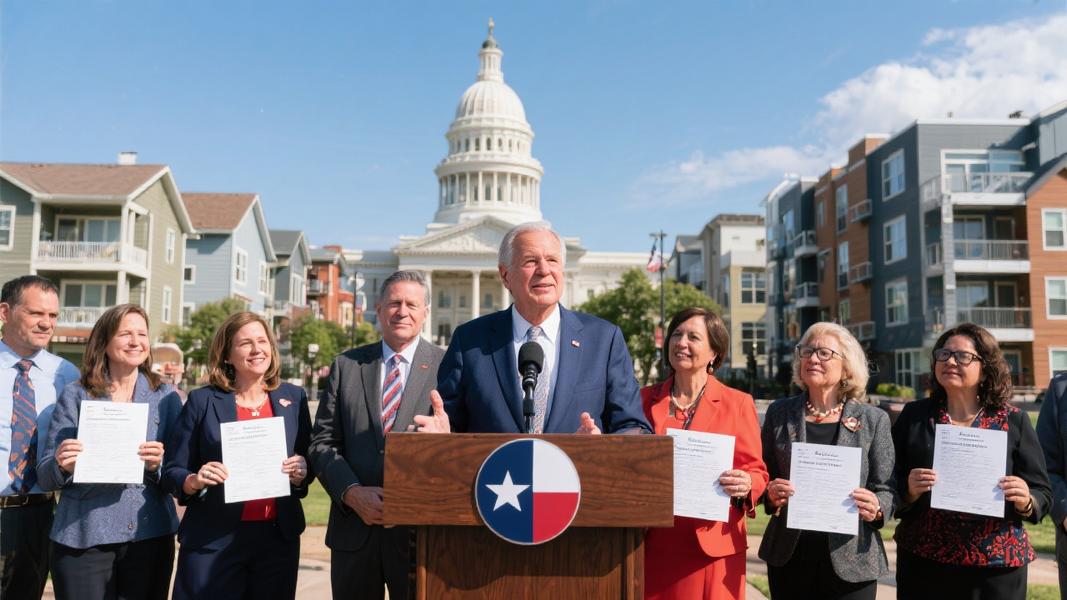
Governor Abbott’s recently signed housing package attempts to address these challenges by tackling zoning restrictions that limit housing density. “Housing affordability is one of the key issues on the minds of Texans today,” Abbott said at the signing ceremony. “Thankfully, we have taken large steps to make the American dream of affording a home a reality.”
The package includes three bills with distinct approaches to increasing housing supply:
Senate Bill 15 prohibits cities from requiring unreasonably large lot sizes on unplatted tracts exceeding five acres, potentially enabling denser development. For smaller lots, it restricts municipalities from imposing certain requirements related to setbacks, parking spaces, ceiling height, and building bulk that might otherwise limit housing density.
Senate Bill 840 takes aim at commercial zones, permitting mixed-use and multifamily developments in areas currently zoned for office, retail, or warehouse uses. The bill also prohibits cities from adopting certain fees and requirements that could create barriers to housing development.
Perhaps most controversially, House Bill 24 reforms what critics have called the “tyrant’s veto” — a petition process that has historically made it difficult to approve zoning changes. The reform aims to make it easier to approve zoning changes that allow for more residential development, potentially increasing supply, density, and affordability.
Will It Be Enough?
Housing advocates have generally welcomed these measures but question whether they’ll be sufficient to address the scale of Texas’s housing crisis. The reforms primarily focus on increasing supply through market-based mechanisms, with less direct attention to the severe shortage of affordable housing for the state’s lowest-income residents.
That said, increasing overall housing supply could help moderate price growth across the market. But for extremely low-income households, who remain four times more numerous than the affordable homes available to them, more targeted interventions may be necessary.
As the Texas housing market continues its transition in 2025, one thing remains clear: the path to housing affordability will require sustained attention from policymakers, developers, and communities across the state. For many Texans still struggling to find an affordable place to call home, the recent legislative changes represent just one step in what promises to be a much longer journey.
