
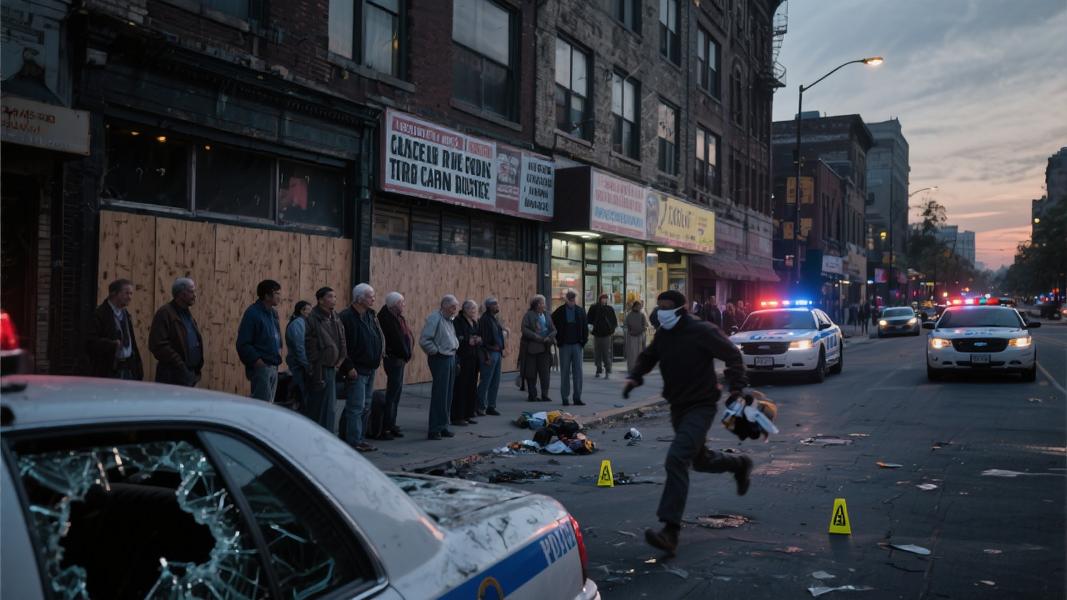
Chicago’s crime crisis has reached a grim milestone, marking the city’s 13th consecutive year with the highest number of murders in America. With a murder rate of 21.5 per 100,000 residents in 2024 — nearly five times higher than New York City — the Windy City’s violence has become a flashpoint in national debates over public safety and potential federal intervention.
The shocking statistics tell only part of the story. Chicago’s murder rate towers over other major metropolitan areas, tripling Los Angeles’s rate and making it America’s murder capital for cities with populations over one million for seven straight years. More troubling still, only 16.2% of the nearly 148,000 crimes reported since January have resulted in arrests.
A City Awash in Illegal Guns
The flood of illegal firearms compounds Chicago’s violence problem. Authorities recover more illegal guns in Chicago than in New York City and Los Angeles combined, with estimates suggesting half a million unlicensed weapons circulate throughout the city. This arsenal fuels a cycle of violence that residents experience firsthand.
“You have seniors that have been shot. Where’s the outcry?” said one resident following a shooting near a senior living facility. “We need to have a police car out here and detail because we don’t know if this will happen again,” they told the Chicago Sun-Times.
The crime wave isn’t limited to gun violence. Motor vehicle thefts have more than doubled since 2021, according to police data. One woman, whose car was vandalized seven times in a single year, expressed her frustration: “I was taking my daughter to school, and I noticed that my window was busted. This is not okay,” she said.
Residents Feel Abandoned
How bad has it gotten? Some Chicagoans have drastically altered their daily routines in response to the violence.
“We have a rule — on weekends, we don’t walk here. If we to West Loop or whatever, we’ll Uber, then we’ll Uber home,” one downtown resident explained after a shooting near a movie theater. Others describe a city transformed. “It was very peaceful. Now it seems more dangerous to walk around the neighborhood,” a small business owner lamented, noting that burglaries and robberies “were not happening a few years ago.”
Many residents blame city leadership for the deteriorating situation. A pub owner who was robbed didn’t mince words: “You hardly see a police car in the neighborhood. It just seems like crime is really out of control right now… Mayor Johnson is more worried about his school board and his pension stuff that he’s working on right now. He should be worried more about the neighborhoods in Chicago,” he stated in a widely shared social media post.
Even local officials acknowledge the severity of the situation. “We certainly have a crime problem in Chicago,” one alderman admitted. Another resident put it more bluntly: “There’s no control. There’s no law and order,” they declared.
Data Discrepancies Raise Questions
Adding to the controversy are apparent inconsistencies in crime reporting. The FBI tallied 499 homicides in Chicago for 2023, while the Chicago Police Department’s own records showed 617 — a discrepancy of 116 murders. Such gaps have fueled skepticism about whether the full extent of Chicago’s crime crisis is being accurately represented.
That said, there are some signs of improvement. Shootings and homicides were down more than 30% in the first half of 2025 compared to the same period last year, with overall violent crime also dropping. City officials have pointed to these statistics as evidence that local policies are beginning to work.
Federal Intervention Looms
The crisis has now escalated to a standoff between federal and state authorities. Reports indicate the Pentagon is planning a military deployment to Chicago, a move Illinois Governor J.B. Pritzker strongly opposes. The governor has accused President Trump of “attempting to manufacture a crisis.”
“The safety of the people of Illinois is always my top priority. There is no emergency that warrants the President of the United States federalizing the @IL_Natl_Guard, deploying the National Guard from other states, or sending active duty military within our own borders,” Pritzker insisted.
The frustration among residents, however, continues to simmer. One downtown Chicago resident, speaking about teen-related violence, captured the disconnect many feel with city leadership: “I don’t think [Mayor Johnson] really listened to our concerns. He doesn’t understand. He needs to come and be in the midst of one of these ‘teen takeovers,’ and then maybe he’ll understand how dangerous it is for everyone,” they told local media.
As federal and local authorities clash over solutions, Chicago residents find themselves caught in the middle — their neighborhoods transformed by a crisis that statistics only partially capture. “I’m shocked and I’m disappointed at the same time,” said one longtime resident after witnessing multiple store lootings, “because this neighborhood used to be a very good neighborhood.”
