
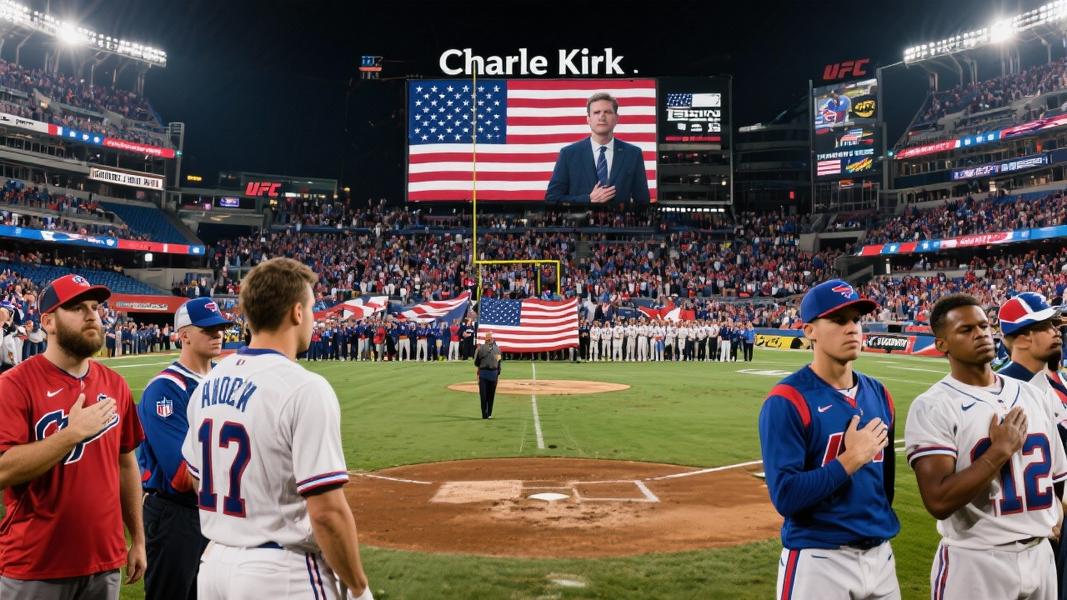
A somber nation mourns the violent death of political activist Charlie Kirk, who was fatally shot while addressing a crowd at Utah Valley University last week, in what authorities are describing as a targeted assassination that has sent shockwaves through America’s political landscape.
Kirk, 31, was speaking to approximately 3,000 people on September 10, 2025, as part of his American Comeback Tour when a single shot fired from a rooftop struck him in the neck. The footage from the event shows Kirk collapsing mid-sentence while ironically discussing mass shootings in America. Despite being rushed to a nearby hospital, he was pronounced dead shortly after arrival.
A Manhunt Ends
Following a two-day search, authorities arrested 22-year-old Tyler James Robinson on September 12. Robinson is currently believed to be the only suspect involved in what has quickly become one of the most significant acts of political violence in recent American history. In a bizarre twist, investigators discovered that bullets recovered from the scene were inscribed with internet memes, adding a disturbing layer to questions about the shooter’s motives.
The shot came from approximately 91 meters away, though some reports suggest the distance may have been as far as 200 meters, highlighting the premeditated nature of the attack. “Kirk was actually being asked by students about mass shootings in America in that moment before he was struck in the neck and collapsed on stage,” said one witness at the scene.
National Mourning
President Donald Trump, a longtime ally of Kirk, announced his death on social media with palpable emotion. “No one understood or had the heart of the youth in the United States of America better than Charlie,” Trump wrote. “He was loved and admired by all, especially me, and now he is no longer with us.”
The day after the shooting, Kirk’s casket was transported aboard Air Force Two from Salt Lake City to Phoenix, accompanied by Vice President JD Vance, Second Lady Usha Vance, and Kirk’s widow, Erika. A memorial service is scheduled for September 21 at State Farm Stadium in Glendale, Arizona, with thousands expected to attend.
Unprecedented Sports Tributes
Just how deeply has Kirk’s death affected American culture? Look no further than the extraordinary response from the sports world. In an unprecedented show of respect, multiple major sports organizations across the country have held moments of silence and special tributes.
NFL franchises including the Green Bay Packers, Dallas Cowboys, Miami Dolphins, and Kansas City Chiefs all paused to honor Kirk’s memory during weekend games. The Pittsburgh Steelers, Tennessee Titans, and Arizona Cardinals similarly held moments of silence, according to White House documents acknowledging the tributes.
The tributes extended well beyond football. In baseball, both the Chicago Cubs and New York Yankees paid respects to Kirk during their games. College football programs weren’t far behind, with the LSU Tigers, South Carolina Gamecocks, and Wyoming Cowboys all participating in commemorations. Even NASCAR and UFC events featured moments of remembrance, highlighting Kirk’s broad influence across American sports and culture.
The White House formally recognized these tributes, stating, “From coast to coast, sports teams and organizations paused this week to commemorate the legacy of Charlie Kirk. The White House recognizes these profound tributes that celebrate Kirk’s enduring legacy as a champion for faith and patriotism and honor the remarkable impact he had on millions of Americans.”
A Nation Divided, United in Shock
While Kirk was a polarizing figure in American politics, the manner of his death has drawn condemnation from across the political spectrum. The assassination marks another disturbing escalation in what many see as an increasingly volatile political climate in America.
As the investigation continues and the nation prepares for Kirk’s memorial service, questions linger about the implications of this tragedy for political discourse in America. In a country already struggling with deep divisions, the killing of a prominent political figure—regardless of ideology—represents a crossing of boundaries that many had hoped would remain inviolable in American democracy.
