
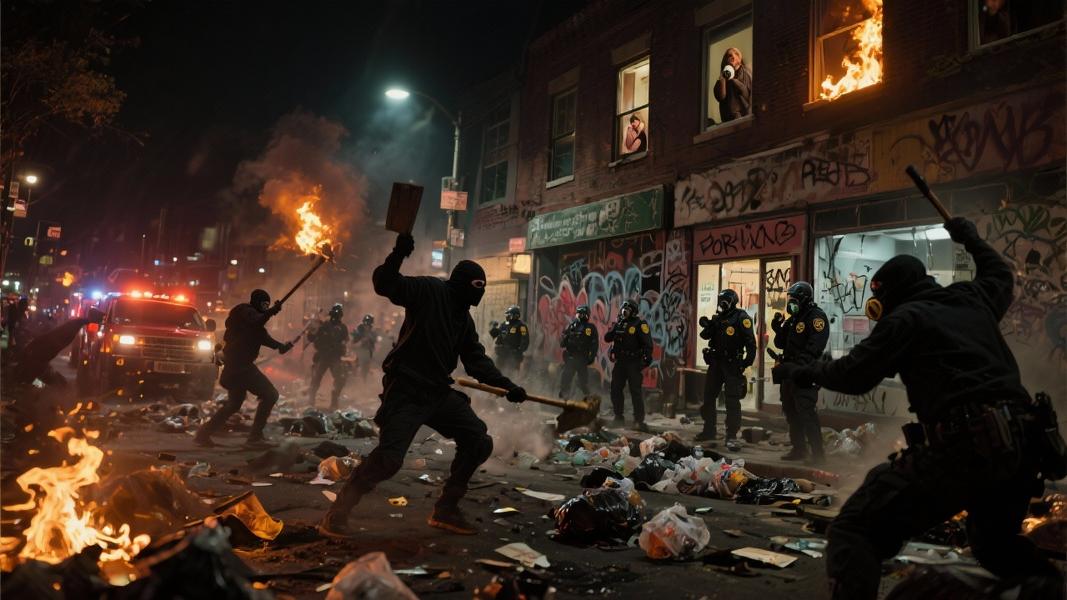
Portland’s long-simmering unrest has boiled over again as federal authorities face ongoing clashes with protesters at an Immigration and Customs Enforcement facility, triggering renewed national debate over the city’s public safety situation and the federal response.
A City Divided: Scenes from South Portland
For months, confrontations have escalated around the ICE field office in south Portland, with authorities reporting dozens of arrests amid scenes of demonstrators using improvised weapons and federal officers responding with crowd control measures. The White House has characterized the situation as a “siege,” claiming protesters have “violently breached the facility by using a stop sign as a battering ram, hurled explosives and projectiles, burned American flags,” and even “rolled out a guillotine.”
The unrest has left some residents feeling caught in the crossfire. “It’s like a war zone. There are times I’ve had to have a gas mask on inside my own home,” said one resident who lives near the ICE facility, who expressed support for National Guard deployment. “The city is failing us and I don’t want to feel like I’m collateral damage — and my rights matter, too.”
Local businesses report feeling the impact as well. “Yesterday morning, I was broken into again for the tenth time,” a downtown Portland business owner told reporters. “We need help here and something needs to be done, so if [the National Guard] is what we need to do to get our leaders paying attention to what’s happening in Portland, then I think it’s a good thing. We’ve been struggling for a long time — since 2020.”
Federal Response and Political Fallout
President Donald Trump’s administration has taken a hard line against the protests. In September, Trump described Portland as “war ravaged” and federal facilities as “under siege from attack by Antifa, and other domestic terrorists” when announcing the deployment of federal troops to the city.
Court battles have ensued over the legality of federal deployment, with state officials challenging the president’s authority to send in troops without local request or consent. Meanwhile, law enforcement agencies have confirmed that 128 people have been arrested in connection with the protests as of early October.
The current tensions follow a complex history of political demonstrations in Portland. The White House has pointed to previous incidents, including the “100 days of carnage and violence” in 2020 when protesters “rioted, looted, burned buildings, bludgeoned officers, deployed power tools and commercial-grade fireworks as weapons, and attempted to destroy a local courthouse.”
One of the most serious incidents of Portland’s protest history occurred in August 2020, when a self-identified anti-fascist shot and killed a member of the right-wing Patriot Prayer group during a demonstration, as documented by researchers tracking political violence.
Crime Statistics Tell a Nuanced Story
Is Portland truly a city in crisis? The data presents a mixed picture.
According to the Portland Police Bureau’s Strategic Services Division, overall crime in the city has actually decreased slightly—by 1%—in 2025 compared to the previous year. Some violent crimes have fallen significantly, with homicides down 39%, human trafficking offenses reduced by 26%, and vehicular manslaughters dropping by 75%, as reported by Time.
That said, certain categories of crime have seen concerning increases. Kidnappings and abductions have risen by approximately 50%, arsons have increased by 25%, and perhaps most dramatically, drug offenses have surged by 226%.
Fact-checkers have noted that some viral social media claims about Portland’s current state may be exaggerated or misleading. While law enforcement has indeed made numerous arrests outside the ICE facility in recent months, some widely shared images and videos are from previous years’ protests but incorrectly presented as current, according to PolitiFact.
A City’s Uncertain Future
For Portland residents, the reality on the ground often feels more complex than either political narrative suggests. While some neighborhoods remain largely unaffected by protests, others—particularly those near federal facilities—report significant disruptions to daily life.
Business owners in affected areas describe a compounding effect: years of pandemic recovery challenges, followed by periodic protest activity, creating a perception problem that has been difficult to overcome even as some crime statistics improve.
As federal troops maintain their presence and court challenges continue, Portland finds itself once again at the center of a national debate about protest, policing, and the proper boundaries of federal intervention—with no clear resolution in sight.
