
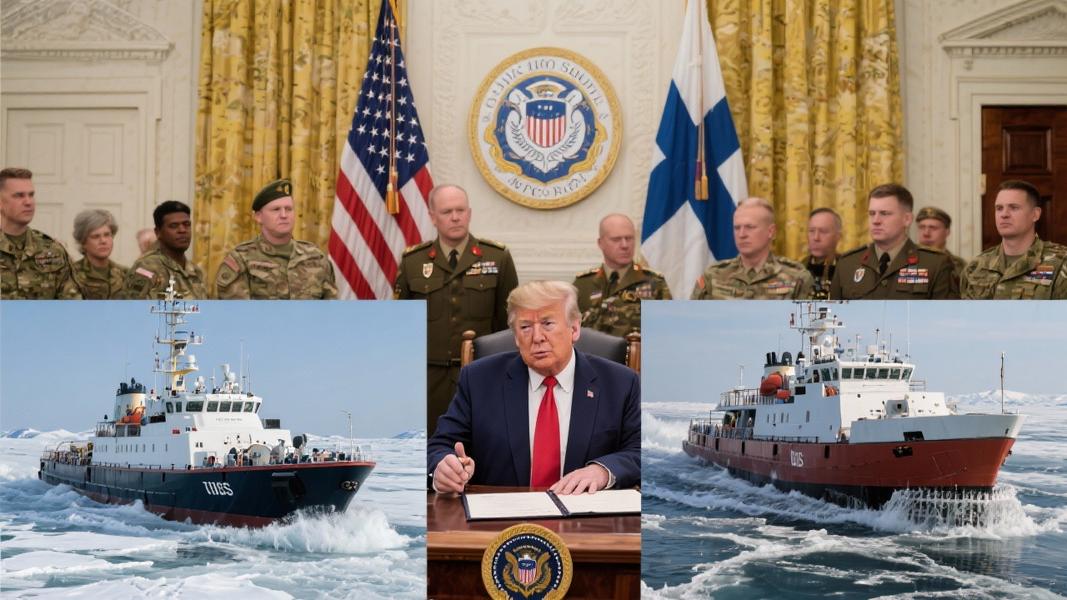
In a bold move to strengthen America’s Arctic presence, the United States has struck a $6.1 billion deal with Finland to acquire 11 icebreaking vessels, addressing critical gaps in U.S. maritime capabilities as competition for Arctic resources intensifies.
The agreement, announced this week, will see four Arctic Security Cutters constructed in Finland, while the remaining seven will be built stateside with Finnish technical expertise. The unprecedented collaboration comes as America’s aging icebreaker fleet has dwindled to just two operational vessels — one dating back to 1976.
A Cold War Heats Up
“What you’re doing is you’re going to be teaching us about the icebreaker business,” President Trump said during the announcement ceremony. “We need these ships very badly because we have a lot of territory… It’s going to be a great partnership,” he emphasized.
The deal represents a significant shift in U.S. procurement strategy. For the first time, a Presidential Memorandum has authorized the construction of military vessels on foreign soil — a testament to the urgency of bolstering Arctic defense capabilities as Russia and China expand their presence in the region.
Finnish President Alexander Stubb expressed pride in his country’s role, noting that “The US administration has negotiated directly with companies. I’m proud that Finnish arctic expertise is appreciated and trusted. The cooperation benefits both countries, Finland and the United States,” he stated.
Breaking the Ice (and Tradition)
Why Finland? The Nordic nation has established itself as a global leader in icebreaker design and construction, with decades of expertise navigating frozen waters. Finnish shipyards have produced some of the most advanced ice-capable vessels currently in operation worldwide.
The $6.1 billion investment isn’t just about ships. It’s about securing America’s strategic interests in a rapidly changing Arctic landscape where receding ice has opened new shipping routes and access to vast natural resources. Russia currently operates more than 40 icebreakers, while China has declared itself a “near-Arctic state” despite having no Arctic territory.
According to the White House memorandum, the decision to procure vessels abroad stems from “urgent national security needs” that couldn’t wait for domestic shipyards to develop the specialized capabilities from scratch.
The seven vessels to be constructed in the United States will involve Davie Defense and Bollinger Shipyards, creating hundreds of high-skilled jobs across multiple states. This knowledge transfer component is crucial, as it aims to rebuild America’s icebreaker construction capabilities for the long term.
Economic Ripple Effects
Beyond national security implications, the deal is expected to generate significant economic benefits. The $6.1 billion program will create jobs on both sides of the Atlantic and bring substantial new investments to the U.S. shipbuilding industry, which has struggled to maintain capacity for specialized vessel construction.
Maritime analysts note that the agreement represents more than just a purchase — it’s a strategic realignment that acknowledges America’s need to rapidly close the “icebreaker gap” with competitors.
The first Finnish-built vessel is expected to be delivered within three years, with the remainder following on a staggered schedule through 2035. Each Arctic Security Cutter will be capable of breaking through ice up to six feet thick and sustaining operations in temperatures as low as -40 degrees Fahrenheit.
That capability matters more than ever. As climate change transforms the Arctic landscape, the region has become a focal point for great power competition, with Russia revitalizing Soviet-era military bases and China investing heavily in Arctic research and infrastructure.
For America’s Coast Guard personnel who currently operate the aging Polar Star — commissioned during the Ford administration — the new cutters can’t come soon enough. The 46-year-old vessel requires millions in maintenance annually and has experienced numerous critical failures during recent deployments.
As the ice recedes and geopolitical temperatures rise in the High North, America’s new Finnish connection may prove to be the partnership that helps it navigate increasingly contested waters.
