
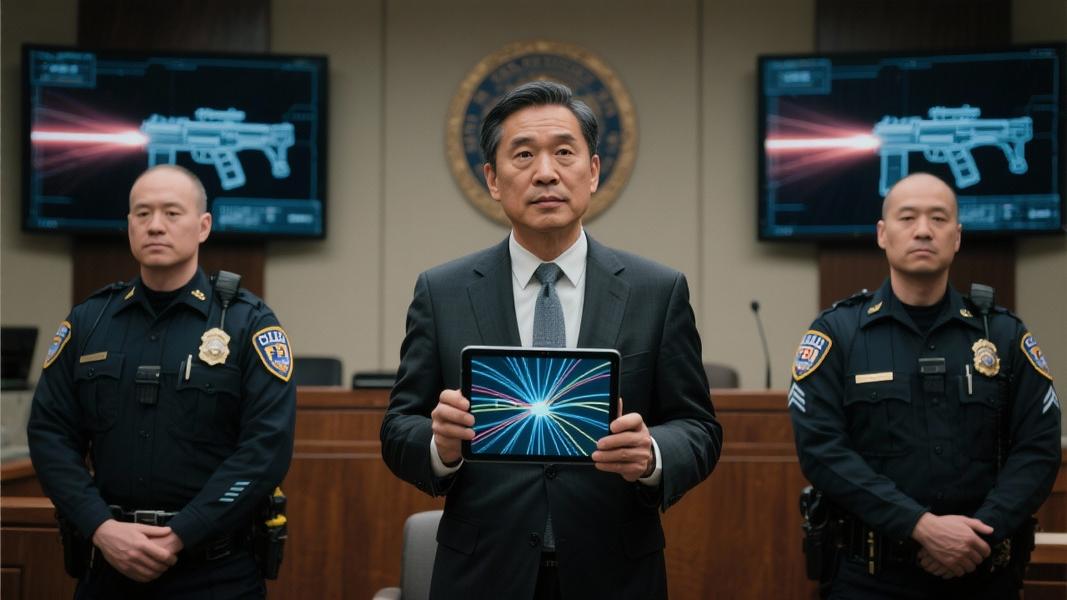
A fiber laser expert with decades of experience has been found guilty of stealing sensitive defense technology, raising fresh concerns about intellectual property theft with national security implications.
Ji Wang, 63, of Painted Post, NY, was convicted by a federal jury on multiple counts including economic espionage and theft of trade secrets for pilfering research related to high-powered fiber lasers from his employer, Corning Incorporated, where he had worked since 1998. The stolen technology was part of a classified defense project with potential military applications, including laser weapons systems designed to neutralize drones and missiles, according to documents released by the Department of Justice.
Defense Technology with Battlefield Implications
The case centers around an ambitious $11.4 million research initiative funded by the Defense Advanced Research Projects Agency (DARPA). Wang served as lead scientist on this five-year project, which aimed to dramatically enhance fiber laser capabilities — potentially increasing their power by more than 1,000 times. Such technology could revolutionize military defense systems by enabling more effective laser weapons to intercept aerial threats, investigators noted in court documents.
“Yesterday, a federal jury found Wang guilty of stealing sensitive defense research from his employer and attempting to use it to pursue personal profit at the expense our national security,” said Assistant Attorney General for National Security John A. Eisenberg following the verdict.
What exactly did Wang steal? According to prosecutors, on July 1, 2016, the scientist absconded with hundreds of files containing non-public data and proprietary manufacturing techniques from the DARPA project. The stolen information would have enabled him to fabricate specialty optical fibers, particularly those used in high-powered laser systems with military applications. The theft occurred while Wang was actively negotiating with Chinese government entities about starting a specialty fiber business in his native country, a fact prosecutors emphasized during the trial.
China’s Thousand Talents Connection
Just two months after the data theft, Wang was selected to receive China’s Thousand Talents Plan Award — a program that has come under intense scrutiny from U.S. officials who view it as a vehicle for technology transfer. The initiative provides substantial financial incentives to Chinese-born scientists working abroad to return to China with their expertise and, in some cases, proprietary technology.
The scientist’s intentions appeared clear in business plans submitted to Chinese government entities between 2014 and 2017. These documents, discovered during the investigation, explicitly touted military applications of the technology, including how specialty fibers “can also be installed on military vehicles” such as tanks. In one particularly revealing statement, Wang claimed that such technology could “be key to deciding victory or defeat” on the battlefield.
Is this case an isolated incident or part of a broader pattern? U.S. intelligence agencies have repeatedly warned about organized efforts to target American research institutions and private companies developing technologies with dual civilian and military applications. Wang’s conviction comes amid heightened tensions between the United States and China over technology transfer and intellectual property issues.
Legal Consequences and Timing
The conviction carries serious penalties. Economic espionage charges alone bring a maximum sentence of 15 years in prison, while theft of trade secrets can result in up to 10 years behind bars. Wang’s sentencing has been scheduled for April 15, 2026, before U.S. District Judge Frank P. Geraci, Jr.
Fortunately for national security concerns, law enforcement disrupted Wang’s business efforts before he could fully exploit the stolen technology. The investigation, conducted jointly by FBI Special Agents and Department of Commerce Office of Export Enforcement Special Agents, appears to have caught Wang before any significant transfer of the technology could take place.
“This conviction makes clear that the FBI and our partners will continue to hold accountable anyone looking to steal U.S. innovation for our enemies,” an FBI spokesperson stated following the verdict.
The case highlights the ongoing challenges in protecting sensitive defense research in an era of global scientific collaboration. As authorities celebrate this conviction, the broader question remains: how many similar cases might go undetected until it’s too late?
