
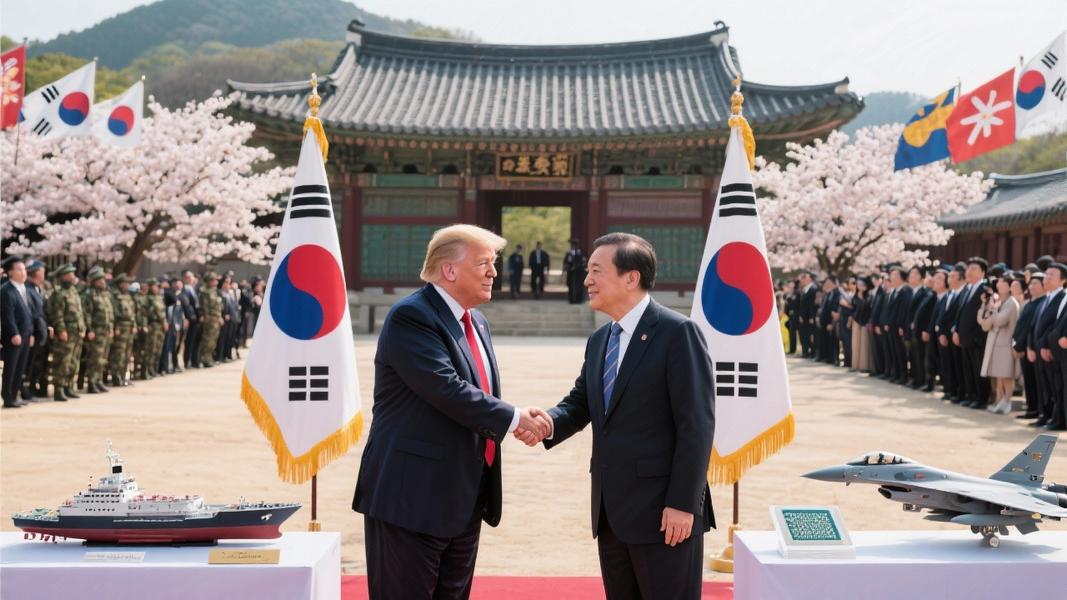
President Trump clinched a major trade victory with South Korea on Tuesday, securing a deal that slashes tariffs on Korean auto imports while netting hundreds of billions in promised investments for American industries.
The agreement, announced on October 29, 2025, following Trump’s meeting with South Korean President Lee Jae Myung at the APEC Summit in Seoul, reduces U.S. tariffs on South Korean automobiles from 25 percent to 15 percent — a concession that comes with substantial Korean commitments to American manufacturing and defense sectors.
A $350 Billion Handshake
What’s in it for America? Quite a lot, apparently. South Korea has pledged to invest a staggering $350 billion in critical U.S. industries, according to details published by trade analysts tracking the negotiations.
President Lee’s chief of staff provided specifics on the investment structure: $200 billion will flow into various sectors in annual installments of up to $20 billion, while another $150 billion is earmarked specifically for America’s shipbuilding industry, as confirmed by multiple sources familiar with the agreement.
The deal wasn’t just about direct investments. Korean Air simultaneously announced a massive purchase of 103 Boeing aircraft valued at $36.2 billion — timing that few observers considered coincidental.
Summit Diplomacy
Trump’s appearance at the APEC Summit marked his first major international engagement of his second term. After arriving in South Korea, the president delivered a keynote address at the APEC CEO Summit luncheon where he emphasized his administration’s focus on “reciprocal trade” — a theme that’s become central to his economic policy.
Behind the smiles and handshakes, analysts note the deal reflects the complex reality of U.S.-Korean relations. South Korea gains breathing room for its vital auto sector while Trump secures concrete investment commitments he can tout as a win back home.
Will the promised billions actually materialize? That’s the question economic observers are asking, pointing to the extended timeframe for the investments and the history of similar announcements that have sometimes fallen short of initial projections.
Still, the immediate political victory is clear for both leaders. President Lee demonstrated his ability to negotiate with Trump — no small feat given the American president’s reputation for driving hard bargains — while Trump can point to concrete numbers backing his claim that he’s bringing manufacturing investment back to American shores.
For American workers in shipbuilding and manufacturing sectors, the deal potentially signals years of increased investment and job creation, though the full impact remains to be seen as the investment unfolds over the coming decade.
