
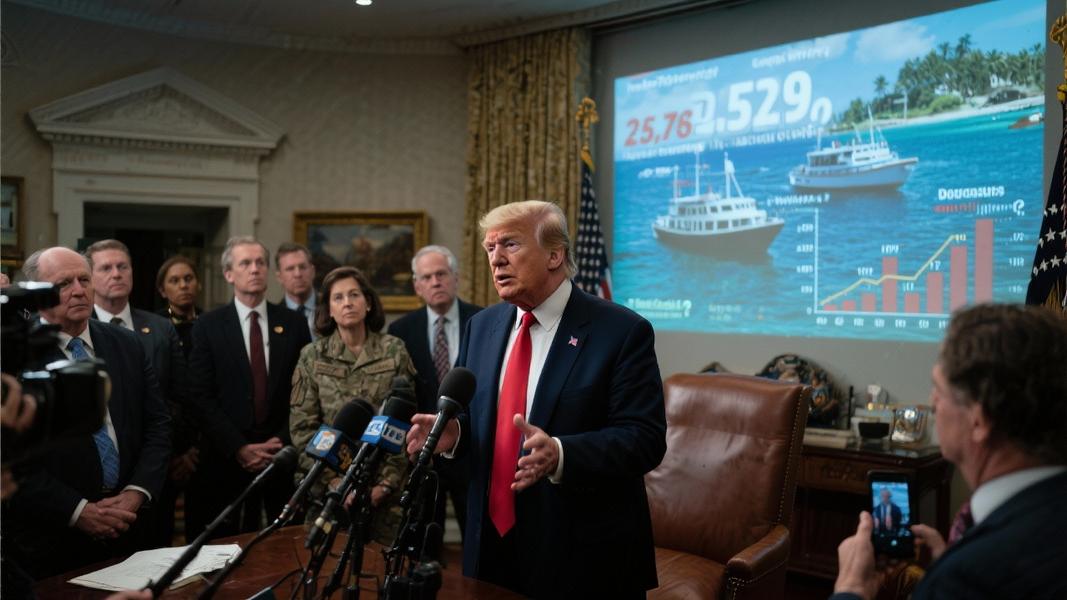
President Donald Trump’s repeated claim that each U.S. military strike on drug-smuggling boats saves exactly 25,000 American lives has been met with widespread skepticism from public health experts who say the math simply doesn’t add up.
“Every boat we knock out, we save 25,000 American lives,” Trump has declared multiple times, suggesting that these maritime interdiction operations are preventing hundreds of thousands of overdose deaths across the country.
But is there any evidence to back this precise figure? Not according to experts who have analyzed the claim.
“The statement that each of the administration’s strikes on alleged drug-smuggling boats saves 25,000 lives is absurd,” one expert told the Associated Press. “The evidence is similar to that of the moon being made of blue cheese. If you look carefully, you will see a resemblance. However, a close analysis of this claim suggests that it lacks all credibility.”
Numbers Don’t Add Up
Perhaps the most glaring problem with Trump’s assertion is that it doesn’t align with actual overdose statistics. CDC data shows that drug overdose deaths in the U.S. have actually declined in recent years, with about 97,000 deaths recorded in the 12-month period ending June 30, 2025, and 53,336 in 2024.
Do the math, and Trump’s claim quickly falls apart. If each boat strike saves 25,000 lives, just a handful of successful operations would theoretically prevent more deaths than actually occur annually in the entire country.
Public health researchers have pointed out that “there’s no empirically sound way to say a single strike ‘saves 25,000 lives,’ even if the statement is interpreted more broadly to mean preventing substance use disorders and resulting ripple effects.”
Why? Because there’s no verifiable cargo data, no published models linking individual interdictions to mortality rates, and drug markets are notoriously adaptive to disruptions.
The White House Response
When pressed for evidence supporting the 25,000 lives claim, the administration doubled down. White House spokesperson Anna Kelly stated, “President Trump is right — any boat bringing deadly poison to our shores has the potential to kill 25,000 Americans or more. The President is prepared to use every element of American power to stop drugs from flooding in to our country and to bring those responsible for justice.”
That statement, however, shifts from claiming lives “saved” to potential lives “at risk” — and still provides no source for the specific number.
Drug policy experts note that even successful interdictions rarely make a lasting dent in supply. “It’s incredibly naive to think that reducing the supply in one place will eradicate the problem because it’s such a massive business,” one researcher explained.
The wrong target? Further complicating Trump’s narrative is the fact that most fentanyl — which accounts for the majority of U.S. overdose deaths — isn’t even transported by sea. It primarily enters the United States overland from Mexico, making the relevance of Caribbean and Pacific boat strikes to the opioid crisis questionable at best.
While interdiction efforts remain an important component of comprehensive drug control strategy, the administration’s specific claims about lives saved per boat appear to be more political messaging than public health reality — a neat, round number that makes for a compelling soundbite but crumbles under scrutiny.
