
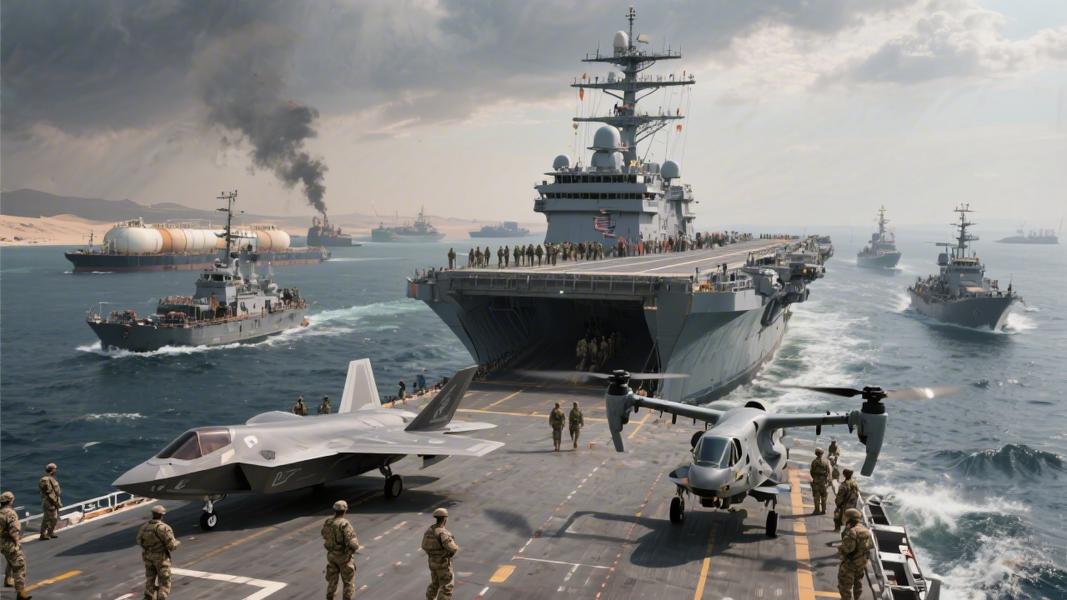
The Pentagon is sending thousands of Marines and one of the Navy’s most capable warships to the Middle East — and the clock, at least according to President Trump, is already ticking.
Defense Secretary Pete Hegseth has approved the deployment of the USS Tripoli, an America-class amphibious assault ship, along with roughly 2,500 Marines from the 31st Marine Expeditionary Unit, to the region. The move, confirmed by a senior U.S. official, comes in direct response to a U.S. Central Command request to expand available options for military action and counter Iranian threats to maritime traffic in the Strait of Hormuz — a chokepoint through which a significant share of the world’s oil supply flows every single day.
A Formidable Force Headed Into an Increasingly Hot Theater
The USS Tripoli isn’t just any warship. It’s the most updated of the amphibious vessels known as a “big deck,” built with enhanced capacity for F-35 Stealth Fighter Jets, Ospreys, and other aircraft, described by CBS News as a significant step up in firepower and flexibility compared to its predecessors. The ship serves as flagship for the Tripoli Amphibious Ready Group, which also includes two amphibious transport docks — the USS New Orleans and the USS San Diego.
Until recently, the Tripoli had been operating in the Philippine Sea, participating in the three-week Iron Fist exercise off Japan. Now it’s pivoting hard toward one of the most volatile flashpoints on the planet. The deployment will introduce thousands of Marines, multiple warships, and F-35 fighter aircraft to a region where U.S. military infrastructure is already under fire — literally, noted Stars and Stripes.
Troops Already Bleeding on the Ground
Here’s the part that puts the deployment in sharp relief. At least 10 U.S. troops were injured — two of them seriously — when Iran fired six ballistic missiles and 29 drones at Saudi Arabia’s Prince Sultan air base. That’s not a skirmish. That’s a direct strike on American personnel, and it underscores just how quickly this conflict has escalated beyond diplomatic posturing.
The wider U.S. military campaign, branded Operation Epic Fury, began on February 28. As of late March, more than 11,000 targets have been struck, according to a CENTCOM fact sheet cited by CBS News. Eleven thousand. That number is staggering, and it suggests a pace of operations that shows no sign of slowing down anytime soon.
Ground Troops? Officially, No. But Don’t Rule It Out.
Secretary of State Marco Rubio tried to thread a careful needle on Friday, saying the United States can meet its objectives “without any ground troops.” Still, he was notably careful not to slam the door entirely. Trump, Rubio said, “has to be prepared for multiple contingencies,” and American forces are being positioned to give the president “maximum optionality” — a phrase that, in diplomatic-speak, means exactly what it sounds like. Options are open. The Marines aboard the Tripoli are, by design, prepared to execute ground missions if directed.
That’s the catch. You don’t send an amphibious assault ship loaded with F-35s and 2,500 Marines to a region just to float around. The Marine Expeditionary Unit is a rapid-reaction force built for exactly the kinds of “contingencies” Rubio was careful to mention.
The Houthis Enter the Picture
As if the situation needed another layer of complexity — it got one. On Saturday, Iranian-backed Houthi rebels announced they had entered the month-old war by claiming a missile launch toward Israel. Israel said it intercepted the missile, reported CBS News. Whether that represents a one-off provocation or the beginning of sustained Houthi involvement remains unclear. Given recent history in the region, betting on the former seems unwise.
Meanwhile, President Trump has set a hard deadline: Iran has until April 6 to reopen the Strait of Hormuz. Iran, for its part, says it hasn’t engaged in any negotiations whatsoever. Two sides, two very different versions of where things stand — and a deployment of this scale suggesting Washington isn’t waiting around to find out who’s telling the truth.
April 6 is close. The USS Tripoli is already moving. And whatever comes next, the United States has made sure it won’t be caught short on options.
