
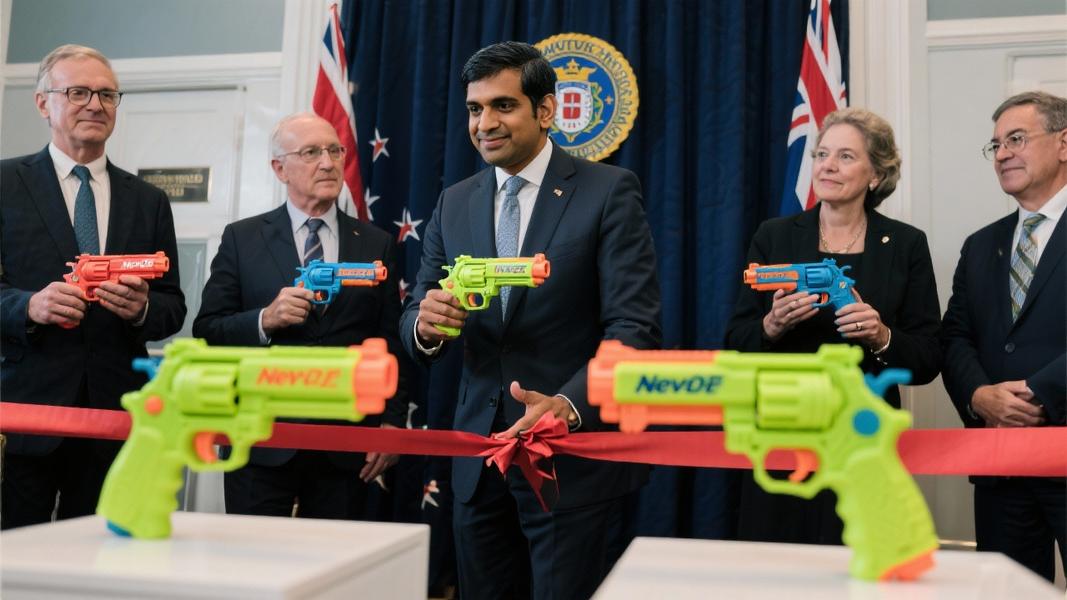
FBI Director Kash Patel’s diplomatic visit to New Zealand last July came with unexpected baggage: five illegal 3D-printed replica guns. The plastic revolvers, gifted to senior New Zealand officials during the opening of the FBI’s first standalone Wellington office, violated the country’s strict firearms laws — creating an awkward diplomatic incident for the very agency tasked with upholding the law.
The gifts, modeled after the toy-inspired “Maverick PG22” design, were presented to five of New Zealand’s highest-ranking security officials, including Police Commissioner Andrew Coster and Police Minister Mark Mitchell. All five officials have since surrendered the items after learning they were illegal to possess under New Zealand law, according to documents obtained through public records requests.
From Toy Design to Potential Weapon
What makes the gifts particularly problematic? The Maverick PG22 is a popular design in the 3D-printing community that mimics a brightly colored Nerf toy gun, but it’s frequently seized by New Zealand authorities despite its toy-like appearance. Under New Zealand law, even inoperable weapons are treated as functional if they can be modified to fire ammunition.
Police armory team leader Daniel Millar explained in documents that converting these replica revolvers into functioning firearms would be alarmingly simple. “These processes are very straight forward processes and require minimal skills and common ‘handyperson’ tools,” Millar wrote. He added that these tools were “a battery drill and a drill bit for the holes and a small screw for the firing pin” — items available in most home workshops.
The five officials who received the controversial gifts included Police Commissioner Andrew Coster, NZSIS Director-General Andrew Hampton, GCSB Director-General Andrew Clark, Police Minister Mark Mitchell, and Defense Minister Judith Collins. After learning of the legal issues, all five voluntarily surrendered the replicas to authorities.
Diplomatic Sensitivity
How serious was this breach? Serious enough that all five guns were destroyed on September 25, 2025. Even a request from the police commissioner to keep one specimen for testing purposes was denied.
New Zealand Police have refused to release photos of the controversial gifts, citing potential diplomatic fallout. In their response to information requests, officials stated that releasing images would be “likely to prejudice New Zealand’s relations with the United States of America” — a rare public acknowledgment of the sensitive nature of the incident.
The timing couldn’t be more awkward. Patel had traveled to Wellington specifically to open the FBI’s first standalone office in New Zealand, a move meant to strengthen law enforcement cooperation between the two countries. Instead, the visit has highlighted stark differences in how the two nations approach firearms regulation.
Safety and Security Concerns
Professor Alexander Gillespie, a firearms regulation expert at New Zealand’s University of Waikato, warned of multiple dangers posed by such items. “The first risk is that it can be made viable and it gets into the hands of the wrong person and it’s used for a crime,” he explained. “The second risk is it just explodes because it’s not actually safe. There’s a reason these have been made in people’s backyards instead of coming from an armory.”
New Zealand has maintained particularly stringent gun control laws since the 2019 Christchurch mosque shootings that killed 51 people. Unlike the United States, gun ownership in New Zealand is considered a privilege rather than a right, and the country has taken an especially firm stance against 3D-printed weapons, which can evade metal detectors and lack serial numbers.
The FBI has not publicly commented on the incident. That said, the episode underscores the challenges of navigating international relations when cultural attitudes and legal frameworks around firearms differ so dramatically — even between close allies with shared intelligence interests.
In a final ironic twist, the illegal gifts were destroyed less than three months after being presented — a reminder that even the world’s premier law enforcement agency occasionally needs a refresher on international firearms laws.
