
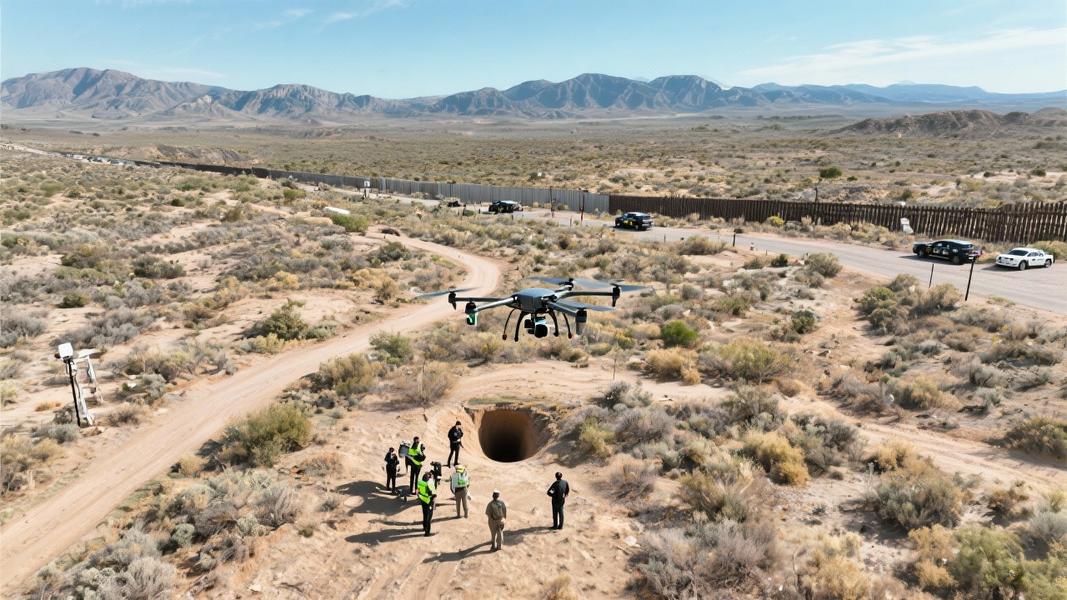
Texas officials are taking the fight against cartel smuggling operations underground — literally. The Texas General Land Office has launched a new initiative to detect and disrupt tunnel networks beneath state-managed lands along the southern border, deploying drones and advanced surveillance technology in what could become a new front in the state’s ongoing border security efforts.
Land Commissioner Dawn Buckingham directed the GLO to identify vulnerable properties along the Texas-Mexico border, with particular focus on Hudspeth County and other high-risk areas where cartel tunnels may exist. Field personnel will use aerial and drone technology to search for signs of underground activity during routine inspections, the agency announced this week.
“Texas stands on the front lines of America’s fight for border security,” Buckingham said in a statement. “The cartels are constantly adapting, moving from the skies and waterways to underground networks of tunnels, and we will not cede an inch of land to these violent illegal criminals. The safety and sovereignty of our state are non-negotiable.”
Underground Threat Emerges
The initiative follows the January discovery of a sophisticated tunnel in El Paso extending from Ciudad Juárez, Mexico. Federal agents found a 36-by-36-inch opening leading to a tunnel roughly six feet high and four feet wide, complete with wooden beam reinforcements, ventilation systems, and lighting — infrastructure suggesting significant cartel investment and engineering. The discovery prompted heightened concern among state officials about similar underground passages.
Why the sudden focus on what’s happening below the surface? As border security has tightened above ground, law enforcement officials believe cartels are increasingly turning to subterranean methods to smuggle drugs, weapons, and people.
The state’s efforts will complement a broader federal initiative. The Department of Homeland Security has expanded its Persistent Surveillance and Detection System specifically to enhance tunnel detection capabilities along high-risk areas of the Southwest border. This system, backed by a $100 million federal investment managed by Customs and Border Protection, is scheduled to begin deployment on November 10, 2025, and is expected to be completed by 2026, according to reports.
Coordinated Response
The GLO’s tunnel detection initiative represents just one component of a multi-pronged approach to border security under Buckingham’s leadership. Since taking office, she has overseen several significant border security projects, including the acquisition of a 1,402-acre ranch in Starr County earmarked for border wall construction.
In 2023, Buckingham declared Fronton Island, a 170-acre island in Starr County, to be state land. Following this declaration, the Texas Department of Public Safety and Texas Military Department cleared vegetation from the area through an operation dubbed “Flat Top,” which officials say dramatically reduced crime in what had been a border hotspot.
The federal response has intensified as well. Under the Trump administration, Mexican cartels have been designated as foreign terrorist organizations, granting federal authorities expanded powers to conduct law enforcement and intelligence operations against these groups.
“Together with President Trump’s Administration, DHS, CBP, and Governor Abbott’s Operation Lone Star, Texas will continue to lead the fight against illegal crossings—above ground and below it,” Buckingham stated.
Technology at the Forefront
How exactly do you find tunnels hidden beneath miles of rugged borderland? The answer lies in increasingly sophisticated detection technology.
The GLO’s approach will rely heavily on drone surveillance and aerial monitoring of state-managed lands, particularly focusing on sparsely populated regions like Hudspeth County east of El Paso where tunneling activity might go unnoticed. Meanwhile, the federal government’s $100 million investment aims to deploy advanced sensors and monitoring systems capable of detecting subsurface disturbances that might indicate tunnel construction.
Contractors are currently being sought to help implement the new technology along the Texas-Mexico border, with the project expected to significantly enhance detection capabilities by 2026. The system will likely combine ground-penetrating radar, seismic sensors, and other technologies designed to identify underground anomalies.
“Texans overwhelmingly expect action—and that’s exactly what they’re getting,” Buckingham concluded in her statement, emphasizing the GLO’s commitment to border security.
As cartels continue to adapt their smuggling methods, the battle for border security increasingly resembles a high-tech game of cat and mouse—one that now extends from the air to deep beneath the Texas soil.
