
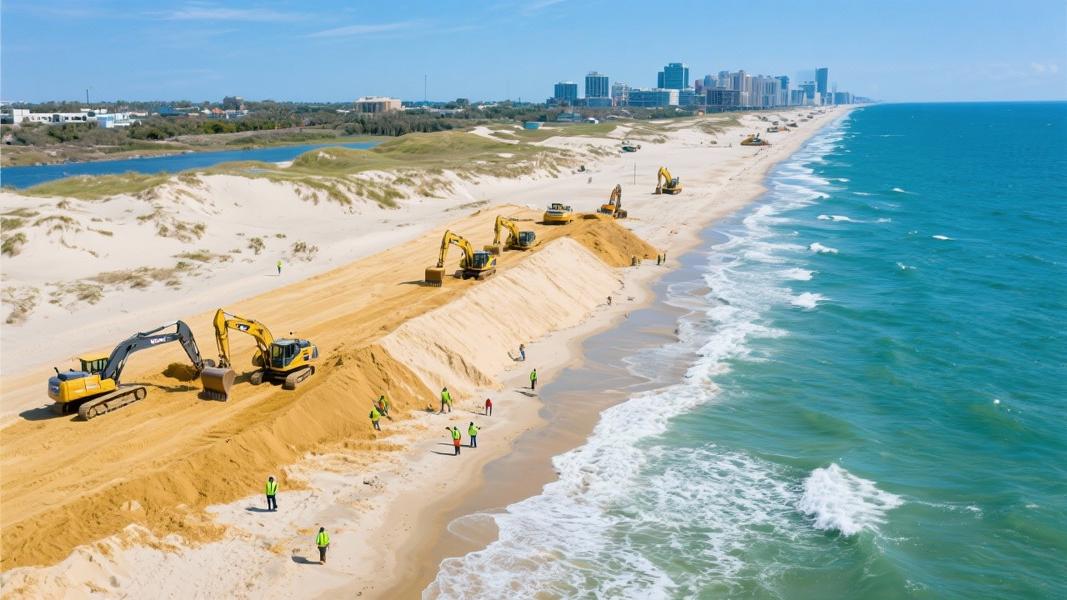
The coastline of Galveston Island is getting a much-needed reinforcement as officials report that more than 93,000 cubic yards of sand have already been added to its western beaches — with much more on the way.
Texas Land Commissioner Dawn Buckingham announced that the CAP 204 West Galveston Beach Nourishment Project has successfully placed 93,308 cubic yards of beach-quality sand along 1,000 linear feet of West Galveston Beach as of November 18, 2025. The project aims to combat severe erosion that’s been eating away at the island’s shoreline at a rate of nearly 7 feet annually.
“Galveston Island was my home for more than a decade. Preserving its beautiful shorelines is a mission that is dear to my heart and essential for the future of the island’s vibrant coastal community,” Buckingham stated in the announcement.
What exactly does 93,000 cubic yards of sand look like? Imagine roughly 9,300 dump trucks full of sand — and that’s just the beginning. The complete project will ultimately deliver an estimated 717,000 cubic yards of dredge material along approximately 9,500 linear feet of beachfront on the west end of the island, according to project details from the Texas General Land Office.
From Ship Channel to Shoreline
The beach nourishment initiative is a collaboration between the U.S. Army Corps of Engineers (USACE) Galveston District, the Texas General Land Office, and the City of Galveston. In an interesting twist of environmental efficiency, the sand being used would otherwise have been discarded offshore — it’s being sourced directly from maintenance dredging of the Galveston Ship Channel, as USACE confirmed.
The project has been moving at a relatively brisk pace through bureaucratic channels. USACE announced the initiative in July 2025, conducted a feasibility study, and by June 2025, the City of Galveston had signed a contract allowing USACE to oversee construction through Great Lakes Dredge and Dock Company.
“These beach nourishment projects are a very standard USACE practice for slowing down the natural process of erosion along beachfront and coastal areas. They’re also a great way for local communities to benefit from the work we’re already doing through routine maintenance,” a USACE spokesperson explained.
By late October 2025, the project had entered the mobilization phase. “The west end beach nourishment project is now in the mobilization and setup phase! Equipment and pipelines are currently being installed along the beach with sand placement scheduled to begin this Friday!” officials announced in an update on October 22.
Access Changes and Restoration Goals
Local beachgoers have had to adapt to some temporary changes. Beach Access Point 10, known as Hershey Beach, remains closed through the end of 2025. To compensate, the City opened 300 feet of vehicular access at Beach Access Point 13 (Pocket Park 3).
The stretch targeted for restoration runs from Sunbather Lane to 11 Mile Road — nearly two miles of coastline that’s been particularly vulnerable to the elements. “This initiative is crucial for safeguarding our coastline, residences, and infrastructure,” according to a statement published by The Galveston organization.
This isn’t Galveston’s first experience with large-scale beach nourishment. A previous project completed in March 2017 cost approximately $18,670,000 and provided nourished beach along nearly 4 miles of shoreline using over 1 million cubic yards of sand, as documented by HDR, an engineering firm involved in the earlier effort.
Can sand placement alone solve Galveston’s erosion problems? While beach nourishment projects like this one are considered effective temporary measures, they require ongoing commitment. The current project represents just one step in the island’s long-term coastal management strategy.
With active construction having begun in September and sand placement continuing through the end of the year, residents and visitors to Galveston’s west end will soon be enjoying wider, more resilient beaches — at least until nature inevitably begins its slow reclamation once again.
