
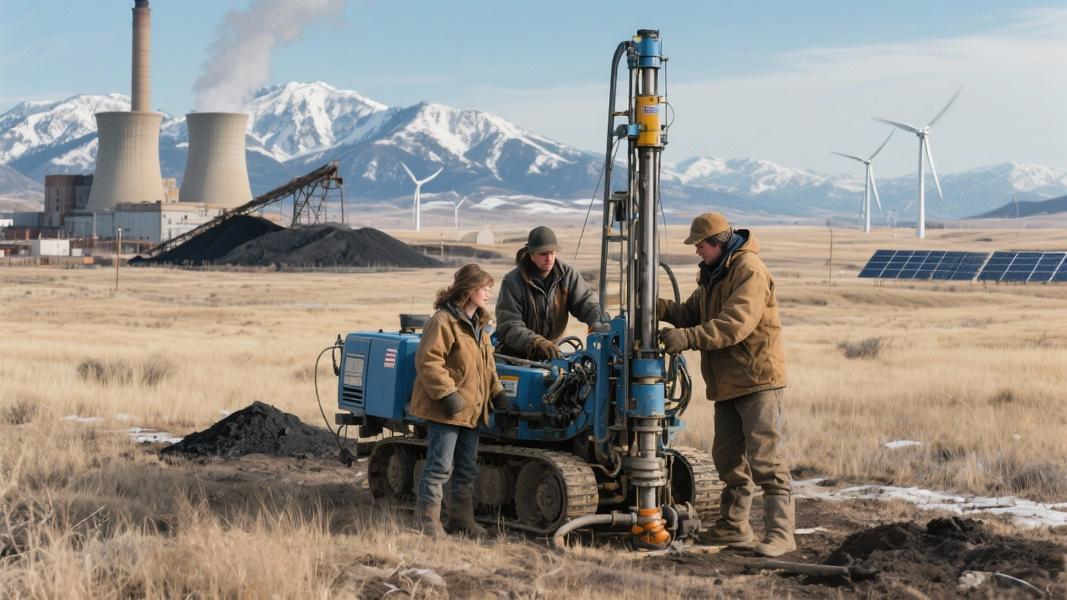
The last coal train from Colowyo mine will rumble out sometime this year, marking another milestone in what many now see as the inevitable end of Colorado’s once-mighty coal industry.
After powering Colorado’s homes and economy for generations, coal production has collapsed to barely a quarter of what it was two decades ago. The state’s remaining coal-fired plants are scheduled to close or convert by 2031, while renewable energy rapidly expands its footprint across the mountainous landscape where coal was once king.
“The era of coal in Colorado appears to be ending, and that poses serious challenges to the workers and communities that rely on it,” according to a report from Colorado’s Office of Just Transition, which was established to help coal-dependent communities navigate this seismic shift.
A Shadow of Its Former Self
The numbers tell a stark story. Coal mining employment has dwindled to about 1,150 jobs statewide. Production is expected to fall to approximately 10 million tons in 2025 — a dramatic decline from the 40 million tons extracted in 2004.
“The reality is Colorado’s coal industry is a shadow of what it once was because the industry has mined the most economic reserves already and now costs are simply too high to maintain nearly any viable mining,” energy analysts noted in a recent assessment.
Tri-State Generation and Transmission Association, a major electricity provider in Colorado, has announced plans to end operations at the Colowyo mine by the end of 2025. The mine has been a primary supplier for Craig Station, where Unit 1 will close in December, with Units 2 and 3 scheduled for shutdown in 2028, the company confirmed.
What’s driving this decline? Economics, primarily. Coal power was 28% more expensive in 2024 than in 2021, costing American consumers an additional $6.2 billion, according to a June analysis from Energy Innovation cited by the Associated Press.
Renewables Rising
Meanwhile, renewable energy has surged past coal in Colorado’s energy portfolio. Wind and solar now provide more than 40% of the state’s power and are projected to exceed 70% by decade’s end, according to utility plans reviewed by industry experts.
Coal’s share of electricity generation has correspondingly fallen from more than half of Colorado’s needs to less than one-third. The state’s six remaining coal-fired plants are all slated for closure or conversion to natural gas by 2031.
The West Elk mine near Somerset remains Colorado’s largest active coal operation, but even it faces declining output and increasing environmental scrutiny. “For many years, the West Elk mine was actually one of the largest emitters of methane gases in Colorado,” environmental advocates have pointed out.
Communities in Crisis
In places like Craig, Colorado, the impending closures represent more than just an economic challenge — they’re an existential threat to a way of life.
“You have a whole community who has always been told you are an energy town, you’re a coal town. When that starts going away, beyond just the individuals that are having the identity crisis, you have an entire culture, an entire community that is also having that same crisis,” one transition specialist explained.
Schools and local governments are bracing for significant revenue losses as coal operations wind down. The shuttering of mines and power plants means the disappearance of well-paying jobs that have supported families for generations.
Can these communities reinvent themselves? Some are trying. Families and workers are transitioning to new industries, including geothermal energy development and craft distilling. “People have to start looking beyond coal. And that can be a multitude of things. Our economy has been so focused on coal and coal-fired power plants. And we need the diversity,” one community leader remarked.
Political Promises vs. Market Reality
Some coal workers and industry advocates remain hopeful that federal intervention could revive their industry. President Trump has attempted to boost coal through executive orders, regulatory relief, and financial incentives.
“President Donald Trump has boosted coal as part of his agenda to promote fossil fuels. He’s trying to save a declining industry with executive orders, large sales of coal from public lands, regulatory relief and offers of hundreds of millions of dollars to restore coal plants,” according to federal energy policy observers.
Yet market forces appear to be overwhelming political promises. The economics of coal extraction in Colorado — where the most accessible reserves have already been mined — make it increasingly difficult for the industry to compete with cheaper alternatives.
For communities that have defined themselves by coal for over a century, the transition represents not just an economic challenge but a profound identity crisis. As one mine closes and another power plant converts, Colorado’s energy landscape is being redrawn — leaving coal towns to either reinvent themselves or face a diminished future.
