
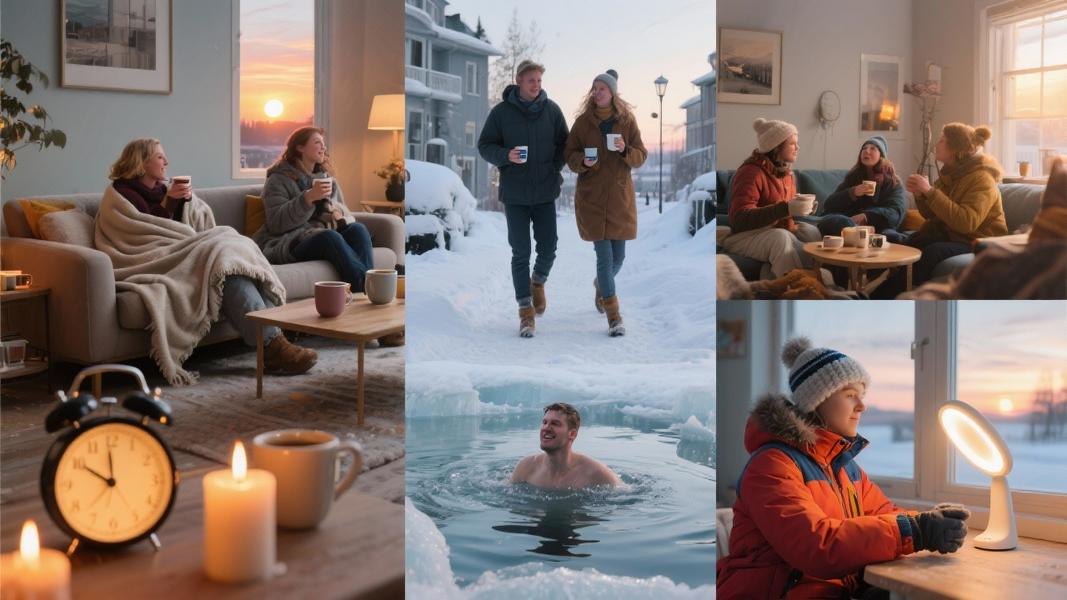
The dark, endless Nordic winter is setting in, and with it comes a familiar foe for millions: seasonal depression. But the people who brave the Arctic’s darkest months have centuries of wisdom for keeping the winter blues at bay — and science is backing up their methods.
In places like Finland and Sweden, where winter daylight can shrink to a mere three or four hours, locals have perfected strategies that combine ancient traditions with modern light therapy to reset disrupted body clocks and maintain mental health during the prolonged darkness.
When Darkness Throws Off Your Internal Clock
“With limited daylight, our internal body clocks cannot reset or synchronize properly and it throws off our sleep,” explains Dr. Timo Partonen, research professor at the Finnish Institute for Health and Welfare. “We may sleep longer in the winter, but we don’t wake up refreshed and can remain tired the rest of the day.”
This circadian disruption affects millions globally in the form of seasonal affective disorder (SAD) — episodes of depression that begin in fall and ease when spring arrives. Research has uncovered a biological basis: people with SAD have reduced sensitivity to blue light wavelengths that affect mood centers in the brain, according to University of Pittsburgh researcher Kathryn Roecklein.
But Nordic experts emphasize that winter blues aren’t inevitable fate. “It’s not like it’s a seasonal fate, and you cannot do anything about it,” notes Christian Benedict, pharmacology professor at Uppsala University in Sweden. “There are possibilities to affect it.”
Let There Be Light (Even When There Isn’t Any)
Light therapy stands as the frontline defense. Benedict advocates using bright light devices (around 10,000 lux for 30 minutes) as part of a morning routine. “The light therapy helps to kickstart your circadian rhythm and increases serotonin in your brain,” he says.
For those struggling to wake up in pitch blackness, dawn simulators — also known as sunrise alarm clocks — have become essential Nordic household items. These devices gradually illuminate your bedroom, easing you awake in a way that mimics natural sunrise, even when the actual sun won’t appear until mid-morning (if at all).
Dr. Partonen recommends using both a dawn simulator and a light therapy device each day before noon for maximum effect. For consumers looking to purchase effective devices, Yale has tested and listed recommended products, while the nonprofit Center for Environmental Therapeutics offers a consumer guide for selecting therapeutic lights.
The Social-Physical Connection
Feel like hibernating until April? That’s precisely what experts caution against.
“It’s important to maintain our relationships,” Partonen stresses, “because symptoms rarely improve in isolation.” The Finnish expert suggests inviting friends along for workouts, creating accountability for exercise routines that combat both winter blues and the associated weight gain.
That wintertime weight gain is no small matter — typically 2 to 5 kilograms (4 to 11 pounds) annually — driven largely by increased evening carbohydrate cravings that intensify during darker months. Regular exercise combined with social interaction creates a powerful defense against both mood dips and expanding waistlines.
Embracing Winter: The Nordic Mindset
Beyond technological solutions lies something perhaps more profound: the Nordic cultural approach to winter itself.
“It’s part of the culture,” observes Ida Solhaug, associate professor in psychology at the University of Tromsø in Norway. “Prioritize a positive outlook as a survival strategy and learn to appreciate the change in seasons. It’s a typical Norwegian way of thinking that can make all the difference when there’s very little daylight for months.”
This mindset manifests in traditions like the Danish concept of hygge (creating cozy indoor environments) and Swedish fika breaks that encourage people to pause for coffee and connection, even in winter’s depths. Many Nordics also embrace cabin retreats, transforming potentially isolating winter darkness into an opportunity for cozy togetherness, suggests research on Swedish winter coping strategies.
The Hot-Cold Therapy Revolution
Perhaps the most distinctive Nordic winter wellness practice involves dramatic temperature contrasts. Solhaug tries to jump into the frigid waters off the coast of Tromsø — an island 350 kilometers north of the Arctic Circle — at least once weekly during winter. “It makes me feel revitalized during the long winter,” she reports.
Finland’s President Alexander Stubb offers his own prescription: “Take an ice bath and then followed up by a sauna and do one more ice bath, one more sauna, then a shower and go out there. You’ll manage,” he advises.
This alternating hot-cold therapy isn’t just folk wisdom. Cold plunging and sauna use have been linked to reduced anxiety and improved mood through physiological mechanisms similar to how hot baths promote relaxation, but with potentially stronger effects.
Could the answer to winter blues really be as simple as plunging into ice water? For those living through months of darkness, anything that creates physical and mental contrast becomes valuable.
“Challenge yourself to look for light in the darkness,” Solhaug suggests — advice that works both literally and metaphorically in the long Nordic winter.
