
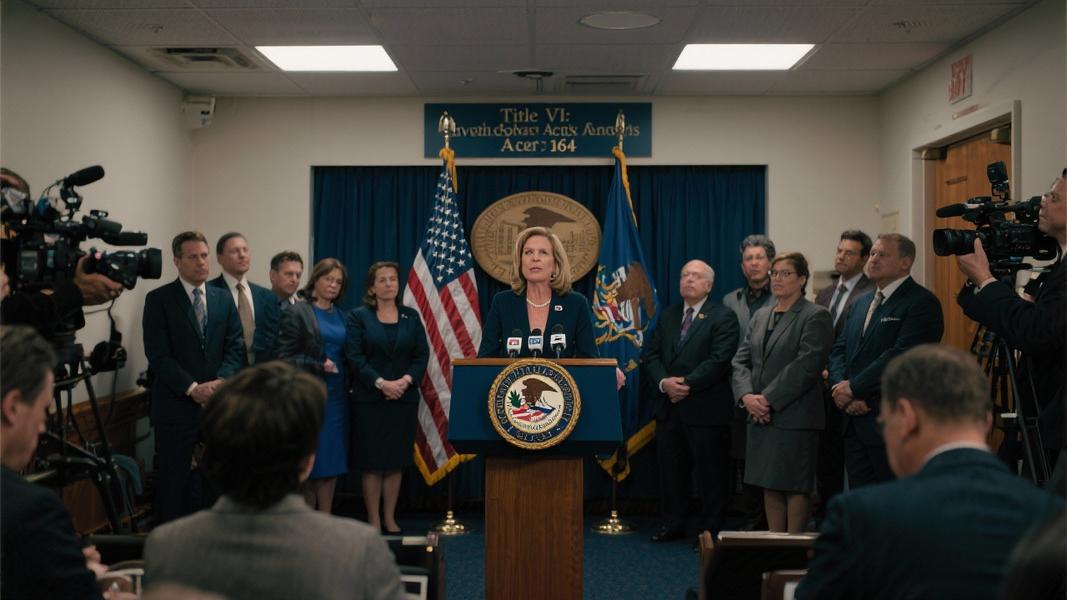
The Department of Justice has overhauled its approach to civil rights enforcement, eliminating the long-standing “disparate impact” standard that allowed discrimination claims based on statistical outcomes rather than proof of intentional bias.
Attorney General Pamela Bondi announced the final rule updating Title VI regulations on Tuesday, marking a significant shift in how the federal government will enforce anti-discrimination laws for recipients of federal funding across education, healthcare, and other sectors.
“For decades, the Justice Department has used disparate-impact liability to undermine the constitutional principle that all Americans must be treated equally under the law,” said Bondi. “No longer. This Department of Justice is eliminating its regulations that for far too long required recipients of federal funding to make decisions based on race,” she stated in the announcement.
What’s changing?
The new rule fundamentally changes how discrimination claims are evaluated, requiring direct evidence of intentional discrimination rather than allowing statistical disparities alone to trigger enforcement actions. The DOJ indicates the change will align enforcement with constitutional equal protection principles while reducing compliance burdens.
Assistant Attorney General Harmeet K. Dhillon defended the change, saying the previous framework had unintended consequences. “The prior ‘disparate impact’ regulations encouraged people to file lawsuits challenging racially neutral policies, without evidence of intentional discrimination,” Dhillon explained. “Our rejection of this theory will restore true equality under the law by requiring proof of actual discrimination, rather than enforcing race- or sex-based quotas or assumptions.”
The policy shift follows a permanent injunction issued by the U.S. District Court for the Western District of Louisiana on August 22, 2024, which already prohibited the DOJ from enforcing disparate impact requirements under Title VI within that state — a sign of the legal challenges the previous standard had faced.
Broader implications
Beyond Title VI enforcement, the rule change appears to be part of a broader administration effort to reshape civil rights policy. A White House policy statement asserted that “disparate-impact liability is wholly inconsistent with the Constitution and threatens the commitment to merit and equality of opportunity that forms the foundation of the American Dream.”
Critics worry the change will make it harder to address systemic discrimination. But Chief of Staff Nicholas Schilling contends the opposite: “For over 50 years, the prior disparate-impact rule fostered the very thing the Civil Rights Act of 1964 prohibited — discrimination on the basis of race, color, or national origin. But with today’s rule… The Department reaffirms Congress’ commitment to measure all Americans by merit,” he maintained.
DOJ officials emphasized that federally funded entities will now “be judged on their actual conduct, not on statistical outcomes or circumstances beyond their control.” This represents a significant departure from previous enforcement approaches that sometimes relied on numerical targets.
Practical effects
The rule change has immediate practical implications. Among them: a scaling back of language assistance services previously required under the disparate-impact theory, potentially affecting multilingual service provisions in federally funded programs.
Additionally, the DOJ issued guidance on July 29, 2025, providing recommendations to recipients of federal funding on avoiding unlawful discrimination. The guidance specifically addresses diversity, equity, and inclusion (DEI) initiatives, suggesting some may need to be reevaluated under the new standard.
What does this mean for institutions that receive federal dollars? The attorney general’s memorandum emphasizes that federal anti-discrimination laws “apply fully to all programs, activities, and employment practices of federally funded entities” — but the bar for proving violations has been raised significantly.
For now, organizations that receive federal funding face the challenge of adapting compliance programs to this new reality — one where statistical outcomes matter less than demonstrable intent, and where the government’s definition of discrimination itself has fundamentally changed.
