
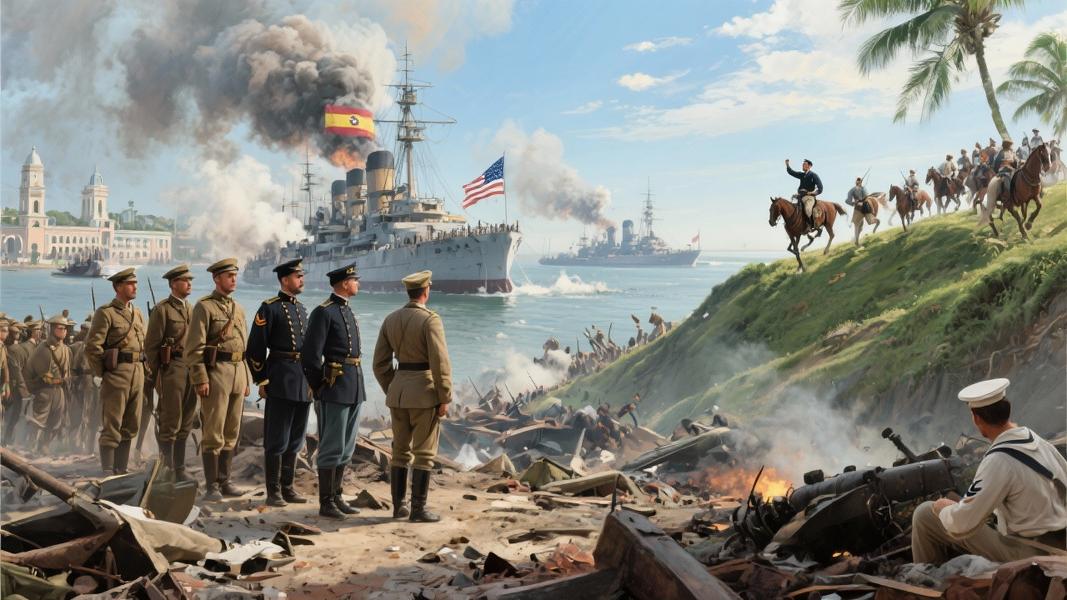
The Treaty of Paris, signed on December 10, 1898, formally ended the Spanish-American War and redrew the map of global power, transforming the United States from a continental nation to an overseas empire virtually overnight.
The treaty forced Spain to relinquish all claims to Cuba and cede Puerto Rico, Guam, and the Philippines to the United States—territorial acquisitions that would shape American foreign policy for generations to come. Spain also assumed Cuba’s massive debt, estimated at $400 million, while the U.S. agreed to pay Spain $20 million for the Philippines, a transaction that scholars note was justified with the American desire to “educate and Christianize” the Filipino people.
The Road to War
How did such a consequential treaty come about? The path to Paris began with an explosion. On February 15, 1898, the USS Maine sank in Havana harbor after a mysterious blast killed 266 American sailors. Though the cause remains disputed to this day, American newspapers—particularly those practicing “yellow journalism”—quickly blamed Spain, stoking public outrage that propelled the nations toward conflict.
The ensuing war was remarkably brief by historical standards. Military operations lasted just a few months before Spain sought peace in August 1898, with the formal treaty signed in December. But the treaty’s consequences would prove far more enduring than the conflict itself.
Colonial Reshuffling
Under the treaty’s terms, Spain “relinquishes all claim of sovereignty over and title to Cuba,” as the document itself states. The island wouldn’t become fully independent, however. Instead, Cuba would become occupied by the United States, which assumed “obligations… for the protection of life and property” during its occupation.
Cuba would eventually gain nominal independence in 1902, though it effectively functioned as an American protectorate, as historical records show. For Puerto Rico, Guam, and the Philippines, the path forward was even more directly tied to American power—they became outright U.S. possessions.
The Philippines proved particularly contentious during treaty negotiations. American representatives worried that Germany might seize the archipelago if the U.S. didn’t, and President McKinley reportedly had a dream that convinced him America should take possession to civilize and Christianize the islands—despite the fact that many Filipinos were already Christian after centuries of Spanish rule.
America’s Imperial Moment
“The final treaty also forced Spain to cede all claim to Cuba and to agree to assume the liability for the Cuban debt,” according to Britannica, marking a decisive shift in global power dynamics. Spain, once the world’s greatest colonial empire, was forced to surrender its last major overseas possessions, while the United States suddenly found itself administering far-flung territories across two oceans.
The treaty’s provisions for prisoner exchanges and other post-war matters were relatively straightforward. But its territorial transfers represented something profound: America’s arrival as a colonial power with global reach and ambitions.
That transformation wasn’t universally celebrated at home. Anti-imperialist voices in the United States—including luminaries like Mark Twain and Andrew Carnegie—opposed the annexation of the Philippines and other territories, arguing it betrayed American democratic principles and the very cause that had ostensibly led to war: Cuban independence from colonial rule.
The Treaty of Paris ultimately stands as one of history’s more consequential peace agreements—a document that formally ended a relatively minor war while simultaneously announcing America’s arrival as a global imperial power. Its legacy lives on today in Puerto Rico’s ongoing relationship with the United States, in the strategic importance of Guam, and in the complex historical ties between America and the Philippines—all stemming from a few signatures on December 10, 1898.
