
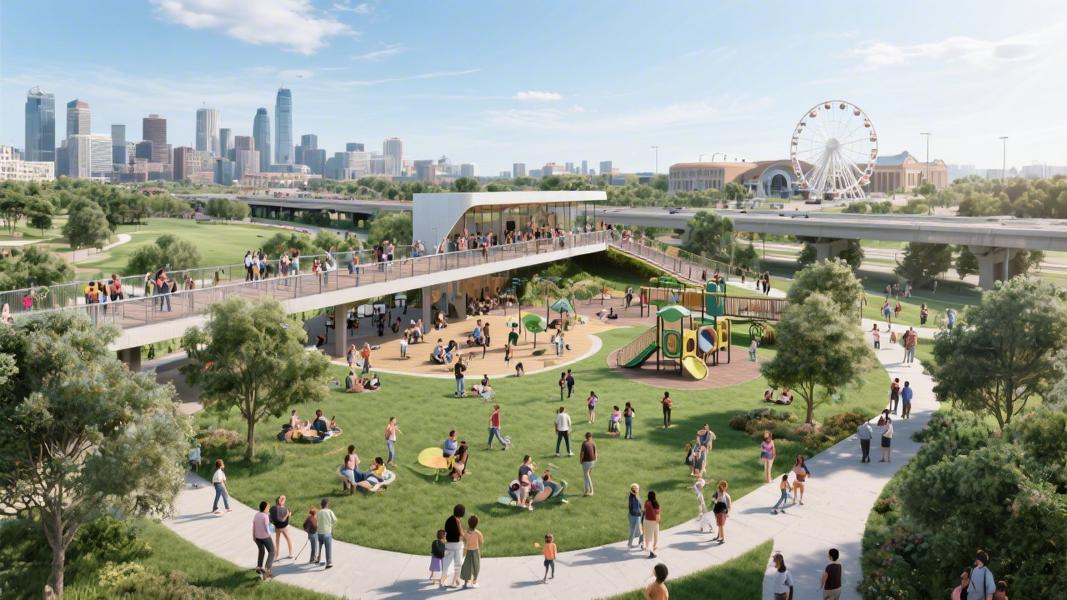
A new park is coming to Dallas — and it’s being built over a highway. That’s not a metaphor. It’s a five-acre deck park spanning Interstate 35E in southern Dallas, and it may be one of the most ambitious urban projects the city has attempted in decades.
Slated to open in late spring 2026, Halperin Park will bridge a divide — both literally and historically — that has defined the southern edge of Dallas for more than half a century. Phase One stretches from Ewing Avenue to Lancaster Avenue, and the amenities planned for that initial footprint are anything but modest. A pavilion, amphitheater, interactive fountains, a playground, a second-level overlook facing the Dallas Zoo and the highway below, and a large event room built for dining and private gatherings are all part of the first rollout, as reported by CultureMap Dallas.
A Highway That Divided a Neighborhood
Here’s the history that makes this more than just a shiny new park. When Interstate 35 was carved through southern Dallas in the 1960s, it didn’t just redirect traffic — it fractured communities. The west side of Oak Cliff was effectively cut off, left to absorb decades of disinvestment, low-income housing pressures, and what planners now openly call generational poverty. The highway did what highways of that era often did to Black and low-income neighborhoods: it split them apart and kept them that way.
Halperin Park is designed, at least in part, to address that wound. The project’s stated goal is to reintegrate the west side of Oak Cliff with the broader city — physically connecting communities that have been separated for sixty years. Whether a park can undo that kind of damage is a fair question. But the investment behind it suggests people are taking the attempt seriously.
The Money Behind the Mission
In 2024, the Halperin Foundation donated $23 million to the project and secured naming rights in the process. It’s a significant private commitment, and it’s part of a broader public-private structure that backers say is built to last. A study conducted by UNT Dallas projects the park will generate $1 billion in economic impact over the next five years — a figure that’s ambitious, sure, but not entirely out of reach given what comparable urban deck parks have done for cities like Atlanta and Houston, as detailed by Secret Dallas.
Still, economic projections are projections. The real test will come when the park opens and the surrounding neighborhood either benefits — or doesn’t.
What Phase One Actually Looks Like
Phase One will deliver 1.2 acres of elevated green space, which is a smaller slice of the full vision but still a substantial debut. The 12th Street Promenade and Walk of Fame runs through it. There’s a “Treehouse in the Woods” playground concept, expansive lawns, performance space, retail, dining, and — perhaps the detail that will age best — free public Wi-Fi throughout the park.
That second-level overlook deserves a second mention. Positioned to face the Dallas Zoo and the sprawl of I-35 below, it’s a deliberate design choice: instead of hiding the highway, the park puts it on display. There’s something almost poetic about that — standing above the infrastructure that once cut your neighborhood in half, looking down at it.
Phase Two and the Long Game
Phase Two won’t arrive until 2032, but when it does, it’ll push the park to its full 5.5-acre form. Plans include a direct connection to the Dallas Zoo, expanded natural and geological features, a dog park, and interactive educational spaces. It’s a long runway, but the phased approach is pragmatic — it lets the city test what works before committing everything.
Dallas has made big promises about equity and urban reinvestment before. What’s different here, at least on paper, is the scale of private capital backing the effort and the specificity of the neighborhood context driving it. Halperin Park isn’t being built somewhere that was already thriving. It’s being built somewhere that was deliberately left behind — and that distinction matters more than any ribbon-cutting ever will.
