
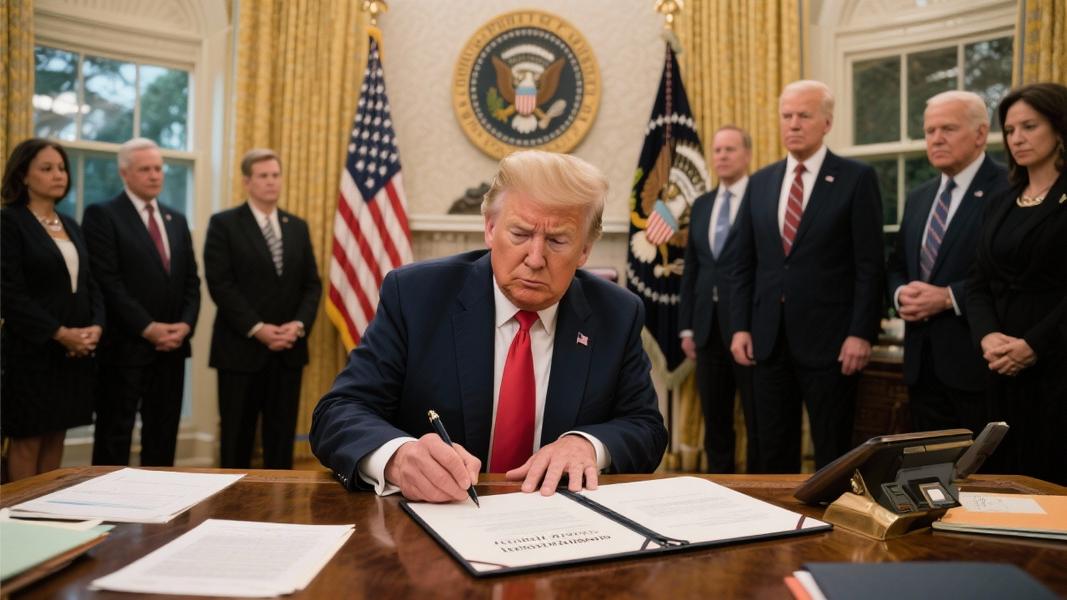
President Trump signed an executive order Tuesday aimed at curtailing what he called a “patchwork” of state-level AI regulations, setting up a high-stakes battle between federal and state governments over who controls America’s artificial intelligence future.
The December 11 order — Trump’s latest in a flurry of executive actions since returning to office — directs the Justice Department to challenge state AI laws deemed unconstitutional and threatens to withhold federal broadband funding from states that don’t align with federal AI priorities. The move comes as state legislatures have introduced over 1,000 different AI bills nationwide.
“Investment in AI is helping to make the U.S. Economy the ‘HOTTEST’ in the World, but overregulation by the States is threatening to undermine this Major Growth ‘Engine,'” Trump declared in a statement accompanying the order. “Some States are even trying to embed DEI ideology into AI models, producing ‘Woke AI’ (Remember Black George Washington?). We MUST have one Federal Standard instead of a patchwork of 50 State Regulatory Regimes. If we don’t, then China will easily catch us in the AI race.”
Federal Muscle vs. State Rights
The executive order, which appears to be number 14364 based on the White House’s registry of Trump’s 218 executive actions this year, creates an AI Litigation Task Force within the Justice Department specifically tasked with identifying and challenging state AI laws that could potentially interfere with interstate commerce.
Perhaps more controversially, it instructs the Commerce Department to evaluate state AI regulations and potentially withhold Broadband Equity, Access, and Deployment (BEAD) funding — billions in federal dollars meant to expand internet access — from states deemed non-compliant with federal AI priorities.
Is this federal overreach? That’s certainly the view from California, where state officials immediately condemned the order as “advancing corruption rather than innovation.” The Golden State, home to many AI industry leaders, has been among the most active in developing state-level guardrails for artificial intelligence technologies.
California Pushes Back
California officials wasted no time responding to what they view as federal interference in their regulatory authority. In a sharply worded statement, the governor’s office argued that the executive order would preempt state laws designed to protect vulnerable populations, including children and seniors, from AI-related harms.
The state also highlighted its leadership in AI development through partnerships with tech giants including Nvidia, Google, Adobe, IBM, and Microsoft — suggesting that California’s approach to AI regulation hasn’t hampered innovation but rather fostered it.
“We’ve created a balanced regulatory environment that protects consumers while encouraging responsible AI development,” a California tech policy advisor told reporters on condition of anonymity because they weren’t authorized to speak publicly. “This executive order threatens that balance.”
Industry Reaction Mixed
Tech industry reaction has been split along predictable lines. Larger AI companies with multistate operations have generally welcomed the push for regulatory uniformity, while privacy advocates and smaller AI firms have expressed concerns about potentially weakening consumer protections.
The tension reflects the broader challenge of AI governance: balancing innovation with accountability in a rapidly evolving technological landscape. While a single federal standard could simplify compliance, critics worry it might establish a regulatory floor rather than a ceiling.
Legal experts expect immediate challenges to the order, particularly regarding the constitutionality of withholding BEAD funding as leverage against state AI regulations. The Commerce Department hasn’t yet detailed how it will determine which state laws conflict with federal priorities.
As the AI arms race between the U.S. and China intensifies, one thing seems certain: the battle over who governs America’s artificial intelligence future — Washington or the states — is just beginning.
