
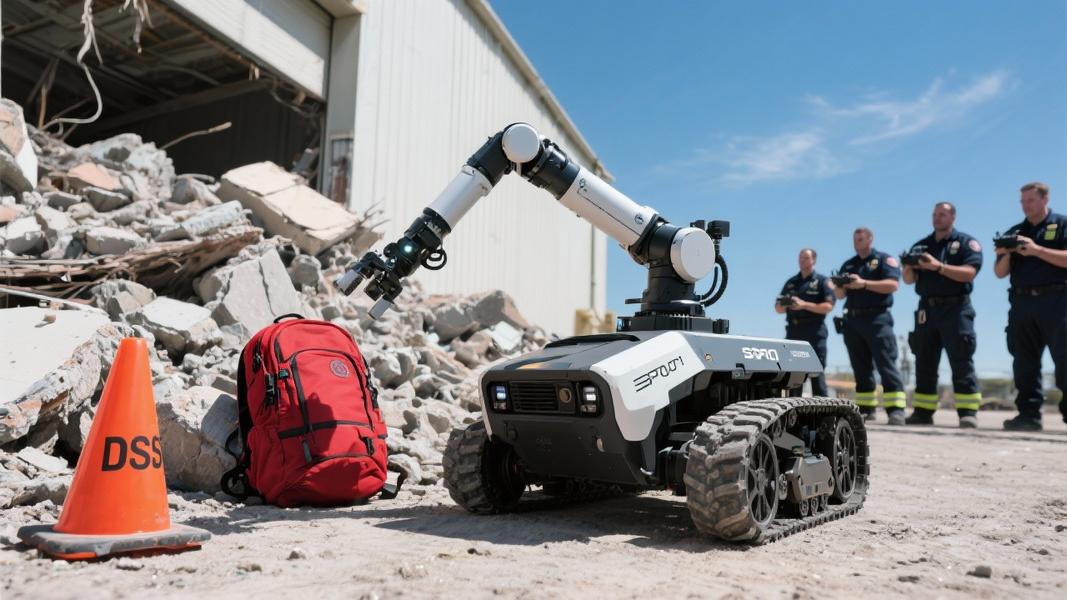
Robots to the rescue? Emergency responders across the nation are increasingly turning to unmanned ground vehicles (UGVs) to handle potentially lethal situations, and a major new assessment is showing just how these mechanical allies might save lives.
The System Assessment and Validation for Emergency Responders (SAVER) program recently evaluated three cutting-edge UGV systems — Boston Dynamics SPOT, Teledyne FLIR Packbot 525, and Ghost Robotics Vision 60 — in a series of high-stakes emergency scenarios. The assessment, conducted over four days in August 2025 at the Environmental Protection Agency’s Region 2 Laboratory in Edison, New Jersey, brought together emergency personnel from six states to put these mechanical first responders through their paces.
Mechanical First Responders
“This assessment of UGVs is a direct result of input from emergency responders from a diverse set of agencies and missions, highlighting how useful these technologies can be in a broad scope of operations,” said NUSTL Test Lead Tyler Mackanin, who oversaw the evaluation.
The robots were tested in simulated hazardous materials incidents, search and rescue operations, and emergency medical scenarios — situations where sending in humans first might mean putting lives at unnecessary risk. Responders evaluated each system on multiple criteria including capability, usability, deployability, battery life, and maneuverability.
Can these machines actually climb stairs? That’s one of the critical tests they faced. The assessment specifically examined each UGV’s ability to navigate switchback staircases — a common challenge in building emergencies where elevators are typically unavailable.
Keeping Humans Safe
“These technologies can be equipped with sensors that can identify hazardous chemicals and relay critical data back to teams positioned at safe remote distances, enabling them to determine the best approach for containment and mitigation,” Mackanin explained.
The technology isn’t exactly new. Military and security operations have long utilized robotic systems, but their application in civilian emergency response has been gaining momentum as the technology becomes more sophisticated and affordable. Recent advancements in artificial intelligence, battery life, and sensor technology have dramatically expanded what these machines can do.
“UGVs can reach areas inaccessible or potentially harmful to human rescuers, allowing teams to scout for hazards and safe entry points to make real-time, informed decisions about how to proceed,” said Mackanin.
The National Academies of Sciences, Engineering, and Medicine has documented the growing importance of measurement science in evaluating the capabilities of autonomous and remotely operated robotic systems, including ground vehicles for emergency response applications.
Looking Ahead
The assessment involved not just emergency responders but also representatives from the Department of Homeland Security Science and Technology Directorate’s National Urban Security Technology Laboratory (NUSTL), Pacific Northwest National Laboratory (PNNL), and the UGV companies themselves.
While the final results haven’t been published yet, preliminary feedback suggests these mechanical helpers are becoming increasingly valuable tools in emergency response arsenals — particularly for high-risk scenarios involving hazardous materials or unstable structures.
As one participant noted during the assessment, “It’s not about replacing humans. It’s about sending the robot in first, so when humans do go in, they know exactly what they’re facing.”
