
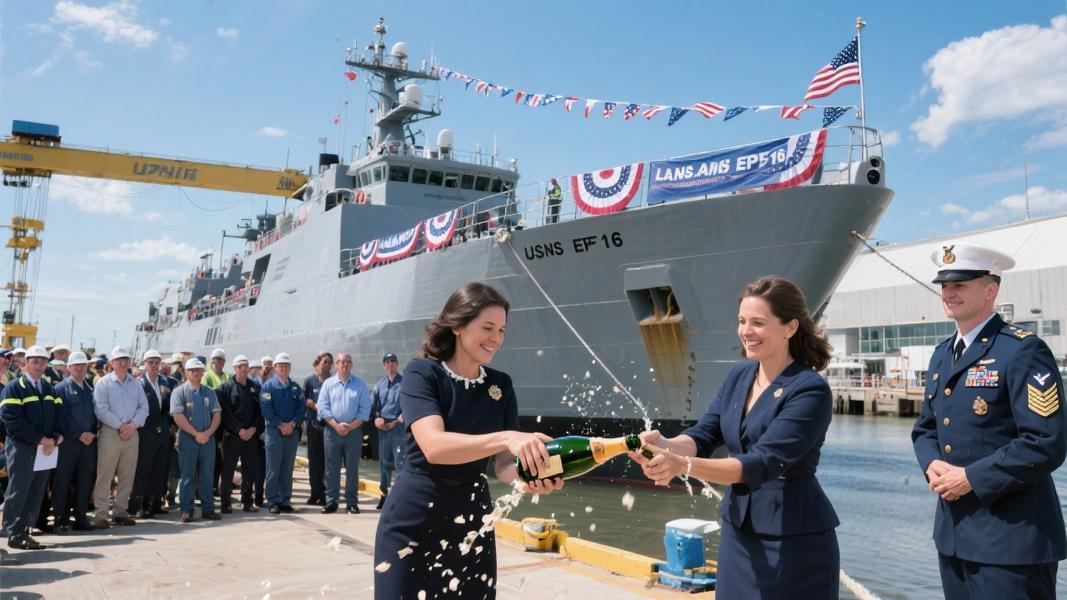
The U.S. Navy will christen its newest expeditionary fast transport vessel, the future USNS Lansing (EPF 16), during a ceremony at Austal USA in Mobile, Alabama, this Wednesday, marking a pivotal transition from construction to testing for the versatile platform.
Michigan Roots and Maritime Future
Under Secretary of the Navy Hung Cao will deliver the principal address at the January 10 ceremony, where Michigan Governor Gretchen Whitmer and U.S. Representative Lisa McClain will serve as ship sponsors, performing the traditional bottle-breaking across the bow. The 10:30 a.m. event signals the ship’s shift from construction to rigorous testing and trials.
“As we christen the future USNS Lansing, we celebrate another symbol of the unbreakable linkage that ties the workmanship of our shipyard workers to those of our American mariners who will man these ships,” Cao stated ahead of the ceremony. “This also marks the pivotal transition from construction to the rigorous test and trials phase to ensure these platforms are ready to answer the call.”
Named for Michigan’s capital city, the vessel honors a region with deep military manufacturing roots dating back to the Civil War. The connection isn’t merely historical. Secretary of the Navy Carlos Del Toro has emphasized that the naming recognizes “the capital city of the state that is a leader in developing the techno-industrial workforce we need to build and assemble the ships, munitions, parts, and pieces our Naval fleet requires.”
Medical Capabilities Meet Maritime Speed
What sets the Lansing apart from its predecessors? As the final “Flight II” vessel of the Spearhead class, EPF 16 represents an evolution in naval auxiliary design, combining speed with expanded medical capabilities.
The ship can operate as a traditional expeditionary fast transport, a Role 2E enhanced medical platform, or a hybrid of both configurations. This flexibility allows the Navy to rapidly deploy the vessel for varied missions across the globe.
When configured for medical operations, the Lansing will offer facilities including an ICU, ward beds, X-ray capabilities, laboratory services, and dental support — essentially functioning as a floating hospital that can reach crisis zones at impressive speeds.
Traditional EPF vessels are designed to transport 600 short tons of military cargo 1,200 nautical miles at an average speed of 35 knots. The Flight II variants, however, trade some lift capacity — down to 330 short tons — for these enhanced medical and operational features.
From Keel to Christening
The Lansing’s journey began formally on September 6 when its keel was laid at Austal USA, marking the start of major hull assembly. That milestone represented the beginning of physical construction for the vessel, which has now progressed to the point of christening.
“The future USNS Lansing is one step closer to joining the U.S. fleet and Military Sealift Command to answer the call to action, any ocean, any time,” Under Secretary Cao noted, highlighting the ship’s intended rapid-response profile.
Once commissioned, the vessel will be crewed by 31 civilian mariners and can embark up to 155 additional personnel or an Expeditionary Medical Unit as missions require.
Strategic Maritime Context
The christening comes amid broader Navy efforts to strengthen America’s maritime capabilities. Del Toro has linked the Lansing directly to the Maritime Statecraft initiative, which he describes as “a national, whole-of-government effort to restore the comprehensive maritime power of our Nation.”
Last month, Del Toro and Governor Whitmer announced the Michigan Maritime Manufacturing (M3) initiative, further cementing the connection between the state’s industrial capacity and naval shipbuilding.
From seabed to space, the Navy frames vessels like the Lansing as part of its 250-year tradition of innovation and maritime dominance, delivering what officials characterize as “power for peace” while remaining “always ready to fight and win.”
As the sixteenth and final vessel in the Spearhead-class expeditionary fast transport program, the Lansing represents both the culmination of existing design work and a bridge to future naval auxiliary capabilities — a floating testament to how military requirements, medical needs, and industrial capacity intersect on the high seas.
