
From German immigrant to decorated WWII airman, John F. Bremer Jr.’s harrowing journey through 30 combat missions over Nazi-occupied Europe has been immortalized through a Texas veterans’ oral history program that preserves the fading voices of America’s greatest generation.
Texas Land Commissioner and Veterans Land Board Chairwoman Dawn Buckingham recently highlighted Bremer’s story as part of the state’s Voices of Veterans program, which captures firsthand accounts from those who served before their stories are lost to time.
From Germany to America
Born in Germany in 1921, Bremer’s American journey began when he was just three and a half years old. His father had left for Pennsylvania after securing work in America, sending money home for about a year until young Bremer, his mother, and sister could join him across the Atlantic — a common immigrant story of the era that would later come full circle as Bremer fought against his birth nation.
Twenty years later, Bremer would find himself listening to the radio with his parents when news of the Pearl Harbor attack broke. He recalled being “in the car checking out some of the countryside, his mom and dad were in the backseat,” when the broadcast changed American history — and his life trajectory — forever.
From Civilian to Airman
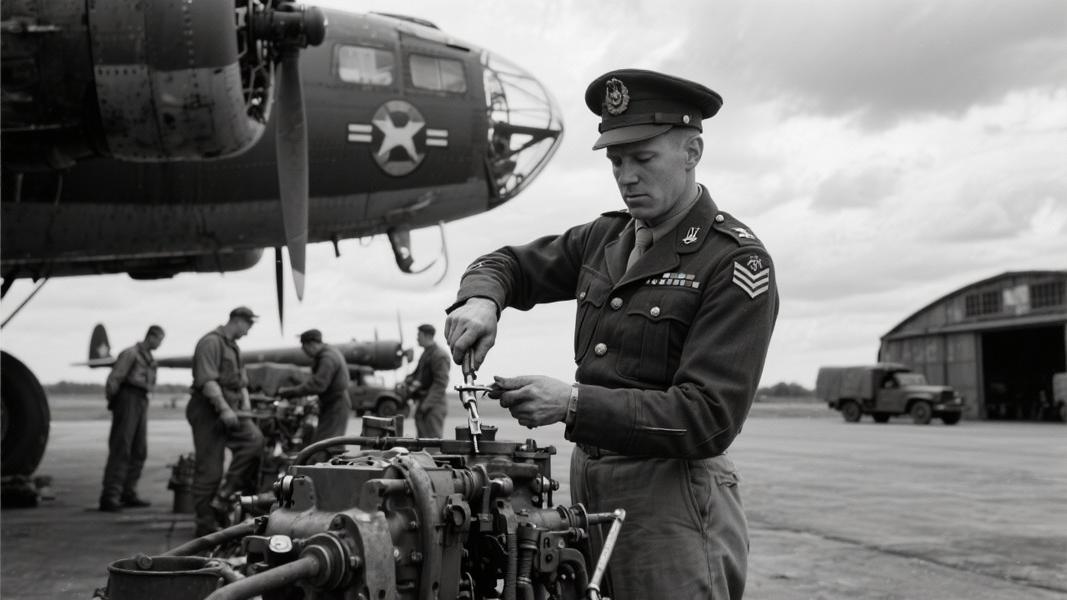
Drafted into the Army Air Corps in 1942, Bremer’s military education began with a brief stint at boot camp in Miami, Florida. But his mechanical aptitude quickly became apparent to his superiors, who redirected him to Amarillo, Texas, where he would train specifically as a B-17 aircraft mechanic.
“They told me I would be learning to be a B-17 aircraft mechanic,” Bremer said about the phone call that changed his assignment. “I want to say the schooling for that lasted about six months but I am not absolutely sure.”
What followed was a whirlwind tour of specialized training across America. After Amarillo, Bremer was sent to Seattle, Washington, where he attended the Boeing Factory School to learn instrument repair for “exactly 31 days” before heading to Salt Lake City. A quarantine in Utah — after “one guy got sick and so they quarantined the whole barracks” — further delayed his deployment.
Ever wonder what it takes to prepare a mechanic to become a combat airman? For Bremer, that transformation happened at gunnery school in Kingman, Arizona, where he learned to operate weapons ranging from BB guns to the powerful .50-caliber machine guns that would soon become his responsibility in combat.
“Would you believe it, a 22-caliber machine gun and it housed little tiny pellets,” he remarked about his training. “They also taught me about BB guns, a rifle and a pistol, a 30-caliber machine gun and a 50-caliber machine gun.”
Into the European Theater
Following his stateside preparation, Bremer was deployed to England, where he would serve with the 379th Bomb Squadron. His role shifted from mechanic to waist gunner aboard the legendary B-17 Flying Fortress — a strategic bomber that would carry him through some of the war’s most dangerous airspace over Nazi-occupied Europe.
His combat record was extensive: thirty missions over France, Holland, and Germany. Each mission brought the young airman face-to-face with the deadly reality of aerial combat during history’s largest conflict.
On his 21st mission, while targeting a German air base in France, Bremer experienced firsthand the terrifying chaos of combat. “We ran into some flack,” he recounted. “One of the bombs exploded just above our plane and a piece of the metal, which was three inches long, came through the top of the plane and hit me in the shoulder and lodged into my ribs.”
That injury earned Bremer the Purple Heart, one of several decorations he would receive for his service, including the Distinguished Flying Cross — one of the highest honors awarded to airmen.
Preserving Veterans’ Voices
Bremer’s story might have faded into obscurity like so many other veterans’ experiences, but the Voices of Veterans program ensures these crucial firsthand accounts remain accessible to future generations. As the first veteran oral history program run by a Texas state agency, it serves a vital historical purpose.
“Voices of Veterans is a state agency’s first Veteran oral history program. It records the stories of Texas Veterans through their time in service and after returning home from combat,” the Texas General Land Office explains.
These interviews aren’t just filed away in some forgotten archive. They’re permanently housed in the Office of Veterans Records at the Texas General Land Office, where they join historical documents from other Texas heroes like Sam Houston, Davy Crockett, Jim Bowie, and William Barret Travis — placing ordinary veterans’ stories alongside those of the state’s most celebrated historical figures.
Later in life, Bremer resided with his wife of 73 years at the Ussery-Roan Texas State Veterans Home, part of the generation that returned from war to build families and communities across America.
In an era when the voices of World War II veterans grow fewer with each passing year, programs like Voices of Veterans serve as crucial links to our shared past — preserving not just the stories of famous battles and campaigns, but the human experiences of individuals like John Bremer who, from immigrant beginnings, embodied the complex, courageous American journey through the most consequential conflict of the 20th century.
