
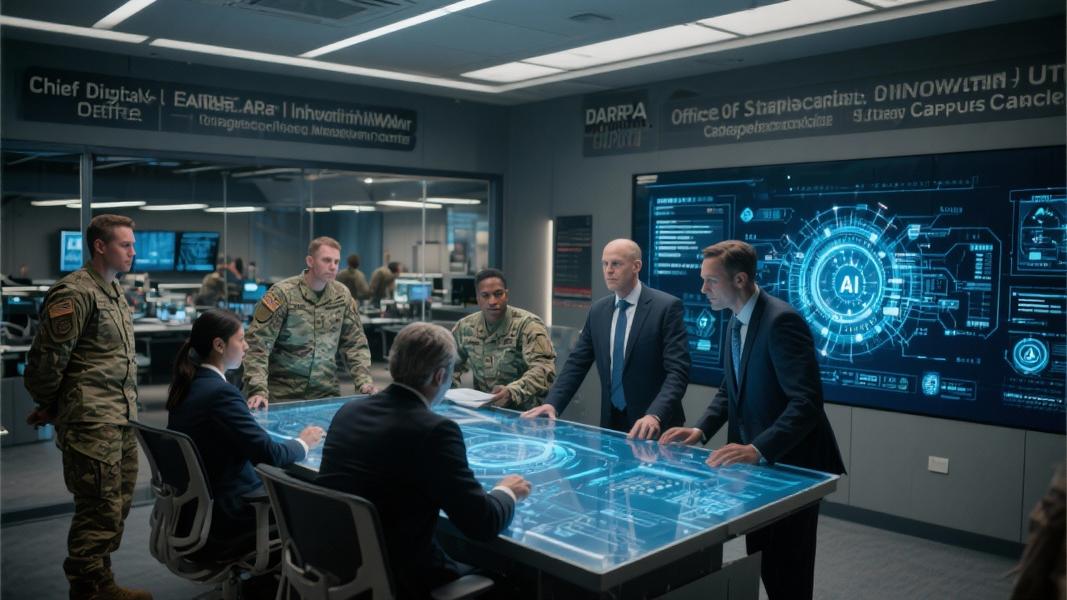
The Department of War unveiled a sweeping overhaul of its innovation ecosystem on January 12, 2026, marking the most dramatic restructuring of defense technology development in decades. The transformation aims to break down bureaucratic barriers and accelerate cutting-edge technologies to warfighters.
New Innovation Leadership Takes Command
At the heart of the reorganization is Emil Michael, newly appointed Under Secretary of Research and Engineering and Chief Technology Officer, who will lead a unified innovation structure built around six execution organizations. “We are rolling out the red carpet for innovators who want to work with the War Department,” said Michael. “This new structure creates a stronger identity for our innovation ecosystem and gives industry a more direct path to move technology into the hands of the American warfighter.”
The Defense Innovation Unit (DIU), now designated as a Department of War Field Activity, will be led by Owen West, who reports directly to War Secretary Pete Hegseth as a Principal Staff Assistant. DIU will work closely with the Mission Engineering and Integration Activity to bridge the notorious “valley of death” that has historically prevented promising technologies from reaching deployment. Congress has emphasized partnering with DIU to grow the innovation ecosystem, with programs like APFIT receiving $100 million in FY22 funding.
Similarly, the Strategic Capabilities Office (SCO) has been designated a Department Field Activity, maintaining statutory reporting to the Deputy Secretary while operationally aligning under the CTO. Both DIU and SCO will adopt term-limited appointments — a significant departure from traditional defense hiring practices — to maintain agility and attract top talent from the private sector and operational force.
AI at the Forefront
Can artificial intelligence transform military operations? The War Department is betting heavily on it. Cameron Stanley has been named the new Chief Digital and Artificial Intelligence Officer to drive Department-wide AI adoption. This appointment comes as DoW has narrowed its Critical Technology Areas to six priorities, including Applied Artificial Intelligence focused on rapid integration into operations for efficiency and decision superiority, as industry analysts have noted.
The department has already taken bold steps in this direction, entering an agreement with xAI to expand GenAI.mil with frontier-grade capabilities based on the Grok family of models, targeted for IL5 deployment in early 2026. This partnership represents a significant shift toward embracing commercial AI capabilities for defense applications.
Breaking the Acquisition Mold
Perhaps most dramatically, Secretary Hegseth is completely scrapping the Joint Capabilities Integration and Development System (JCIDS), the decades-old requirements process often blamed for procurement delays. It will be replaced with a Requirements and Resourcing Alignment Board that prioritizes commercial options and creates financial incentives for production increases, according to reports.
“The Department of War’s move toward an acquisition approach that mirrors commercial development is the most important step it can take to accelerate capability delivery,” Applied’s Chief Technology Officer Peter Ludwig said in a statement after Hegseth’s speech. “Modern systems evolve too quickly for bespoke development cycles.”
The reform strategy emphasizes speed and agility, risk acceptance, commercial leverage, strategic alignment, and department-wide accountability, including digitizing acquisition with AI. The Accelerate the Procurement and Fielding of Innovative Technologies program has already awarded more than $1 billion to small businesses and non-traditional contractors, according to defense acquisition analysts.
Industrial Base Expansion
The overhaul extends beyond organizational charts to the defense industrial base itself. The FY26 Defense Appropriations bill calls for establishing a Civil Reserve Manufacturing Network to address gaps in production capacity and enable surge manufacturing in crisis scenarios, lawmakers have indicated.
Meanwhile, DoW has invested $32.7 million via Defense Production Act Title III in Systima Technologies ($5M) and REDAR ($27.7M) to expand solid rocket motor production. “The surge in demand for propellant-based weaponry, coupled with a narrow supplier base, has created a bottleneck in SRM production. With these strategic investments, we are fortifying our national security by expanding critical nodes of the SRM supply chain to accelerate munitions manufacturing,” said Michael Duffey, Under Secretary of War for Acquisition and Sustainment, in a statement.
New Governance Structure
To tie these initiatives together, the department has established a CTO Action Group to anchor innovation alignment, drive accountability, and ensure transparency on transition decisions. Military Services will also reorganize their innovation ecosystems and present Service Innovation Plans focusing on technology, product, and operational capability innovation.
The War Department’s comprehensive reorganization reflects a growing consensus that traditional defense acquisition and innovation processes cannot keep pace with rapidly evolving global threats and technological change. Whether this dramatic overhaul will succeed where previous reform efforts have stumbled remains to be seen — but one thing is clear: the Pentagon’s innovation ecosystem will never be the same.
