
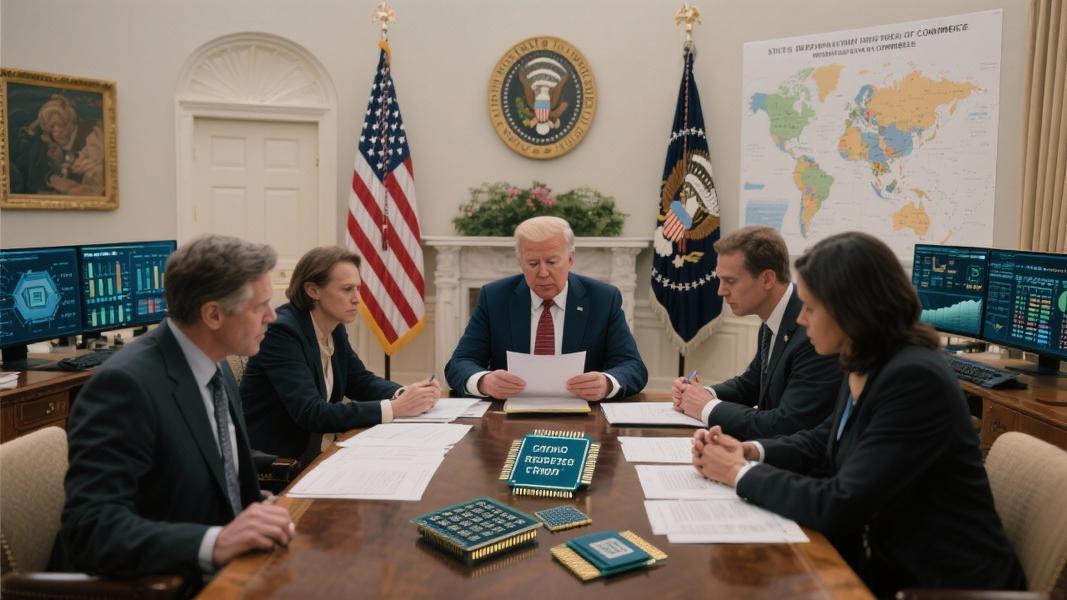
President Trump has imposed a 25% tariff on certain advanced computing chips, citing national security concerns in a move that could reshape the global semiconductor landscape. The proclamation, signed January 14, 2026, targets high-performance processors while creating exemptions for various domestic applications.
“I have determined that it is necessary and appropriate to impose an immediate 25 percent ad valorem duty rate” on specific advanced computing chips and derivative products, Trump stated in the official proclamation. The tariffs will take effect just after midnight on January 15.
Critical Tech Vulnerability
The White House’s decision comes amid growing concerns about America’s semiconductor dependency. Despite consuming roughly a quarter of the world’s chips, the United States manufactures only about 10% of its semiconductor needs domestically — a gap the administration describes as creating “heavy reliance on foreign supply chains.”
Why target these specific chips? The proclamation identifies semiconductors as “essential to each of the 16 critical infrastructure sectors” outlined in a national security memorandum from April 2024. These tiny components power everything from communications infrastructure and energy grids to nuclear facilities and medical systems, making them vital to both economic and national security interests.
Defense applications represent a particular concern. “Modern defense systems depend on high-performance semiconductors for radar and communication systems, electronic warfare and cybersecurity systems, and guidance and control systems for missiles and drones,” the proclamation notes.
Targeted Approach with Exemptions
Not all chip imports will face the new tariff. The policy specifically exempts semiconductors imported for U.S. data centers, repairs and replacements, research and development, startups, consumer applications outside of data centers, civil industrial applications, public sector use, or “other uses that… contribute to the strengthening of the United States technology supply chain,” according to the proclamation.
Industry analysts note that specific high-performance chips like Nvidia’s H200 and AMD’s MI325X — processors that power advanced AI applications — appear to be primary targets. These components have become increasingly critical in the global technology race, particularly for artificial intelligence development, as reported by industry observers.
Two-Phase Strategy
The tariffs represent just the first phase of a broader semiconductor strategy. The administration has outlined a two-part approach that begins with “ongoing trade negotiations with foreign jurisdictions” alongside these immediate tariffs on “narrow categories of AI-enabling semiconductors,” according to the White House document.
A second phase would potentially involve broader tariffs on semiconductors with a “tariff offset program” following the conclusion of negotiations. The Secretary of Commerce and U.S. Trade Representative have been directed to update the President within 90 days on the status of these negotiations.
Could data center chips eventually face tariffs too? The proclamation requires the Commerce Secretary to provide an update by July 1, 2026, on “the market for semiconductors that are used in United States data centers” to determine whether tariff modifications might be appropriate.
This move represents the latest in a series of trade measures implemented by the Trump administration since returning to office. The semiconductor industry, already navigating complex global supply chains and geopolitical tensions, now faces another variable in its strategic calculations — one that could accelerate efforts to diversify manufacturing locations and strengthen domestic production capabilities.
