
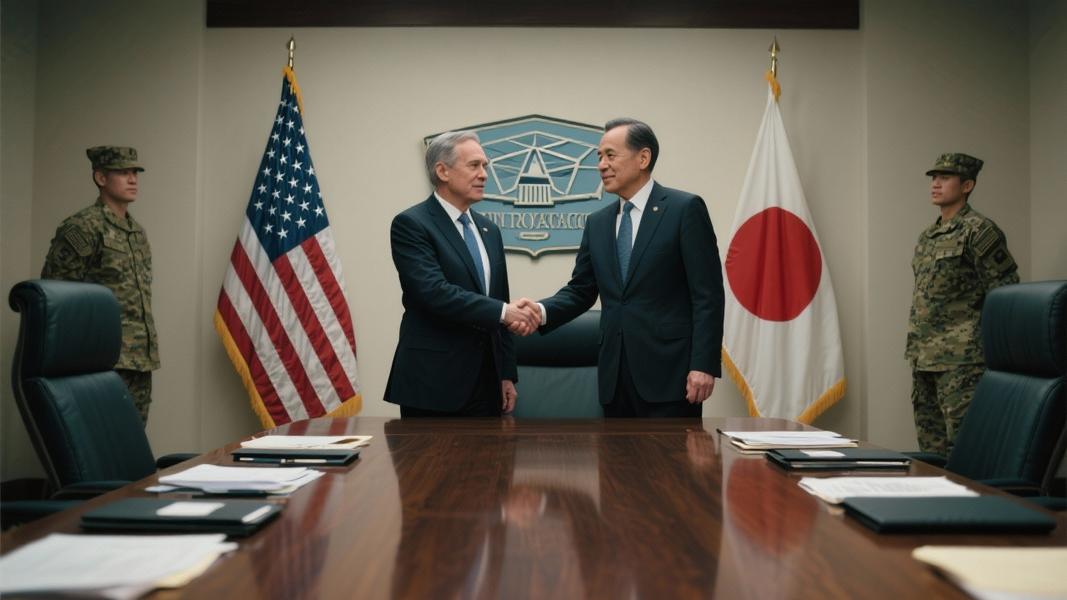
U.S. Defense Secretary Pete Hegseth met with his Japanese counterpart on Monday, underscoring the deepening military alliance between the two nations as Japan ramps up its defense capabilities amid growing regional tensions.
Chief Pentagon Spokesman Sean Parnell confirmed that Secretary Hegseth welcomed Japanese Defense Minister Shinjirō Koizumi at the Pentagon on January 15. The high-level meeting focused on affirming “the critical role of the U.S.-Japan alliance in deterring Indo-Pacific aggression” and discussing Japan’s increased defense investments, which have reached historic levels.
Record Defense Spending
The talks come less than a month after Tokyo approved a record $58 billion defense budget for fiscal year 2026, marking the 12th consecutive year of increased military spending. The 9.04 trillion yen allocation represents a 3.8% jump from the previous year’s budget.
What’s driving this military buildup? Concerns about China’s assertiveness in the region, particularly regarding Taiwan, appear to be a significant factor.
Japanese Prime Minister Sanae Takaichi raised eyebrows in November when she suggested that Japan’s military could get involved if China were to take action against Taiwan, which Beijing claims as its own territory.
Maritime Focus
The new budget allocates substantial resources toward strengthening Japan’s maritime defense capabilities. This includes $640.6 million for the ‘SHIELD’ national multi-layered coastal defense system and funding for V-BAT unmanned systems to be deployed on Sakura-class Offshore Patrol Vessels (OPVs).
Tokyo has also earmarked $667 million for the construction of a new frigate, $182.3 million for two Sakura-class OPVs, and $773 million for a Taigei-class submarine – all part of Japan’s strategy to counter growing maritime challenges in the Indo-Pacific.
The U.S.-Japan defense relationship has grown increasingly interdependent, with Japan’s procurement from American defense contractors skyrocketing in recent years. Government data indicates that Japan’s defense purchases from the U.S. under the Foreign Military Sales program reached 1.3867 trillion yen in fiscal 2023 – more than triple the 407.8 billion yen spent in fiscal 2018.
Strategic Implications
The Hegseth-Koizumi meeting underscores the Biden administration’s continued focus on strengthening alliances in the Indo-Pacific region as a counterbalance to China’s growing military and economic influence.
For Japan, the dramatic increase in defense spending represents a significant shift from its traditionally modest military posture established after World War II. The country’s pacifist constitution, written under U.S. occupation, has been reinterpreted in recent years to allow for a more assertive defense policy.
As regional tensions continue to simmer, particularly around Taiwan and disputed territories in the East and South China Seas, the U.S.-Japan alliance appears poised to play an increasingly pivotal role in shaping the security architecture of the Indo-Pacific.
