
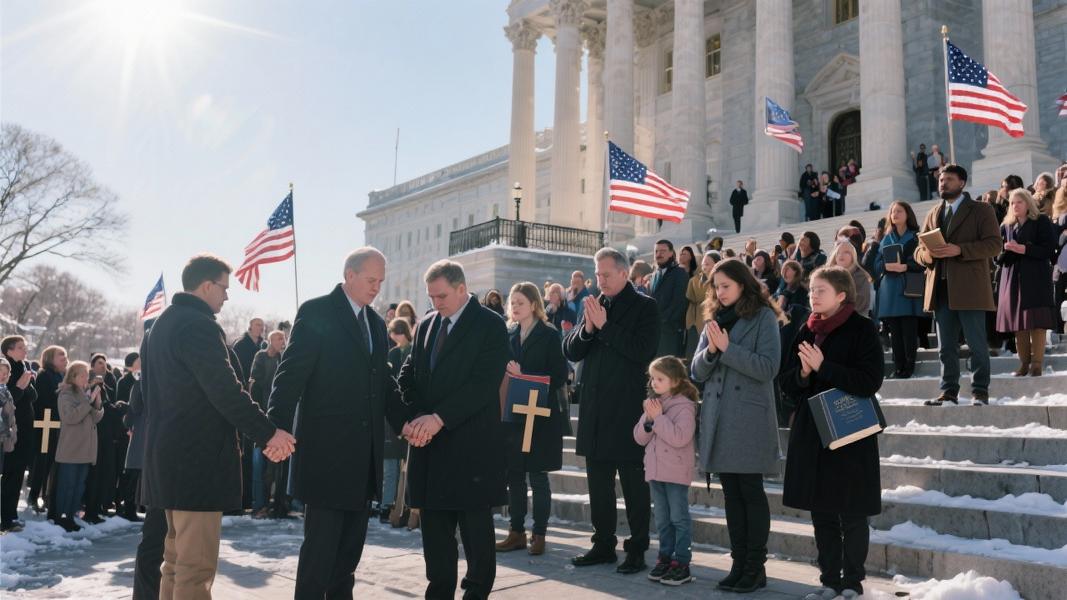
President Trump has declared January 16, 2026, as Religious Freedom Day, marking the 240th anniversary of the Virginia Statute for Religious Freedom and coinciding with the nation’s semiquincentennial celebrations.
“Every person is born with the God-given right to practice their faith, follow their conscience, and worship their God freely and without fear,” reads the presidential proclamation issued earlier today.
A Foundation for American Liberty
The annual observance commemorates the Virginia Statute for Religious Freedom, authored by Thomas Jefferson in 1777 and shepherded through the Virginia legislature by James Madison on January 16, 1786. This landmark legislation established that God “created the mind to be free” and that every individual “shall be free to profess their opinion in matters of religion.”
Trump’s proclamation highlights the Mayflower settlers’ journey over 400 years ago, framing America’s earliest European colonists as seekers of religious liberty. The Virginia Statute would later become the foundation for the First Amendment’s establishment clause, which states, “Congress shall make no law respecting an establishment of religion, or prohibiting the free exercise thereof.”
Why does this matter nearly two and a half centuries later? The answer lies in how Americans continue to navigate the boundaries between faith and government.
A Presidential Tradition
Federal recognition of Religious Freedom Day began with President George H.W. Bush in 1993, with every president since issuing annual proclamations. President Bill Clinton remarked in 1999 that “Americans are a deeply religious people, and our right to worship as we choose, to follow our own personal beliefs, is the source of much of our Nation’s strength.”
The observance typically includes presidential and gubernatorial proclamations, as well as events in homes, schools, and places of worship across the country. Religious Freedom Day has become a moment for Americans to reflect on what many consider a foundational right—one that “undergirds the very origin and existence of the United States,” as Congress unanimously declared in 1998.
Trump’s Faith Initiatives
In his proclamation, Trump highlighted his administration’s establishment of the White House Faith Office, Religious Liberty Commission, and a Task Force to Eradicate Anti-Christian Bias. “I pledge that I will never stop fighting to restore America as a Nation of prayer, a country of faith, and a radiant beacon of liberty and justice for all,” the president stated.
The Virginia Statute’s original text emphasized that rights come from God, not government—a principle that continues to shape American political discourse. It explicitly rejected “all attempts to influence it by temporal punishment or burthens, or by civil incapacitations…and are a departure from the plan of the Holy author of our religion,” according to the document.
This concept of religious freedom has expanded over time. The Universal Declaration of Human Rights, adopted by the United Nations in 1948, affirms that “everyone has the right to freedom of thought, conscience and religion; this right includes freedom to change his religion or belief, and freedom, either alone or in community with others and in public or private, to manifest his religion or belief in teaching, practice, worship and observance,” as noted by the State Department.
As America approaches its 250th birthday, debates about religious freedom’s scope and limits remain as vibrant as ever. The tradition of Religious Freedom Day serves as an annual reminder of what many consider America’s first freedom—the right to believe, or not believe, according to one’s own conscience.
