
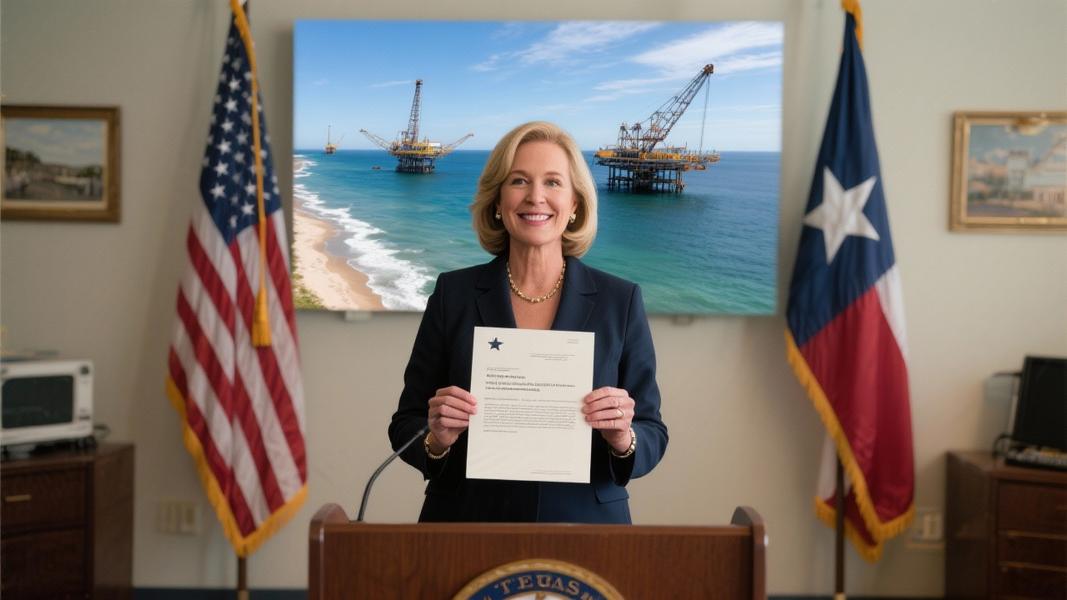
Texas Land Commissioner Dawn Buckingham has thrown her full support behind the Bureau of Ocean Energy Management’s proposed second Gulf of America offshore oil and gas lease sale, positioning Texas to expand its energy dominance while generating billions for public education.
The planned sale, scheduled for January 21, 2026, would offer approximately 15,000 unleased blocks covering nearly 80 million acres in the Gulf — a move Buckingham calls essential to America’s economic strength and national security. “Texas is the energy capital of the world, and expanding responsible offshore production in the Gulf of America is essential to our nation’s economic strength and national security,” she stated in her letter of support.
Energy Strategy Shifts Under New Administration
The lease sale represents a stark shift from the previous administration’s approach to offshore energy development. Under Biden’s 2024-2029 Outer Continental Shelf leasing program, only three sales were scheduled over five years — the lowest number in history and a significant reduction from the previous program’s eleven sales, according to congressional testimony.
Buckingham praised the current administration’s more aggressive leasing strategy. “I applaud BOEM for continuing to deliver on President Trump’s commitment to predictable, pro-energy leasing that puts America first,” she said.
The Texas General Land Office (GLO), which Buckingham oversees, manages more than 13 million acres of state land and serves as the state’s largest land and mineral owner. These holdings have become a powerful economic engine, generating $6 billion since Buckingham took office, with proceeds benefiting the Texas Permanent School Fund (PSF) — a fund that has grown from a modest $2 million to a staggering $60.6 billion over its lifetime.
Carbon Capture Alongside Traditional Energy
While championing traditional oil and gas development, Buckingham has also overseen groundbreaking carbon capture initiatives. The GLO recently signed what’s being called the nation’s largest offshore CO2 storage deal with ExxonMobil, covering more than 270,000 acres of submerged land off the Texas coast.
“Energy independence is vital to ensuring our state and country remain economic leaders around the globe,” Buckingham remarked about the carbon capture deal, adding that she is “thrilled that the revenue from this lease will go toward benefiting [the] state along with our Texas school children.”
In total, Buckingham has signed seven carbon capture and storage leases covering half a million acres, with an estimated value of $10 billion over 30 years.
Offshore Wind Faces Headwinds
But what about renewable energy in the Gulf? That’s where Texas’s energy strategy diverges from some coastal states.
Offshore wind development in the Gulf of Mexico has effectively been paused by an executive order halting new leases. This comes after a 2023 auction in which no companies bid on Texas offshore wind leases, despite projections that they could have generated up to 3.7 GW of power.
Buckingham herself has been openly opposed to offshore wind development near Texas, contrasting sharply with neighboring Louisiana’s more supportive stance. The previous administration’s Bureau of Ocean Energy Management held only one Gulf wind lease sale in 2023, which resulted in RWE securing a $5.6 million bid for a site with 1.24 GW potential — but not in Texas waters.
Financial Impact on Education
The financial stakes for Texas schools are significant. In fiscal year 2024 alone, GLO-managed lands generated $1.4 billion in subsurface revenue from oil and gas royalties that fund the Permanent School Fund, helping avoid property tax increases across the state.
Buckingham has also been vocal in challenging federal policies she sees as threatening this revenue stream, including the EPA’s regulations affecting oil and gas jobs — an industry that employs approximately 2.5 million Texans statewide.
For Texas, the calculus seems clear: offshore energy development means billions for education, thousands of jobs, and what Buckingham describes as essential national security. Whether wind will eventually join oil, gas, and carbon capture in Texas’s offshore energy portfolio remains to be seen, but for now, the Lone Star State is doubling down on the resources that built its reputation as the energy capital of the world.
