
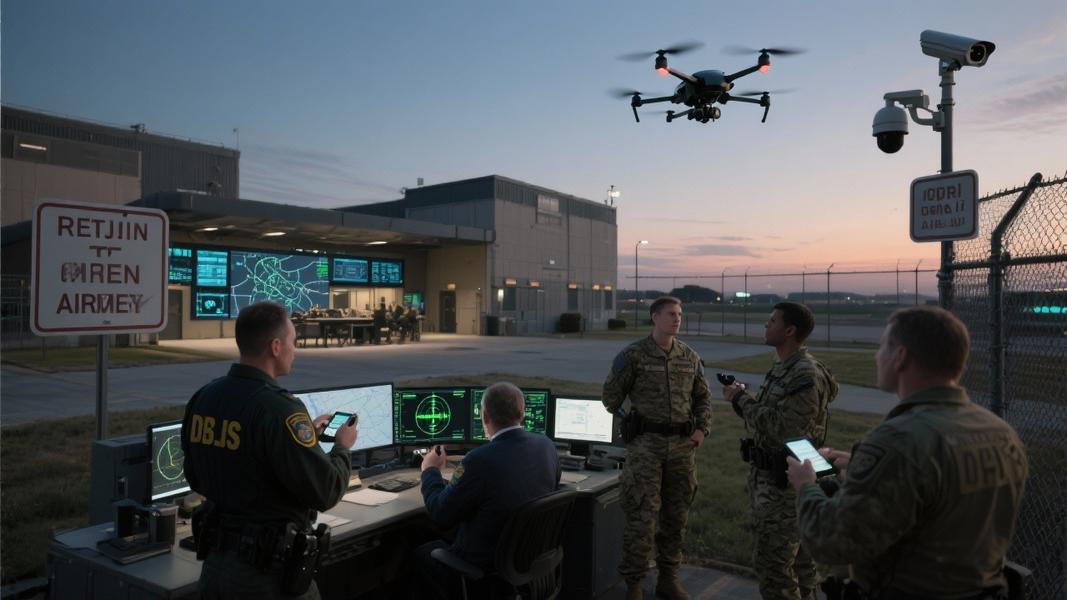
The Pentagon is dramatically expanding its counter-drone authority, giving military installation commanders unprecedented power to defend against what officials are calling “a defining threat for our time.”
The Joint Interagency Task Force 401 (JIATF-401) announced updated guidance on January 26, 2026, that fundamentally changes how U.S. military installations can respond to unmanned aerial systems (UAS). The guidance, signed by the Secretary of War in December, streamlines policies under federal code and extends defensive perimeters beyond traditional fence lines.
“Drones are a defining threat for our time. Technology is evolving fast and our policies and c-UAS strategy here at home must adapt to meet this reality,” said Brigadier General Matt Ross, Director of JIATF-401.
New powers and expanded defense zones
What’s changing? Just about everything in how the military identifies and neutralizes drone threats on American soil.
The updated guidance expands defensive perimeters beyond installation boundaries, treating unauthorized surveillance as an explicit threat even before drones cross physical barriers. It also enhances interagency cooperation with the Department of Homeland Security and Department of Justice, leveraging authorities granted in the FY26 National Defense Authorization Act.
“Countering drones does not start and stop at the fence line,” Ross explained. “With this new guidance installation commanders are empowered to address threats as they develop, and the guidance makes clear that unauthorized drone flights are a surveillance threat even before they breach an installation perimeter.”
The moves come as Pentagon officials have acknowledged that confusing counter-drone rules and slow acquisition processes have left U.S. bases vulnerable. “There’s no doubt that the threats we face today from hostile drones grow by the day,” said Secretary of Defense Pete Hegseth.
JIATF-401: The Pentagon’s drone defense hub
JIATF-401 itself is relatively new, having been established by Secretary Hegseth in August 2025 through a Pentagon memo that placed it under the Secretary of the Army as executive agent. The task force recently marked its first 100 days of operations, consolidating counter-small UAS policies and conducting site assessments.
One of the task force’s early wins came along the southern border, where it delivered $18 million in counter-drone capabilities in January 2026 after completing assessments in just 60 days.
“In less than 60 days — a process that traditionally takes two or three years — JIATF-401 assessed and validated capability gaps on the southern border and translated them into the Joint Task Force-Southern Border requirements document,” said Maj. Anthony Padalino, a JIATF-401 response team member.
Acquisition authority with teeth
Perhaps most significant are JIATF-401’s new powers over military spending. The FY26 NDAA has given the task force authority to set technical standards, run field tests, and — in an unusual move — veto service acquisitions of counter-drone systems that don’t meet performance standards.
“I’ll tell you my interpretation of that law is that we won’t let a service procure something that doesn’t perform, and if they want to, JIATF-401 gets to say no,” an official stated bluntly.
The task force is already flexing its acquisition muscle. Earlier this month, JIATF-401 made its first purchase under the Pentagon’s Replicator 2 initiative: two DroneHunter F700 systems for $3.5 million that will ship to undisclosed U.S. installations in April 2026.
“We are not intending to be a program office; we’re buying the stuff that can be made available to the warfighter as rapidly as possible and then let the user experiment with it,” JIATF Spokesman Lt. Col. Adam Scher told reporters. The purchases will inform a Counter-UAS Marketplace set to launch initial capability by March 1.
The urgency behind these changes reflects lessons learned from the Ukraine-Russia war, where small drones have dramatically altered battlefield dynamics. Now those lessons are being applied to homeland defense, with JIATF-401 focusing on sense-decide-act tools for all military formations.
“Everybody is going to have to be able to defend themselves against UAS. Everyone, every formation that we have,” a task force official emphasized. “And that’s how we’re trying to build it.”
